Choosing an ATV for Family Use: What to Check Before You Buy
The short answer
A family usually needs more than one ATV, not one ATV for everyone. Most ATVs are designed for a single operator and no passengers, and each machine is built for a particular rider size and age range. The right approach is to match each ATV to the person who will ride it: a youth model sized and labeled for each child, and an adult model for each adult.
One condition changes this answer. If your family mainly wants to ride together, with an adult carrying a passenger, a standard single-rider ATV is the wrong vehicle. You would need either a model specifically built and labeled for two riders, often called a two-up or tandem ATV, or a side-by-side, which is a different type of off-road vehicle with bench or bucket seats, a steering wheel and room for passengers.
Start with who will ride and how
Before comparing models, list every person who will ride, their age, size and experience, and the kind of riding you expect, such as trail riding, farm or property work, or occasional recreation. This list determines how many machines you need, what size each should be, and whether a single-rider ATV fits your plans at all.
Who will operate each machine, and whether any of them are children; Whether anyone expects to ride as a passenger; Where you will ride: private land, public trails, or both; Whether the ATV will also be used for chores such as hauling or towing; How much riding experience each person has
Matching a youth ATV to a child
Youth ATVs carry a manufacturer label showing the minimum age the machine is intended for. Follow that label for the specific model and model year you are considering, and do not buy a larger machine for a child to grow into. An ATV that is too big or too powerful is harder to control and is a common factor in youth injuries.
Age is only the starting point. A child also needs to physically fit the machine and have the judgment to ride it safely. Have the child sit on the ATV with protective gear on before buying, and check the points below.
Both feet rest flat on the footrests while seated; The child can stand on the footrests with knees slightly bent and room between the seat and their body; Both hands reach the handlebar grips and the child can turn the bars fully in each direction without stretching; The child can squeeze the brake levers and operate the throttle comfortably; The child can understand and follow riding rules and instructions
Many youth models include features that let a parent limit or stop the machine, such as an adjustable throttle or speed limiter and a tether or remote engine shut-off. Feature availability varies by brand, model, model year and trim, so confirm what the exact unit you are buying includes rather than assuming it from a model name.
Choosing adult ATVs for a family
For adults, the main decisions are engine size, transmission and drivetrain. A larger engine is not automatically better for family riding; a newer rider is usually better served by a machine they can control comfortably.
Transmission: an automatic transmission, usually a continuously variable transmission (CVT) that changes ratios without manual shifting, is generally easier for beginners than a manual clutch and gear lever. Drivetrain: two-wheel drive is simpler, while four-wheel drive helps on mud, hills and loose surfaces. Some models let you switch between the two. Passenger capacity: only carry a passenger if the ATV is designed and labeled for two riders. Check the warning labels and owner’s manual for the specific model. Work use: if the ATV will haul or tow, check the rated rack and towing capacities in the manufacturer’s specifications for that model year and trim.
Checks before committing to a purchase
Once you have a shortlist, these checks are the ones most likely to change your decision.
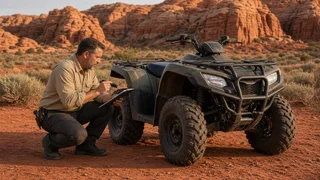
Confirm the exact model, year and trim
Specifications, age labels, safety features and capacities can differ between model years and trims of the same named model. Base every comparison on the exact version listed, and ask the seller to confirm the model year and trim if the listing is vague.
Check paperwork and recalls
Record the vehicle identification number (VIN) and check it against the manufacturer’s recall information. For a used ATV, ask for proof of ownership such as a title or bill of sale, depending on what your state requires, and confirm the VIN on the frame matches the paperwork.
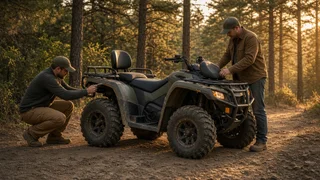
Inspect a used ATV’s condition
Frame and suspension for bends, cracks or welded repairs; Tires for wear and damage; Brakes for responsive, even stopping; Steering for play or binding; Engine for hard starting, smoke or unusual noises; Fluid leaks under the machine; Plastics and racks for damage that may indicate a rollover or crash; All youth safety features, such as limiters and tethers, present and working; Owner’s manual and warning labels present and legible
Check where you can legally ride
Rules for registration, trail permits, minimum operator ages and safety training differ by state and sometimes by riding area. Check the requirements in your state and on any trails you plan to use before buying, since they may affect which machines your children are allowed to operate.
Budget for the full cost of ownership
No verified prices were available for this guide, so it does not quote purchase or ownership figures. When you compare quotes, note the date, whether the price is an advertised asking price or an actual sale price, and which costs are included. Dealer prices may or may not include freight, setup and documentation fees.
Beyond the purchase price, a family should plan for these costs for every rider and machine:
Protective gear for each rider: an approved helmet, eye protection, gloves, boots, long sleeves and long pants; Registration, trail permits and insurance where required; A trailer or truck capacity to transport the ATVs; Routine maintenance, tires and repairs; Secure storage; Rider training courses
Plan for training and supervision
Hands-on rider training is widely recommended for both adults and children, and some states require it for younger riders. Children should ride only under adult supervision, on a machine sized for them, and should not carry passengers or ride on paved public roads. Setting these rules before the purchase helps you choose machines that fit how your family will actually ride.
Next steps
List every rider and decide whether you need single-rider ATVs, a two-up model or a side-by-side; Shortlist models by exact model year and trim for each rider’s age label and fit; Have each rider sit on the machine with gear on before buying; Check the VIN, paperwork, recalls and condition; Confirm your state’s riding rules and price out gear, training and transport