2-Person ATV: What to Check Before You Buy a Two-Up Quad
The short answer
If you want to ride with a passenger, buy an ATV that the manufacturer specifically designs and labels for two riders. These are often sold as two-up or touring versions. They have a dedicated, raised passenger seat, passenger handholds and footrests, and usually a longer wheelbase (the distance between the front and rear axles). Most standard ATVs are built for one operator only and carry warning labels against passengers. Adding an aftermarket seat to a single-rider quad does not change that design limit. One condition changes the answer: if your passenger needs to sit beside you, wear a seatbelt or ride inside a protective structure, a side-by-side (UTV) is usually the better fit than any ATV.
How to confirm a quad is really rated for two
Do not rely on seat length or a seller's description. Check the on-vehicle warning labels and the owner's manual for the specific model year and trim. A two-up model will state that it is designed for an operator and one passenger. A single-rider model will say passengers are not allowed. Some product lines offer both one-seat and two-seat versions under similar names, so confirm the exact version rather than the model family.
Buying checklist for a two-person ATV
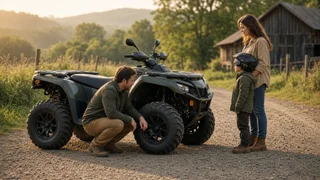
Passenger rating: confirmed on the labels and in the manual for the exact model year, trim and market. Total load capacity: the rated maximum usually includes both riders, cargo and accessories. Add up your real weights against the figure on the spec label or in the manual. Passenger fit: the passenger should be able to sit upright, reach the footrests flat-footed and hold both handholds firmly. Have your usual passenger sit on the machine before you buy. Passenger age and size: the manual may set minimum requirements for passengers. Youth-model ATVs are never meant to carry passengers. Powertrain and drivetrain: two riders add weight. Compare engine options, 4WD availability and power steering within the model line, because these often vary by trim. Brakes and suspension: check whether the suspension can be adjusted for the extra load, and review the braking setup listed for that trim. Transport and storage: a longer wheelbase means a longer machine. Measure your trailer, truck bed and garage space against the manufacturer's listed dimensions. Riding gear: budget for a properly fitted helmet and protective gear for both riders.
Two-up ATV or side-by-side?
Factor | Two-up ATV | Side-by-side (UTV); Seating | Passenger sits behind the operator on a raised seat | Occupants sit next to each other; Rider involvement | Operator and passenger shift their weight actively; the passenger needs to hold on and stay alert | Occupants stay seated and do not shift their weight; Occupant protection | No seatbelts or roll structure | Typically has seatbelts and a rollover protective structure; Trail access | Narrower width may suit trails with width limits; check local rules | Some trails restrict wider vehicles; Transport | Generally more compact | Generally larger and heavier to haul
Choose a two-up ATV if you want a narrower, rider-active machine and your passenger is comfortable holding on. Choose a side-by-side if passenger comfort, restraints or carrying less experienced riders is the priority.
US rules to check before you ride
Passenger rules, helmet requirements, minimum operator ages, registration, titling and trail or road access vary by state, and sometimes by land manager. Check with your state's off-highway vehicle authority, and with the agency that manages the trails you plan to use, before you assume two-up riding is allowed.
Extra checks for a used two-person ATV
Use the VIN to confirm that the model, year and trim match the seller's description and that the machine is a factory two-up version, not a single-rider unit with a bolted-on seat. Confirm title or ownership documents as your state requires, and check for liens. Inspect the passenger seat mounts, handholds and footrests for damage or missing parts. Look for signs of hard use under load: worn suspension components, brake wear and drivetrain noise. Ask for service records and check for open recalls with the manufacturer or a dealer.
What this guide could not confirm
No model-specific data was available for this article, so it contains no prices, load ratings, engine sizes, dimensions or current model lineups. These details change by model year, trim and market. Get them from the manufacturer's published specifications or a dealer for the exact unit you are considering, and compare them against the checklist above.