Brake Rotor Resurfacing: When Machining Is an Option
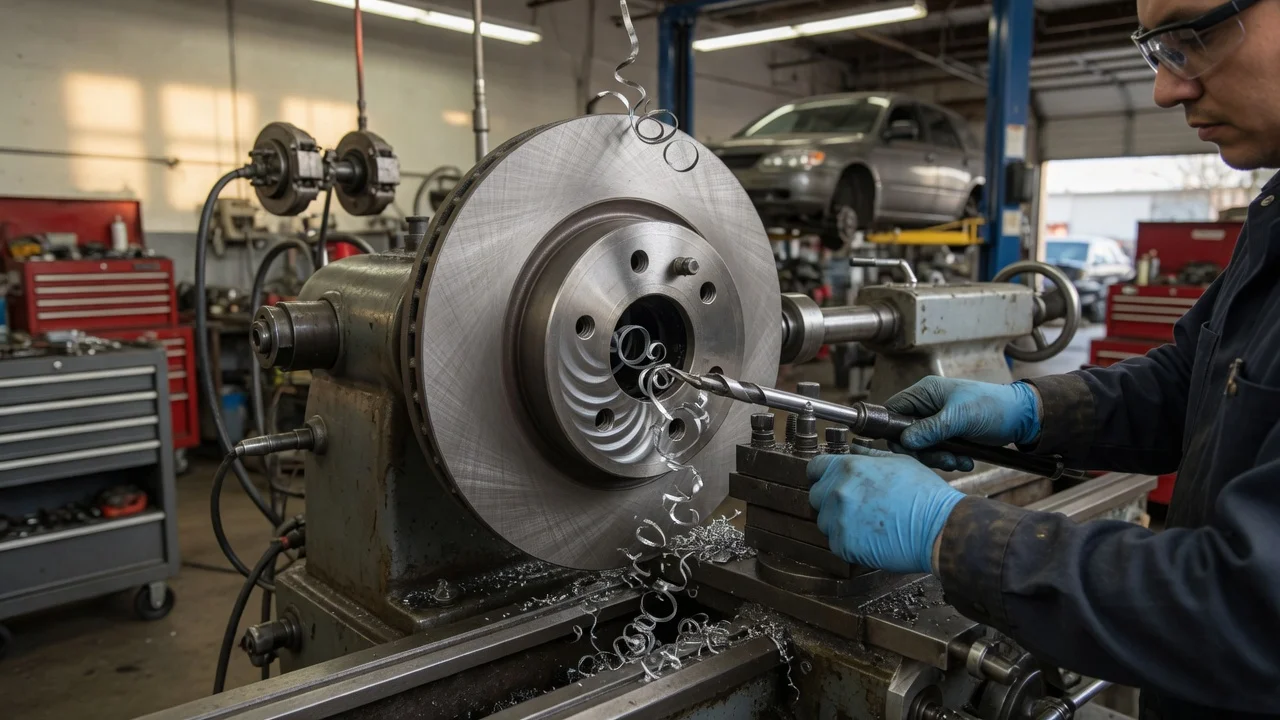
When machining a rotor is an option
Brake rotor resurfacing, also called machining or turning, is the process of cutting a thin, even layer of metal from each friction face so the disc is again smooth, parallel, and within runout limits. It is an option only when the rotor can be restored that way and still remain at or above the manufacturer’s minimum thickness, the disc is structurally sound, and the vehicle’s service information allows machining rather than requiring replacement.
The essential answer is therefore conditional. Resurfacing is a thickness-and-condition decision, not a default at every pad change. Many late-model vehicles, coated or composite rotors, and some performance or parking-brake-in-hat designs are specified as replace-only. Those instructions, and the discard or machine-to thickness stamped on the rotor or listed in the service data, override any general habit of “turning the rotors.”
What resurfacing is meant to correct
A rotor is a cast-iron or composite disc that the brake pads clamp. Heat, wear, corrosion, and uneven pad contact can leave ridges, rust lips, light scoring, or thickness variation that shows up as pulsation in the pedal or steering. Machining removes that damaged surface so new pads meet a true, even face.
It does not restore strength lost to heat cycles, does not repair cracks, and does not add metal. If the cut needed to clean up both sides would take the disc below the published minimum, replacement is the supported path. Exact millimetre or inch limits are rotor- and vehicle-specific; they are not supplied as a single figure for all cars and should be read from the disc, the service manual, or the parts specification for that model year, generation, and brake package.
Conditions that support machining
Enough material remains: after the cut, thickness must still meet or exceed the minimum thickness (often marked MIN TH or similar on the hat or edge) and any separate machine-to specification the maker publishes. Damage is shallow: light scoring, surface rust, a pad-wear ridge, or modest thickness variation that a conservative cut can remove. The rotor is one-piece and serviceable as designed: conventional vented or solid iron discs that the maker still lists as machineable. Runout and parallelism can be brought into spec on a proper lathe, on the vehicle or off, with the hub face cleaned and the assembly torqued as specified. Cost and downtime make sense: machining plus new pads is cheaper than quality replacement rotors, and matching thickness side-to-side is still possible.
Conditions that rule it out
Thickness at or below minimum before the cut, or a cleanup cut that would go below it. Cracks, deep heat checking, a blue or heavily discoloured heat-damaged face, or missing chunks of friction surface. Severe grooves, hard spots, or thickness variation that would require removing more metal than the remaining margin allows. Service information that specifies replacement only, including many coated, geometrically treated, two-piece, or carbon-ceramic rotors, and some designs with an integral parking-brake drum. Hub or bearing problems that would leave excessive runout after a perfect rotor cut; the disc is not the only source of pedal pulsation. A prior machine already close to discard, leaving no useful life for another cut.
Variant matters. Compact cars with thin, low-mass discs often have little extra material compared with heavy-duty truck rotors. Hybrid regenerative systems, electronic parking brakes, and performance trims can change both rotor construction and the official repair method. Claims about a given vehicle should be tied to that model year, brake package, and market’s service data.
What a shop should confirm before cutting
Measure thickness at several points around both faces with a micrometer, not a ruler, and compare the lowest reading with the published minimum. Inspect for cracks and heat damage. Check lateral runout of the rotor on the hub, and the hub face itself, because machining a disc on a dirty or bent hub will not hold a true path. If an on-car lathe is used, the setup must follow that tool’s procedure so the cut is indexed to the installed position.
After machining, both faces should be smooth and parallel, thickness still legal, and runout within the vehicle specification. New pads belong on a freshly cut surface; mixing worn pads with a new face is a common cause of early noise and uneven wear. Bedding, or the maker’s equivalent transfer-layer procedure, still applies. Documented specifications for runout, thickness variation, and torque are vehicle-specific; they are not restated here as universal numbers because those figures were not supplied for a particular model.
Replacement versus resurfacing
Replacement is the clearer choice when the disc is at minimum, cracked, heat-damaged, coated or composite, or listed as non-machineable, or when a quality new rotor costs little more than the machine work. Resurfacing remains reasonable on a thick, undamaged, machineable iron rotor when measurement shows a safe margin, the hub is sound, and the owner accepts that the disc will be thinner—and have less thermal mass—than when it was new.
Editorial judgment, separate from any shop measurement: on many current passenger cars, replacement has become the default because rotors are cheaper, thinner, and sometimes coated, so the machining window is small. That is a market and design trend, not a test result from a particular vehicle. The supported next action is to have thickness and condition measured against that vehicle’s data, then machine only if the disc clears those limits and the maker still allows it.
Gaps in this guide
No model-year, generation, powertrain, or trim specifications were supplied, so this article does not list discard thicknesses, runout limits, or official replace-only notes for any vehicle. Those values must come from the rotor marking and the applicable service information. No laboratory or road-test findings were supplied; nothing here is a first-hand test of a particular lathe, pad compound, or aftermarket rotor.