Brake Rotor Resurfacing: When It Is Suitable and What the Procedure Involves
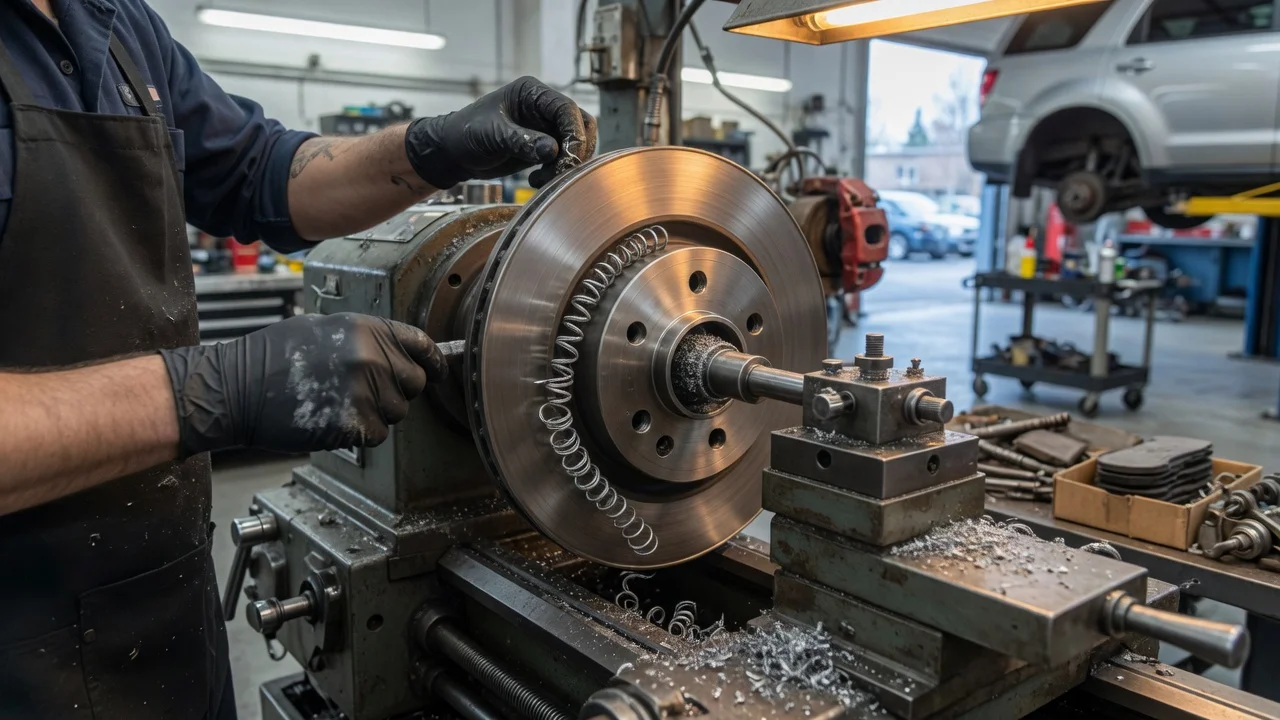
What brake rotor resurfacing is, and when it applies
Brake rotor resurfacing is a machining process that removes a thin, even layer of metal from both friction faces of a disc so the pads meet a flat, parallel, clean surface. It is a suitable repair only when the disc will remain thicker than the vehicle manufacturer’s minimum discard thickness after the cut, and only when the rotor has no cracks, severe heat damage, or other faults that a lathe cannot correct.
The answer changes with rotor design and service policy. Many late-model discs sit close to minimum thickness in normal use, so there is little or no surplus metal for a cut. Some makers specify replacement rather than machining for a given model, generation, or rotor type. Coated, two-piece, and carbon-ceramic rotors follow the manufacturer’s service method; a conventional shop lathe is not a universal fix. If thickness, runout, or damage cannot be confirmed against that vehicle’s specifications, replacement is the conservative path.
How machining restores a disc, and what it changes
A brake lathe holds the rotor, or turns it on the hub, while a cutting tool feeds across each face. The cut reduces surface roughness, restores parallelism between the two faces, and can reduce disc thickness variation that shows up as pedal pulsation. Both faces are machined so thickness stays even and the pads contact across the full friction ring.
Two machine setups exist. A bench, or off-car, lathe removes the disc and cuts it between adapters, which restores the rotor itself. An on-car lathe cuts the disc while it remains on the hub, so the tool follows the axis the disc actually runs on. On-car work can reduce assembly runout caused by the stack of hub, corrosion, and rotor. It does not repair a damaged hub; the hub face still needs to be clean and within the maker’s runout limit.
Material removed does not return. Every cut shortens remaining life and brings the disc closer to discard thickness. Machining also cannot reverse metallurgical hard spots or heat checking in the friction ring. Those defects can remain below a freshly cut surface and come back as noise, judder, or cracking. Resurfacing does not free a sticking caliper, restore a collapsed hose, or correct a bent hub; those faults will wear or pulse a newly cut disc again.
Strengths, limitations, and who it suits
Suitability is a thickness-and-condition decision, not a rule to always machine or always replace. The points below are general service practice. They are not results from a controlled comparison test, and they yield to the service information for the specific vehicle, model year, market, and rotor design.
When enough metal remains, machining can restore a usable friction surface at lower parts cost than new rotors and can give new pads full contact after light scoring or surface rust. On-car turning is useful when the complaint is pulsation and the hub-and-rotor stack is the source of runout. A correct finish also supports even pad bedding. Those benefits last only while remaining thickness and the rest of the brake system stay in specification.
There is no usable repair if the planned cut would take the disc below minimum thickness. Cracks, heavy grooving, bluing, and heat spots are replacement conditions. Thin replace-only rotors, and many coated or composite designs, leave little or no machining allowance. A poor lathe finish, dull bits, or a dirty hub can leave a disc that looks freshly cut and still pulses. Comfort and noise depend on pad choice, sliding hardware, and bedding as much as on the cut. A previous machine cut that did not cure pulsation often points to the hub, wheel, or a related hydraulic or mechanical fault rather than a need for another pass.
Resurfacing fits a vehicle whose rotors will remain above the manufacturer’s minimum after the estimated cut, show only light surface defects, and are a type the maker allows to be machined. It suits a technician who can measure thickness and runout and produce an acceptable finish. Replacement is the better match when the disc is near discard thickness, the rotor is a replace-only or special-material design, inspection finds cracks or heat damage, or the owner wants maximum remaining life on a disc that is already marginal. No efficiency, range, or instrumented stopping-distance figures are attached to this choice; the relevant limits are thickness, runout, and structural condition in the applicable service data.
Steps to inspect, machine, and confirm the job
Use the service information for that vehicle before any cut: minimum thickness, any separate machine-to thickness, maximum lateral runout, whether resurfacing is permitted, pad and hardware notes, and the tightening sequence and torque for hat bolts if used, the caliper bracket, the caliper, and the wheel. Those values are model- and year-specific. They are not listed here and must not be replaced with a generic figure.
Prerequisites and tools
Service data for the vehicle, including thickness and runout limits and any ban on machining. A micrometer for rotor thickness, with readings taken at several points around the disc. A dial indicator and a rigid mount if lateral runout or pulsation is part of the complaint. A brake lathe in good order with sharp bits, or new rotors if machining is not allowed or not possible. Replacement pads and abutment hardware as required, with lubricant only where the maker specifies and never on friction faces. Cleaning materials that remove swarf and cutting oil without leaving residue on the pad contact area.
Inspection and the replace-or-machine decision
Identify the rotor type and confirm that the manufacturer allows resurfacing for this application. Inspect the friction ring and hat for cracks, missing sections, heavy rust between hat and hub, deep grooves, and heat checking. A cracked rotor is removed from service; it is not machined. Measure thickness at several locations around each disc and compare every reading with the stamped or published minimum. Estimate how much metal the lathe will remove. If any area would fall below minimum, replace the rotor. Replace both discs on the same axle if one is out of limits, unless the maker directs otherwise. If the concern is pedal pulsation, measure lateral runout on the vehicle according to the service procedure, with the hub face cleaned. Excessive hub runout or corrosion under the hat is corrected at the hub; cutting the rotor alone may not last. Proceed to machining only when thickness after the cut will remain above the limit and the disc has no structural or heat damage.
Machining, cleaning, and refit
Set up the bench or on-car lathe so both faces are cut evenly and the tool does not chatter. On-car equipment is the usual choice when assembly runout is being corrected and the rotor design allows it. Machine to a smooth, even finish while staying above minimum thickness. Stop and replace the disc if the cut reveals cracks, hard spots that will not clean up, or a thickness that reaches the limit. Remove burrs if the procedure calls for it. Wash the rotor so chips and cutting oil cannot contaminate the pads or a wheel-speed sensor area. Fit the rotor to a clean hub. Tighten hat bolts, caliper bracket bolts, caliper bolts, and wheel fasteners in the manufacturer’s sequence and to the published torque. Recheck runout if pulsation was the original complaint. Install pads and hardware so they slide as designed. Bed the pads using the pad or vehicle maker’s procedure so transfer film forms evenly across the fresh surface. If the hydraulic system was opened, bleed it by the method specified for that vehicle, using the specified fluid type.
Completion check and professional boundaries
The job is complete when thickness remains above the minimum, the pedal is firm, the disc runs without grind or scrape, and any previous pulsation is gone at the speeds where it appeared. Wheel fasteners are at specified torque, and there is no leak if the hydraulics were disturbed.
Stop use and move to replacement or professional diagnosis if a crack is found, thickness is at or below minimum, the lathe cannot hold a true finish, hub damage is visible, a wheel-speed sensor ring is at risk from the setup, or pulsation remains after a correct cut and hub clean-up. Work that leaves a soft pedal, a pulling brake, or a disc below minimum thickness is not finished. Tightening values, discard thickness, runout limits, surface-finish targets, and pad-bedding speeds vary by model year, market, and rotor design; confirm each setting in the applicable manufacturer guidance before the cut or the torque pass.