Brake Rotor Resurfacing: When It Is Suitable and What It Involves
Direct answer
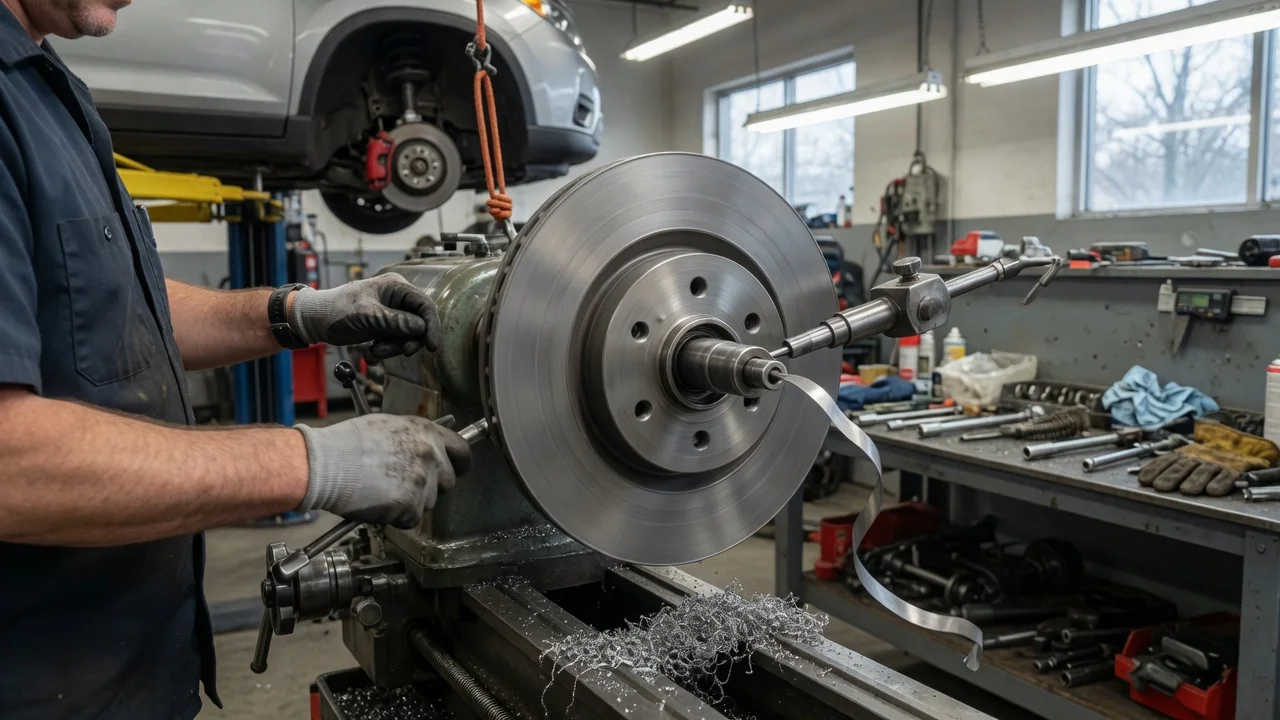
Brake rotor resurfacing, also called rotor machining or turning, is suitable only when a rotor has enough remaining thickness to stay above the vehicle manufacturer's minimum specification after metal is removed. The process cuts a thin layer from both friction surfaces to correct mild scoring, rust, hard spots, or thickness variation and to create a clean, flat surface for new pads. It is not the right repair when a rotor is already at or below minimum thickness, severely cracked, heat-damaged, deeply grooved, or warped beyond what can be cut safely.
How rotor resurfacing works
A brake rotor is the metal disc that the brake pads clamp against to slow the vehicle. Over time, the friction surface develops grooves, glaze, corrosion, and uneven wear. Thickness variation can make the brake pedal pulse or the steering wheel shake during braking. Resurfacing mounts the rotor on a brake lathe and removes the minimum amount of material needed to make the surface flat, parallel, and smooth again. This restores an even contact area for the pads instead of correcting the underlying metallurgical condition of the rotor.
After machining, the rotor is thinner and will absorb heat less effectively than a new rotor of full thickness. That is why the minimum thickness specification is the controlling measurement. A rotor machined below this limit may flex, overheat, crack, or cause reduced braking performance. The specification may be stamped on the rotor hat, the outer edge, or listed in the vehicle service information.
When resurfacing is suitable
Resurfacing is appropriate when the rotor thickness before machining is sufficient to remove the visible damage and still leave a safe margin above minimum thickness. Common suitable conditions include light-to-moderate surface grooving, light rust that has not caused deep pitting, minor thickness variation, and a friction surface that is otherwise structurally sound. A rotor with only cosmetic surface condition may not need machining at all if the pads are being replaced and the surface is smooth and within specification.
When replacement is safer
Replacement is indicated when the rotor is near or below minimum thickness. It is also indicated when the required cut would remove too much material, when cracks extend beyond the surface, when heat checking is widespread, or when the rotor has a hard spot that cannot be corrected cleanly. Deep grooves and severe corrosion that penetrate past the safe machining allowance also rule out resurfacing. In these cases, supplying a new rotor returns the brake system to full thermal capacity and removes doubt about structural condition.
Steps in the resurfacing process
Measure the rotor thickness in several places with a micrometer and compare it with the manufacturer's minimum specification. Inspect both friction surfaces for cracks, hard spots, deep grooves, and corrosion pitting that would rule out machining. Remove the rotor if it is a separate component; for some designs with captured rotors, use an on-car brake lathe. Clean all mounting surfaces, including the hub and the rotor hat, so that installed runout is not created by rust or debris. Set up the rotor on the lathe and make the minimum cut required to clean both sides, keeping the rotor above minimum thickness. Apply a non-directional finish appropriate to the pad type if the shop procedure calls for it. Wash and dry the machined rotor, then inspect it for remaining surface defects and measure the final thickness. After installation, check rotor runout and complete the applicable bedding procedure for the new pads.
The procedural details, final minimum thickness, permissible runout, and torque values vary by vehicle make, model, and brake system. Manufacturer service information takes priority over generic guidance.
Strengths and limitations
Strength: restores a smooth, flat friction surface and reduces pedal pulse or steering vibration caused by thickness variation. Strength: can be less expensive than new rotors when the existing rotors have enough remaining material. Limitation: reduces thermal mass and heat capacity, so the rotor is not equivalent to a new full-thickness part. Limitation: cannot repair cracks, structural overheating, deep pitting, or rotors already below specification. Limitation: on many modern vehicles, rotor replacement has become the more predictable option when the cost and remaining life of a thin rotor are weighed against the risk of machining.
Who it suits
Resurfacing suits a driver whose rotors are thick, free of structural damage, and affected only by surface faults that can be removed within the safety allowance. It is less suited to high-performance or towing use where maximum heat capacity is a priority, or to any rotor that cannot be returned to a durable thickness. The sound decision starts with measurement: if the rotor does not clearly remain above minimum thickness after the necessary cut, replacement is the safer route.