3.5 EcoBoost Wastegate Actuator: How to Identify Your Type and Its Faults
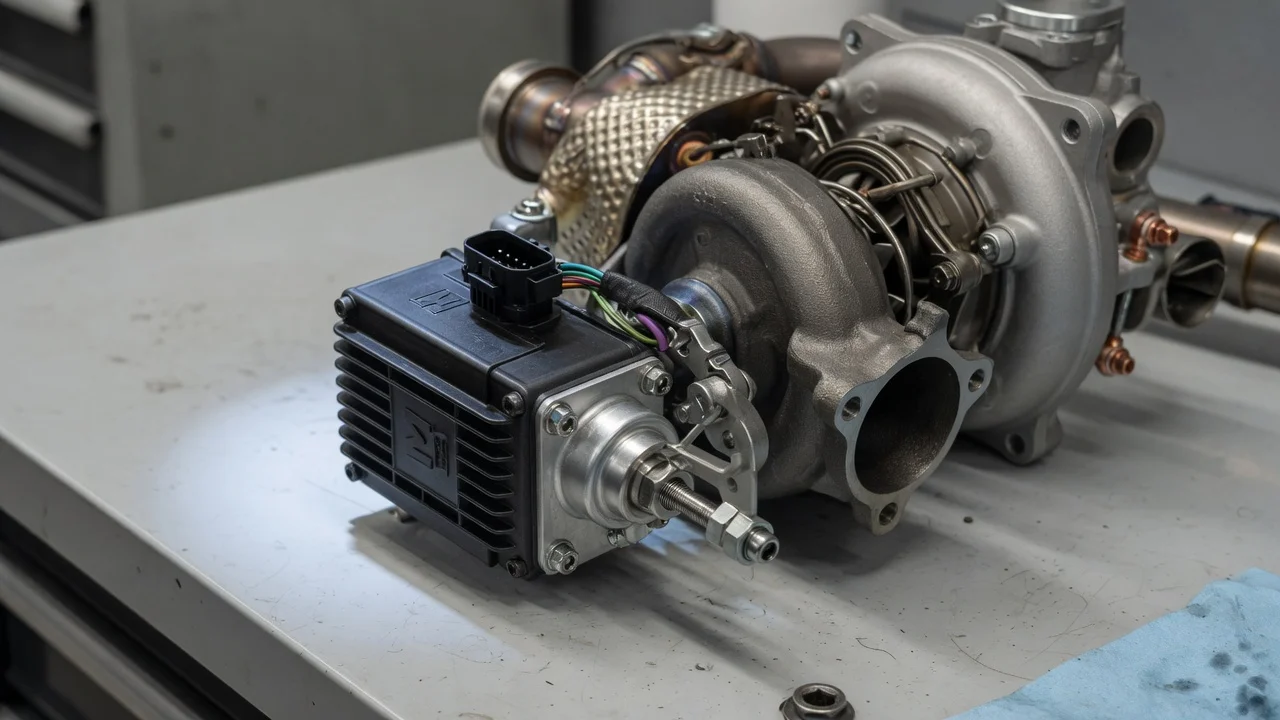
The 3.5 EcoBoost V6 has two turbochargers, and each one has its own wastegate actuator. Which type you have depends on the engine generation, not just the model year. Whether the actuator is actually at fault depends on the symptoms you are chasing. This guide covers how to recognize the actuator on your truck or SUV, how it controls boost, and how to tell a genuine actuator failure from noises and codes that only resemble one.
Which wastegate actuator your 3.5 EcoBoost has
First-generation 3.5 EcoBoost engines arrived in the 2011 F-150 and were also used in several Ford and Lincoln cars and SUVs. They control their wastegates with vacuum-operated actuators. The second-generation engine, introduced in the 2017 F-150, switched to electronically actuated wastegates. In that design an electric actuator positions the wastegate instead of a vacuum diaphragm. Other vehicles adopted the newer engine on their own schedules, so a model year alone does not settle the question. The engine generation fitted to your specific vehicle is what determines the actuator type.
Once you can see the actuators, the two types are easy to tell apart. A vacuum actuator is a round metal canister on a bracket attached to the turbocharger. It has a small vacuum line connected to it and a rod running to the wastegate lever. An electronic actuator is a sealed housing with an electrical connector and no vacuum line. Because the engine is twin-turbo, there are two actuators, one on each side of the engine. Each is diagnosed separately, and a fault may affect only one side.
How the actuator controls boost
The wastegate is a valve that lets some exhaust bypass the turbine. Opening it limits turbine speed and therefore boost pressure, and the actuator is what opens and closes it. On vacuum-controlled engines, the powertrain control module operates a wastegate control solenoid that regulates vacuum to the actuators. The diaphragm inside each canister moves the rod, and the rod moves the wastegate arm. On electronically controlled engines, the module commands the actuator to a target position and receives position feedback. This allows more direct control over how far the wastegate opens.
The actuator is only one link in this chain. The wastegate valve, its pivot shaft and the linkage arm sit in hot exhaust and can wear independently of the actuator. Many complaints described as actuator problems turn out to involve linkage play, valve wear or the control side: the solenoid, vacuum supply, wiring or software calibration. Identifying the actuator type tells you which parts of that chain to examine first.
What changes the diagnosis
On first-generation engines, likely causes of poor wastegate control include cracked or disconnected vacuum lines, a failing control solenoid, or a leaking actuator diaphragm. These usually show up as underboost: weak acceleration, often with a code such as P0299, which is the generic turbocharger underboost code. That code is not specific to the actuator. A boost leak at the intercooler piping, a turbo fault or a sensor problem can set the same code.
On second-generation engines, faults are more often electrical: connector or wiring damage, an actuator motor problem, or a position feedback fault. These typically set diagnostic codes related to boost control circuits or actuator position, not only an underboost code. Many owners of 2017-and-later trucks report a metallic rattle at low engine speed, during deceleration or after a cold start, and attribute it to wastegate linkage. Ford has issued service bulletins addressing wastegate rattle on some applications. Whether one applies to your vehicle depends on its VIN, build and repair history. A rattle report from an online forum is a symptom description, not a verified diagnosis of your engine.
Operating conditions also matter. Towing, high ambient temperature, altitude and sustained heavy throttle all raise boost demand, so an intermittent fault may appear only under load. Performance variants of the 3.5 EcoBoost use the same principle with different calibrations. Boost behavior that seems abnormal on one variant may be normal on another, so compare it against the specifications for your exact engine configuration.
What you can check yourself
Start by confirming the engine generation. You can check the underhood emissions label or the owner's manual, ask a dealer to decode the VIN, or look at the actuators for a vacuum line versus an electrical connector. Next, read stored codes with an OBD-II scanner and save the freeze frame data. Write down the symptom conditions: engine temperature, speed, load, whether you were towing, and whether the problem is constant or intermittent. These notes are often more useful to a technician than a code alone.
On vacuum-controlled engines, inspect the accessible vacuum lines for cracks, hardening and loose fittings. Listen for hissing with the engine idling. On electronically controlled engines, check the actuator connectors for damage or corrosion, and check nearby wiring for chafing or heat damage from the exhaust. In both cases, let the engine cool fully before reaching near the turbochargers, because the exhaust components get extremely hot. Review the service history for prior turbo work, completed bulletins or recalls, and calibration updates.
Avoid buying an actuator based only on a rattle or a single code. Depending on the engine and the parts catalog, an actuator may be serviced separately or only as part of a turbocharger assembly. Confirm the correct part for your VIN and side of the engine before ordering anything.
Limitations and next step
Visual identification tells you which actuator type you have, but it cannot confirm that the actuator has failed. Testing an electronic actuator requires a scan tool that can command it and read its position. Testing a vacuum actuator requires a vacuum pump and the manufacturer specifications for your engine. Access is also a factor. The turbochargers sit low on each side of the engine, and reaching them usually means lifting the vehicle and removing heat shields, and sometimes removing exhaust components.
If the codes, symptoms or noise persist, take your scan results, symptom notes and service history to a dealer or a shop familiar with EcoBoost engines. Ask whether any open bulletins, recalls or remaining powertrain warranty coverage apply to your VIN. A proper inspection at that point is the reliable way to separate a worn linkage, a control fault and a failed actuator.