Why Does an Engine Rev Higher Going Uphill?
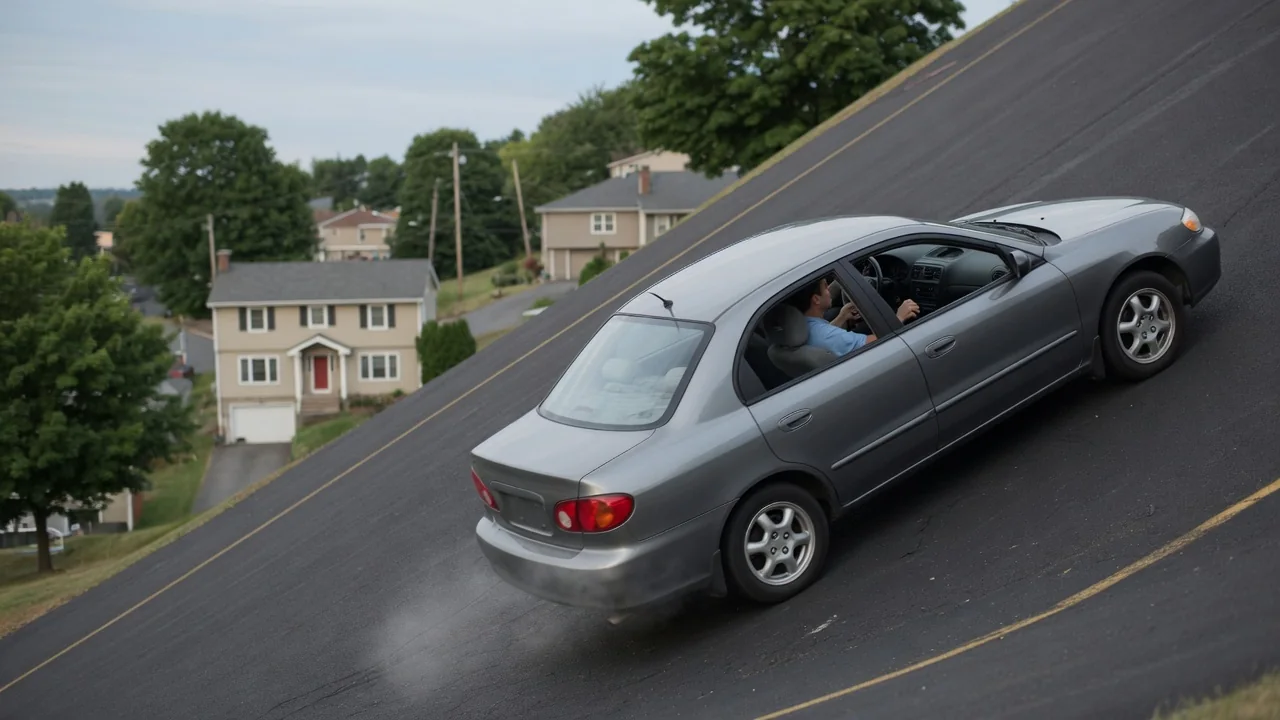
Drivers often ask why does an engine rev higher going uphill even when road speed stays the same. The short answer is that climbing demands more power, and the transmission responds by choosing a lower gear so the engine can spin faster and deliver it. Understanding how load, gearing and throttle interact helps separate ordinary behavior from signs worth investigating.
Grade force
On a level road, the engine only has to overcome rolling resistance from the tires and aerodynamic drag. A slope adds a third opponent: a portion of the vehicle's weight now pulls backward along the road surface. This grade force grows with both steepness and mass, so a loaded pickup towing a trailer feels a hill far more than a light hatchback does. To hold the same speed, the wheels must receive noticeably more power than they needed a moment earlier on flat pavement.
Power is the product of torque and rotational speed, so an engine has two ways to produce more of it: open the throttle further or turn faster. At low rpm with a wide throttle, many engines simply cannot generate enough output, and the vehicle begins to slow. Drivers notice this as a pedal that must be pressed deeper just to maintain pace, sometimes with a deeper intake sound. How quickly that happens varies with engine size, turbocharging, vehicle weight, and how much cargo or how many passengers are aboard.
Gear selection
A lower gear multiplies engine torque at the wheels and lets the engine spin faster for the same road speed, moving it into a range where more power is available. An automatic transmission's control module watches throttle position, vehicle speed, and calculated load, then commands a downshift when the current gear cannot meet demand. The tachometer needle jumps, and the car holds its pace. In a manual, the driver makes the same decision by hand when the engine begins to lug or lose speed.
Other designs reach the same outcome differently. Many automatics first unlock the torque converter clutch, which raises rpm modestly without a full gear change. A continuously variable transmission slides its ratio smoothly, so revs climb and stay steady rather than stepping. Hybrids may run the gasoline engine faster to supplement the electric motor, and some vehicles have grade logic that holds a lower gear to prevent repeated shifting. The exact strategy depends on manufacturer calibration, drive mode selection, and whether a tow or haul setting is active.
Normal limits
Higher revs on a climb are expected as long as road speed rises or holds in step with engine speed. A brief jump after a downshift, steady rpm well below the redline marked on the tachometer, and a return to lower revs once the road levels all describe healthy operation. Small engines in heavier vehicles may work quite hard on long grades, and that alone is not a fault. Coolant temperature should stay within its usual range, and no warning lights should appear.
The pattern changes when revs climb without matching acceleration. If the tachometer rises freely while the vehicle barely gains speed, the transmission or clutch may be slipping instead of transferring power. Harsh or delayed shifts, constant hunting between two gears, a burning smell, or a flashing warning indicator also fall outside ordinary behavior. A manual clutch that slips usually shows up first in higher gears under heavy load, which makes hills a common place to notice it. These signs deserve attention rather than adaptation.
Everyday Use and Observations
On a familiar highway grade with cruise control set, a typical sequence is a slight speed drop, a downshift of one or two gears, and a louder engine note until the crest. Air conditioning, a roof box, a full load of passengers, or a headwind adds to the demand and can trigger that shift earlier. At high elevation, naturally aspirated engines make less power in thinner air, so they may need even lower gears, while turbocharged engines tend to compensate better.
Drivers can influence the behavior. Building a little speed before the slope and applying steady throttle often avoids an abrupt kickdown, whereas stabbing the pedal midway invites a sudden multi-gear drop. Selecting a lower gear manually, or using a tow mode when hauling, keeps the transmission from shifting back and forth and limits heat buildup in the fluid. The owner's manual explains which modes a particular vehicle offers and when the manufacturer recommends using them, since those features differ widely between models.
Limits and Next Steps
When uphill revving seems different from before, consistent observation is more useful than guessing. Note whether the change appears cold or warm, at light or heavy throttle, and whether speed follows rpm. Checking that the load, tire pressures, and tire size have not changed rules out simple explanations. If the vehicle provides a way to check transmission fluid, the manual describes the correct method; many modern units are sealed and require a shop to assess level and condition.
A check engine or transmission warning light means stored fault codes should be read, but a code is evidence to interpret, not proof that a specific part has failed. Manufacturer-specific codes in particular need confirmation against information for that exact vehicle. A qualified technician can compare engine speed with transmission input and output speeds during a road test to confirm or rule out slip. Until then, avoiding heavy loads and steep climbs reduces the chance of turning a minor problem into expensive damage.