Why Does AM Radio Sound Different From FM in a Car?
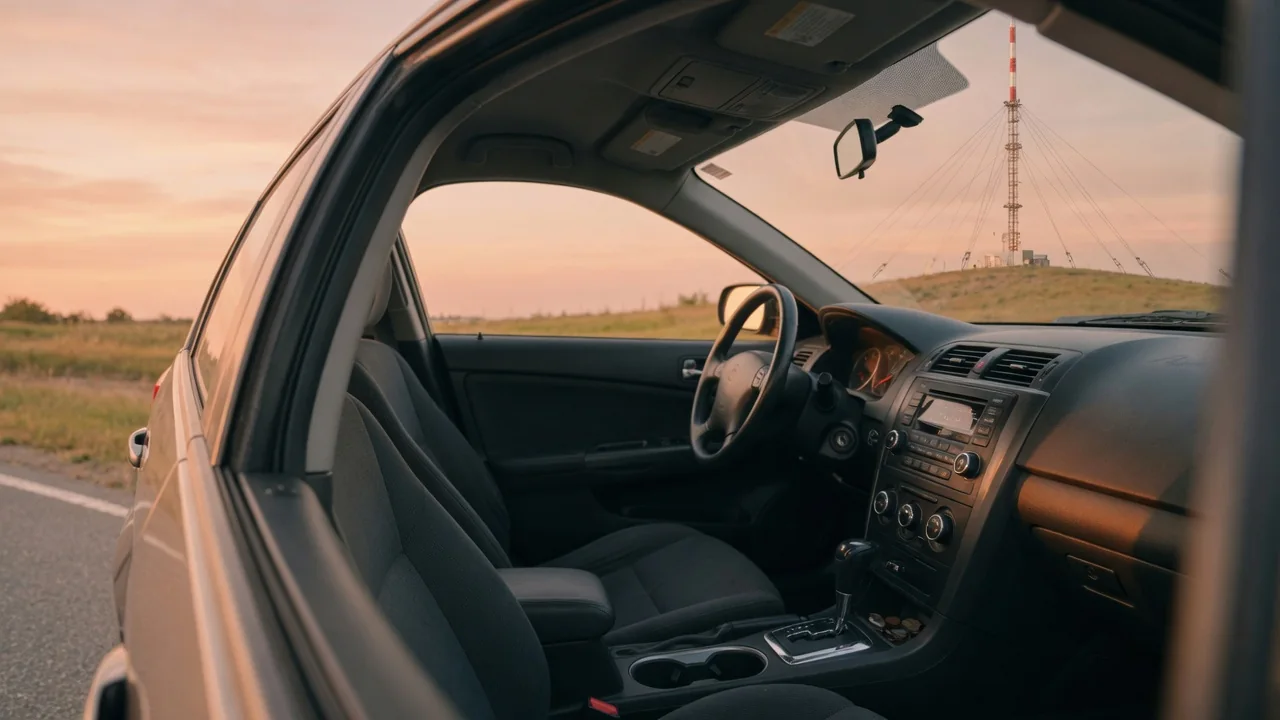
If you have ever switched from an FM music station to an AM talk station and heard the sound turn flat, muffled, and slightly buzzy, nothing is wrong with your car. The difference comes from three things: how each band encodes audio, how each reacts to electrical and environmental interference, and how much frequency space each station is allowed to use. Here is why AM radio sounds different from FM in a car, and what that means on the road.
Modulation: Two Ways to Carry the Same Audio
AM stands for amplitude modulation. The station transmits a carrier wave at a fixed frequency, and the audio makes the strength, or amplitude, of that carrier rise and fall. The receiver in your dashboard tracks those changes in strength and turns them back into sound. The method is simple and was the basis of early broadcast radio, which is one reason AM receivers can use relatively basic circuitry. The catch is that the receiver cannot tell a change in strength caused by the program from a change caused by anything else. Any disturbance that adds energy to the signal becomes part of what you hear.
FM, or frequency modulation, keeps the strength of the carrier essentially constant and instead shifts its frequency slightly up and down in step with the audio. The receiver listens for those shifts, not for changes in level. Because the information lives in the frequency, an FM tuner can pass the signal through a limiter that strips away amplitude variations before demodulation, discarding much of the noise that would get through on AM. FM also shows a capture effect: when two signals arrive on the same frequency, the receiver tends to lock onto the stronger one and suppress the weaker, rather than mixing them as AM does. The FM broadcast system was also designed to carry stereo using a pilot tone and a subcarrier above the main audio, while most AM stations broadcast in mono.
Interference: Why AM Picks Up Noise in a Car
A car is an electrically noisy place for a radio. Ignition systems, alternators, fuel pumps, electric motors for fans and seats, switching power supplies in modern electronics, and aftermarket accessories such as phone chargers and dash cameras can all radiate or conduct small bursts of radio-frequency energy. Much of that energy is broadband and overlaps the AM broadcast band, which in the US runs from roughly 540 to 1700 kHz. Because AM decodes amplitude, the energy shows up as a whine that rises and falls with engine speed, a ticking sound, or a steady hiss. Vehicle makers use shielding, filtering, and grounding to keep this under control, but results vary between designs, so the amount of AM noise you hear is vehicle-specific rather than a fixed property of the band.
Outside the vehicle, AM is affected by power lines, electrical equipment, lightning and atmospheric static, and large structures. Reception often weakens or turns noisy under bridges, in tunnels, and among steel-framed buildings. At night, the upper atmosphere reflects medium-wave signals over long distances, so a station that sounded clean during the day can pick up whistles and faint competing programs from distant stations on the same or nearby frequencies. This is a normal characteristic of the band, not a receiver fault.
FM is not immune to trouble; it simply fails in different ways. Its signals, between 88 and 108 MHz, travel mostly by line of sight, so hills and buildings limit range. Signals bouncing off terrain and structures reach the antenna at slightly different times, a problem called multipath, which in a moving car can cause rapid fluttering often described as picket-fencing. As a signal weakens, many car tuners gradually blend stereo toward mono and reduce high frequencies to mask noise, so a distant FM station may sound duller before it drops out. When FM does fail, it tends to break up abruptly rather than fading gently into static.
Bandwidth: How Much Audio Each Station Can Send
The third reason is space. In the US, AM stations are assigned channels 10 kHz apart, and broadcast standards limit AM audio to roughly 10 kHz. In practice, many receivers, including many car radios, use narrower filters to reduce interference from neighboring stations and electrical noise, which trims treble further. The result is the familiar AM character: intelligible speech, little sparkle in cymbals or voices, and a narrower, boxier tone. AM stations also commonly apply heavy audio processing to stay loud and clear over noise, which adds to the compressed feel.
FM channels in the US are spaced 200 kHz apart, giving each station far more room. That allows audio up to about 15 kHz, covering most of the range that matters for music, along with the stereo subcarrier and space for additional data services. FM broadcasting also uses pre-emphasis, boosting high frequencies at the transmitter and reducing them at the receiver, which lowers audible hiss. Together with a lower noise floor, this gives FM wider dynamic range, so quiet passages stay clean and the sound feels more open and detailed than AM, even through the same car speakers.
Practical Implications and Limits
Knowing these mechanisms helps you interpret what you hear. A whine on AM that tracks engine speed points toward the charging or ignition system, while a buzz that appears only when a particular device is plugged in suggests that device is the source. Unplugging accessories one at a time is a simple, non-invasive way to narrow it down. Fluttering on FM in a dense city is usually multipath and tends to clear as you move, whereas constant noise across every AM station may indicate an antenna connection or grounding issue worth having inspected. Check the owner's manual before touching antenna or power wiring, since procedures differ by vehicle.
Some limits cannot be adjusted away. Raising treble on the head unit cannot restore audio that was never transmitted or that the tuner filtered out, and it may only make hiss more noticeable. Some radios offer AM noise reduction or similar settings, but their availability and behavior depend on the specific unit. Some stations also broadcast HD Radio digital signals alongside analog on both bands, which can improve sound on compatible receivers, though reception falls back to analog when the digital signal weakens. Electrified drivetrains add powerful switching electronics that can make AM reception harder, a factor some manufacturers weigh when deciding whether to include an AM tuner. In everyday terms, AM remains well suited to speech and wide-area coverage, while FM is the better choice when sound quality matters.