How Does a Car Antenna Receive Radio? Signal, Cable and Reception Explained
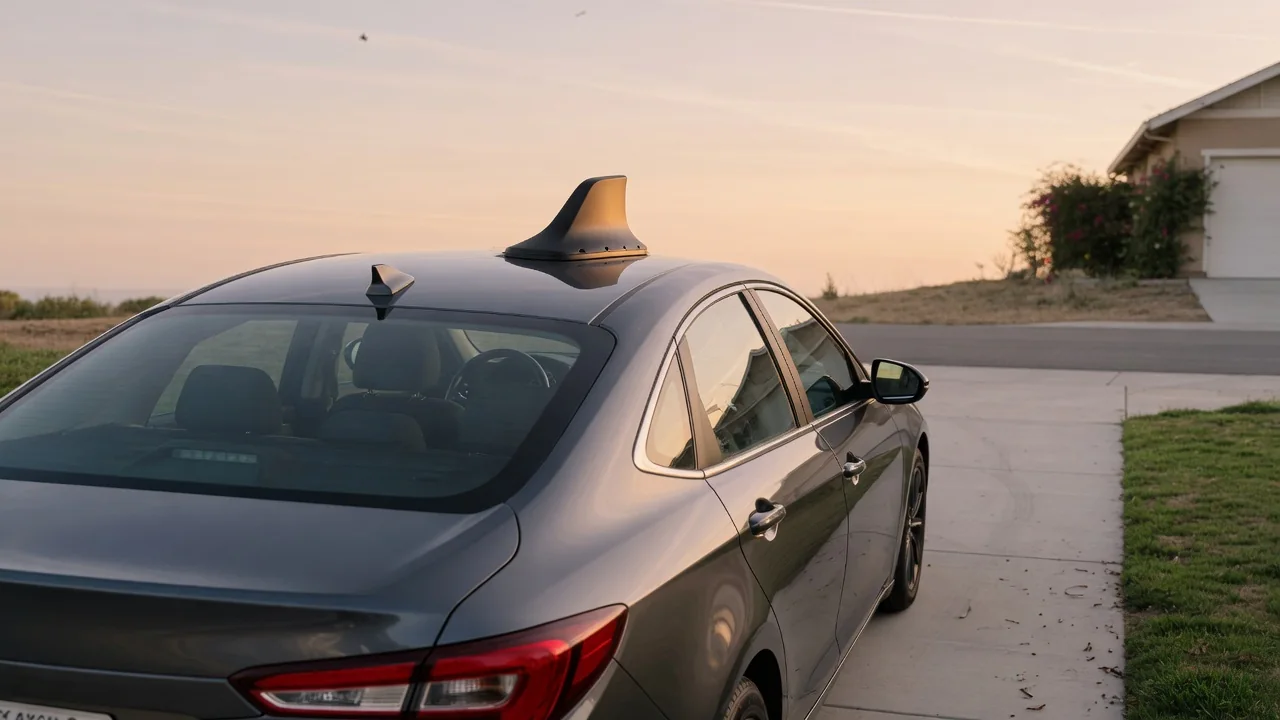
A car antenna receives radio by intercepting electromagnetic waves sent from a broadcast tower and turning them into a very small alternating voltage. A cable carries that voltage to the radio, where a tuner picks out one station and converts it back into audio. Understanding car radio antenna operation in three stages, the broadcast signal, the cable, and the receiver, makes it easier to see why reception changes as you drive and what can realistically be done about it.
Broadcast signal: what reaches the antenna
A radio station sends audio by modulating a carrier wave, an electromagnetic wave oscillating at the station's assigned frequency. In the United States, AM stations occupy the medium-wave band from roughly 530 to 1700 kHz, while FM stations use roughly 88 to 108 MHz. AM varies the strength, or amplitude, of the carrier to represent sound. FM keeps the strength constant and shifts the frequency slightly above and below the carrier. Many stations also transmit a digital HD Radio signal alongside the analog one, and FM broadcasts commonly carry a stereo pilot tone and RDS text data such as station names.
When these waves pass a conductor, their changing electric and magnetic fields push electrons back and forth inside it, creating a tiny alternating current that follows the transmitted signal. That is the core job of the antenna element: it is a passive conductor placed where the field can act on it. Its length matters because an element works most efficiently when it relates to the wavelength of the signal. FM wavelengths are about 3 meters, so a quarter-wave element is roughly 75 cm, close to the length of a traditional fender or roof mast. AM wavelengths are hundreds of meters long, so any practical car antenna is electrically very short for AM and captures only a small fraction of the available energy. The vehicle's metal body also plays a role, often acting as a ground plane that completes the antenna system and shapes how it responds to signals arriving from different directions.
Cable: carrying a tiny signal to the radio
The voltage induced in the antenna is extremely small, typically in the microvolt range, so the path between antenna and radio must protect it. Cars use coaxial cable for this. A coax has a center conductor surrounded by insulation, a braided or foil shield, and an outer jacket. The shield, connected to ground, keeps the signal contained and blocks interference from the electrical systems around it, such as the ignition, alternator, electric motors, and switching power supplies. Because the cable is routed through pillars, headliners, and under trim, its length and condition directly affect what arrives at the radio.
Many modern vehicles do not use a simple mast at all. Antennas may be printed as fine conductive lines on the rear window or side glass, built into a roof-mounted housing, or split into several elements. Short or hidden designs collect less signal than a full-length mast, so they are frequently paired with a small amplifier near the antenna. That amplifier needs power, which may come through a separate wire or be sent along the coax itself, a method often called phantom power. Some vehicles also run more than one antenna lead to the radio to support diversity reception.
Connectors are part of the cable system and a common weak point. The plug at the radio, any adapters, and the base of the antenna must make solid contact with both the center conductor and the shield. Corrosion, a loose mast, a pinched cable, or a broken shield can introduce noise or cut the signal sharply even when the antenna itself looks fine. Connector types vary by vehicle and era, which is why replacing a head unit often requires an adapter.
Reception: how the radio turns the signal into sound
At the radio, the antenna feed contains every station within range at once, plus noise. The tuner's first job is selectivity: choosing one frequency and rejecting the rest. Many car radios use the superheterodyne principle, mixing the incoming signal with a locally generated frequency to shift the chosen station to a fixed intermediate frequency, where filters and amplifiers can work consistently. Many current radios handle much of this processing digitally, but the goal is the same: isolate and strengthen one station without amplifying its neighbors.
Next comes demodulation, which recovers the audio. An AM detector follows the changes in carrier strength, while an FM demodulator tracks the changes in frequency. For FM stereo, the radio uses the pilot tone to separate the left and right channels. If an HD Radio signal is present and strong enough, a compatible receiver decodes the digital stream instead and falls back to analog when the digital signal weakens. The recovered audio then passes to the amplifier and speakers.
Because a car moves, reception is constantly changing. Signals reflect off buildings, hills, and other vehicles, so the antenna receives several copies arriving at slightly different times, an effect known as multipath. This causes the rapid flutter, often called picket-fencing, heard on FM in cities. Radios counter it with automatic gain control, noise blanking, and blending stereo to mono when the signal is weak. Some vehicles also use diversity reception, which switches between or combines antennas to use whichever has the cleaner signal at that moment.
Practical implications and limits
The two bands behave differently on the road. FM travels mostly by line of sight, so hills, tall buildings, parking structures, and tunnels can block it, and its range depends on the transmitter's power and height. AM can travel farther, especially at night when signals reflect off the upper atmosphere, but it is far more sensitive to electrical noise. Devices inside the car, such as phone chargers, dash cameras, LED bulbs, and other aftermarket electronics, can create hum or buzzing on AM that has nothing to do with the antenna.
When reception degrades, the cause is often physical rather than electronic. Common culprits include a bent or loose mast, a damaged rear-window grid line, a corroded antenna base, an amplifier power lead left disconnected after a stereo replacement, or a cable damaged during unrelated repairs. Some window films contain metal and can weaken signals for antennas mounted on or behind glass. Because antenna layouts differ widely, component locations and the correct test procedure should come from the specific vehicle's service information.
There are also limits no antenna can overcome. An antenna cannot create signal that is not there, and boosters amplify noise along with the station, so they help mainly when cable losses or an unpowered amplifier are the problem, not when the car is simply too far from the transmitter. A station that drops out in the same place every day usually reflects terrain or broadcast coverage rather than a fault. Knowing how a car antenna receives radio helps separate these cases: weak reception across all stations points to the antenna system, while trouble on a single station or in one area usually points to the signal itself.