Why Does a Windshield Glare at Night?
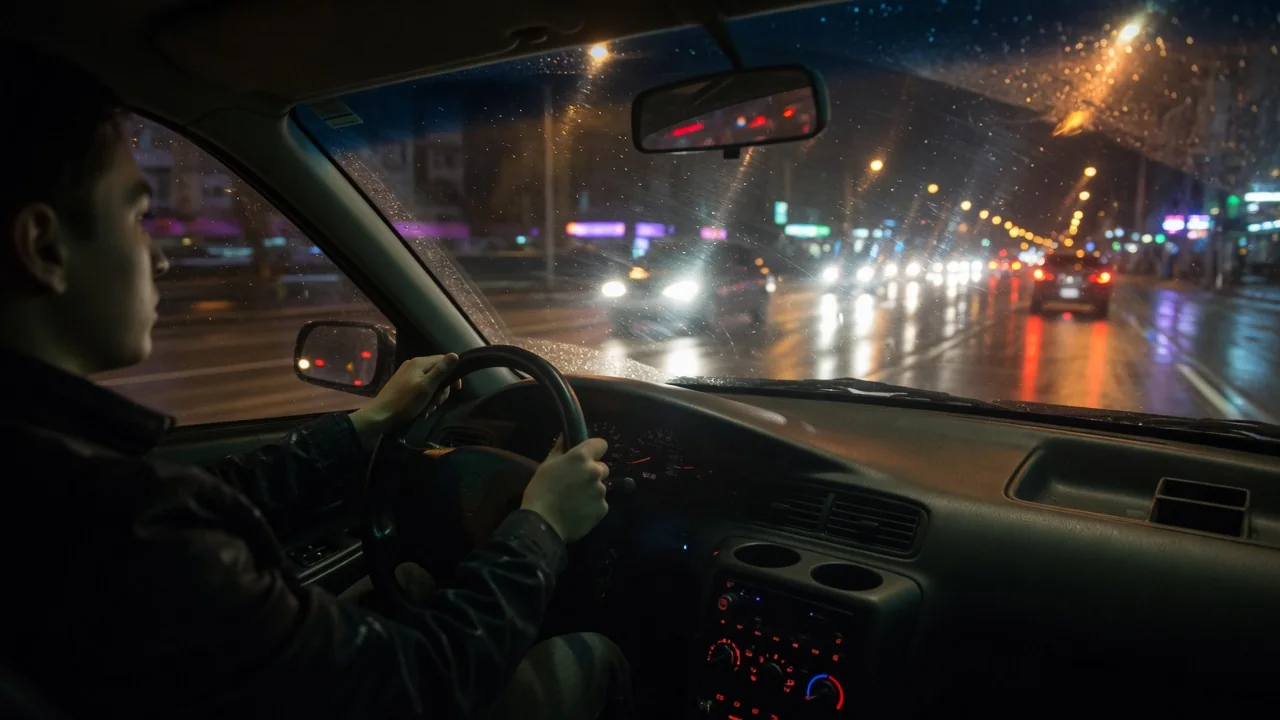
Drivers who ask why does a windshield glare at night are usually noticing the same thing: headlights and streetlamps bloom into halos, streaks, or a milky veil instead of staying crisp points. The cause is rarely the glass itself. Thin films and fine damage on both surfaces scatter incoming light, and darkness makes that scatter far more visible.
Interior haze
The inside of a windshield collects a film that most people never see in daylight. Plastics, vinyl, adhesives, and upholstery in the cabin slowly release vapors, especially when a parked car heats up in the sun, and those vapors condense on the cooler glass. Add residue from breath, skin oils from fingertips, smoke or vape aerosol, and dust carried by the ventilation system, and the result is a faintly greasy layer that sits evenly across the surface and dulls transparency a little more each week.
At night that layer behaves like a diffuser. Each tiny droplet or particle redirects part of an oncoming beam, so the light spreads into a soft glow that washes out the darker road around it. A simple check is to wipe a clean, dry fingertip across the glass and look for a clear track, or to view the windshield at a low angle against a streetlamp. How quickly haze builds varies with cabin materials, vehicle age, climate, and how often recirculation mode is used.
Outside grime
The outer surface faces a different mix of contaminants. Road spray carries oil, rubber dust, and exhaust soot, while trees contribute sap and pollen, and insects leave protein residue that bakes on in warm weather. Car wash waxes and some water-repellent treatments can also leave an uneven coating. Wiper blades then drag this material across the glass, pressing it into a thin smear that follows the arc of each sweep rather than removing it completely.
Those arcs are often the giveaway after dark. When oncoming headlights hit a smeared sweep pattern, the glare appears as curved streaks or a brief flash of haze just after the wipers pass, particularly in light rain or mist. Hardened or worn blade edges make the effect worse by chattering and leaving fine lines of water. Mineral spots from hard water and sprinklers add another layer of scatter, and their severity depends heavily on local water quality and where the vehicle is usually parked.
Cleaning
Because the film is oily, a quick dry wipe tends to spread it rather than lift it. A dedicated automotive glass cleaner and clean microfiber cloths generally work better, with one cloth used to loosen the film and a second, dry one to buff away what remains. Working in shade on cool glass helps prevent the cleaner from flashing off and leaving its own streaks. Many owners wipe the inside in one direction and the outside in the other, which makes it easy to tell which surface still holds a streak.
The interior is usually the harder side, since the dashboard limits reach near the base of the glass, where haze is often thickest. Products should be chosen with care on vehicles that have aftermarket tint film, head-up display areas, or camera and sensor housings near the mirror, and the owner's manual is the right reference for what is safe. Outside, cleaning the rubber wiper edges matters as much as the glass, because dirty blades will redeposit grime on the first sweep.
Everyday Use and Observations
Daily habits shape how fast the problem returns. Running the defroster against a hazy windshield can make fogging linger, because moisture clings readily to a contaminated surface, and the fog itself scatters light. Dashboard dressings that leave a glossy finish can reflect in the glass and contribute vapor to the film. Vehicles parked outdoors in hot sun, or driven mostly in heavy traffic and wet conditions, typically need attention sooner than garaged cars used on dry, open roads.
Certain situations expose the scatter most clearly. Glare tends to peak on wet roads, when reflected light arrives from below as well as ahead, and when cresting a hill into oncoming traffic. Tall vehicles and bright modern headlamps strike the glass at angles that light up every smear. Drivers may also notice that glare is worse in one zone, such as low on the driver's side or along the wiper path, which points toward the surface and the source worth inspecting first.
Limits and Next Steps
Cleaning cannot fix everything. Years of sand and grit leave microscopic pits in the outer surface, and worn wipers can etch fine arcs into it; both scatter light permanently and often show as a sparkle or haze when driving toward a low sun or bright headlamps. Chips, cracks, and a cloudy band near the edges of laminated glass are also physical conditions rather than films. If glare persists on a windshield that is verifiably clean on both sides, a glass specialist can judge whether polishing or replacement makes sense.
The glass is also only one part of the picture. Clouded headlamp lenses or poorly aimed beams reduce useful light and make oncoming glare feel harsher by comparison, and dirty eyeglasses add their own scatter. Vision matters as well: halos and starbursts that appear around lights regardless of the vehicle are worth raising with an eye care professional. Checking these factors in order, from cleaning both surfaces to inspecting blades, glass condition, and lighting, usually narrows down why night glare continues.