Why Does a Restoration Need a Reassembly Plan?
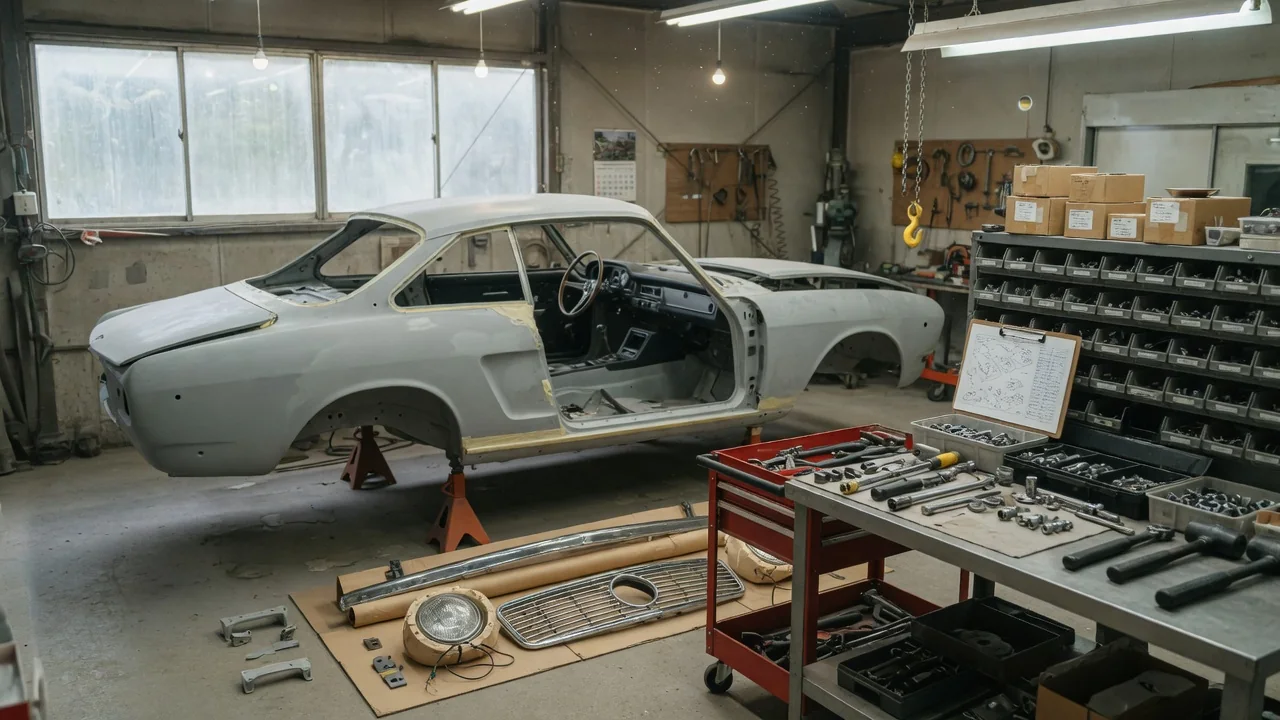
Disassembly tends to feel like progress, but a restoration is judged by how well the car goes back together. So why does a restoration need a reassembly plan? Because many parts depend on others being installed first, original fasteners are easy to mix up once they leave the car, and some faults can only be found while systems are still accessible. A written plan turns a pile of refinished parts into a predictable, checkable sequence.
Dependencies
A car is assembled in layers, and many of those layers hide or block the ones beneath them. On a typical body-on-frame or unibody vehicle, brake lines, fuel lines, and wiring harnesses are far easier to route before the engine, transmission, and exhaust are in place. Heater boxes, firewall grommets, and under-dash wiring are usually simplest to fit before the dashboard and steering column go back in. Sound deadening and insulation generally need to be installed before carpet and interior panels, and door glass and regulators normally have to be adjusted before door trim is fitted. Installing a component out of sequence rarely makes the job impossible, but it often means removing finished parts again, which risks scratching fresh paint, chipping plating, or disturbing seals that were already set.
Dependencies are not only physical. Paint, body sealers, and adhesives need time to cure before panels are handled or loaded, and the product instructions, not a convenient schedule, decide when that is. Panel gaps are typically set with fasteners snug rather than fully tightened, so doors, fenders, and hood can be adjusted together before everything is locked down. Outside work adds another layer: a rebuilt engine from a machine shop, re-chromed bumpers, or new upholstery may arrive on a different timeline than the rest of the project. Writing these relationships down shows which tasks sit on the critical path and which can be done whenever parts are ready, so a delay in one area does not stall the entire car.
The most reliable starting point is the information gathered during teardown: photos, notes, and the procedures in a factory service manual or equivalent repair documentation for the specific vehicle. Reading the disassembly record in reverse gives a rough vehicle restoration reassembly order, which can then be corrected wherever refinishing, upgrades, or replacement parts change what has to happen first.
Fastener records
Fasteners look interchangeable once they are off the car, but they usually are not. Bolts that share a head size can differ in length, thread pitch, strength grade, shank style, and finish. A bolt that is slightly too long can bottom out in a blind hole before it clamps, or protrude far enough to rub a brake line or wire. One that is too short may engage only a few threads. Using a lower-grade bolt where the original was a higher grade reduces the clamping and shear strength the joint was designed around. Restorations make mix-ups more likely because hardware is often removed in large batches, cleaned or replated together, and stored for months before it is needed again.
A useful fastener record ties every piece of hardware to its location. For each joint, note the quantity, size, thread, length, head markings, and any washers, spacers, or clips that came with it. Record whether thread locker, sealant, or anti-seize was present, and look up the tightening specification and sequence in the service documentation rather than relying on memory or generic charts. Mark fasteners the manufacturer designates as one-time use, such as torque-to-yield bolts or certain self-locking nuts, so replacements are ordered before they are needed. Labeled bags or trays, cross-referenced to photos, keep the record usable when work resumes after a long pause.
Shims and spacers deserve their own entries. On many vehicles they set suspension alignment, body-to-frame height, or panel position, and losing track of their original stack can turn a simple refit into a lengthy adjustment exercise.
Testing
A reassembly plan should place checks at the point where each system is complete but still accessible. Once a wiring harness is installed, continuity and basic function can be verified before the dash, carpet, and trim cover it. Brake and fuel lines can be inspected for leaks and correct fitting engagement while they are still visible, rather than after the engine and exhaust block the view. Cooling system hoses and clamps are easier to check before accessories crowd the engine bay. The principle is simple: find a fault while the fix is still straightforward, not after it requires undoing finished work.
The first start and early driving deserve their own checklist. Typical items include confirming oil pressure promptly, watching for fluid leaks, verifying that gauges and warning lights work, checking that the charging system is functioning, and bleeding air from the cooling and brake systems as the manufacturer describes. Some joints, such as wheel fasteners, exhaust connections, and certain gaskets, are commonly rechecked after an initial period of use; the service documentation indicates which ones and how. A professional wheel alignment and a gradual road-test progression, starting at low speed in a safe area, help reveal issues before the car is driven normally.
Recording each test result alongside the fastener record creates a simple history of what was checked, when, and with what outcome. That history makes it easier to trace a later problem back to a specific step.
Practical implications and limits
In everyday terms, a plan mainly reduces rework and uncertainty. It makes parts orders easier to time, keeps the budget tied to actual stages instead of guesses, and lets a project survive interruptions, whether the pause is a few weeks or several seasons. It also makes it possible to hand portions of the job to a shop or a helper without losing context, because the sequence, hardware, and completed checks are documented rather than remembered.
A plan also has limits. It is only as accurate as the information behind it, and assembly sequences can vary between models, model years, body styles, and even mid-production changes. Aftermarket or reproduction parts may fit differently from originals and alter the order of work. Unexpected findings, such as hidden corrosion or a damaged mounting point, will force revisions, so the plan should be treated as a living document rather than a fixed script.
Finally, no restoration plan replaces the manufacturer's procedures or qualified inspection for safety-critical systems such as brakes, steering, suspension, fuel, and restraints. The plan organizes the work; correct specifications and competent verification still determine whether the result is safe to drive.