Why Do Restoration Projects Take Longer Than Planned?
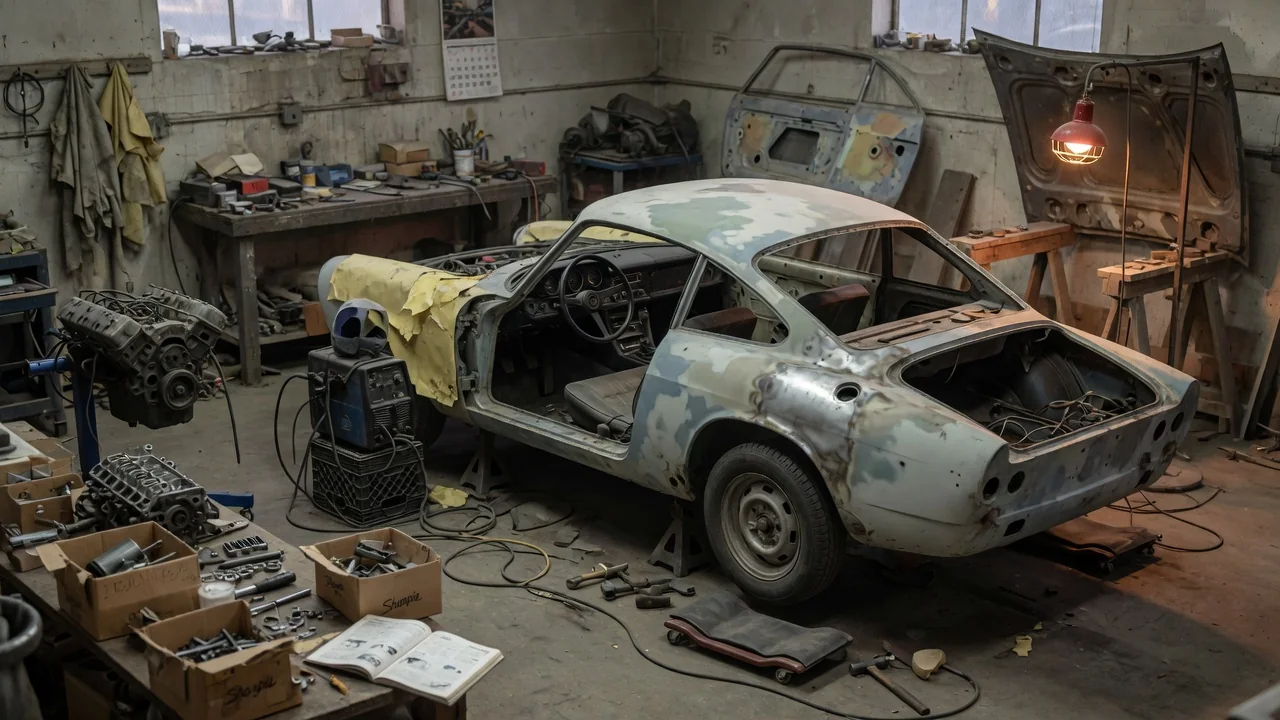
Most restoration plans are built on what can be seen before work begins. Yet much of what decides the real timeline only appears once a vehicle is taken apart. If you have wondered why restoration projects take longer than planned, the answer usually comes down to three connected causes. The first is damage hidden under paint and trim. The second is parts that take time to locate or arrive. The third is work that has to be done twice. Understanding each one makes car restoration schedule delays easier to anticipate.
Hidden damage: what disassembly reveals
An initial inspection can only assess what is accessible. Paint, undercoating, body filler, carpet, sound deadening and interior panels all cover metal that may be in very different condition from the visible surfaces. Rust commonly develops from the inside out where moisture collects, such as enclosed sills, the lower parts of doors, floor pans and seams where panels overlap. By the time bubbling shows through the paint, the corrosion underneath is often more extensive than the surface suggests. Previous repairs add more uncertainty, because filler, patch panels or non-original welds may conceal damage that was never properly fixed.
Mechanical and electrical systems carry similar unknowns. An engine that runs may still have worn internal components that only become apparent when it is opened up. A gearbox, axle or brake system can hide wear, seized fasteners or incorrect parts fitted by a previous owner. Wiring that looks intact may have brittle insulation, corroded connectors or improvised splices. Fasteners that have been in place for decades often resist removal, and a single seized or snapped bolt can turn a short task into a lengthy extraction job.
Each discovery tends to expand the scope rather than simply add one fixed task. Replacing a section of rusted floor may require measuring the body to confirm alignment, fabricating or sourcing repair panels, and refinishing a larger area than planned. These findings arrive after the schedule has been set. As a result, they push back every stage that depends on them, from bodywork through paint to final assembly.
Parts lead time and availability
Even when the needed work is clear, progress often stalls while waiting for components. Availability varies widely depending on the vehicle, its age and how many examples were produced. Some parts remain in production or are widely reproduced. Others are no longer made at all and must be found used, rebuilt from the original or fabricated. Searching for a specific trim piece, badge or model-specific component can take far longer than fitting it.
Lead time is not only about locating a part. Items may need to be ordered from distant suppliers, may be backordered, or may ship in batches. Components sent out for specialist services, such as rebuilding, machining, plating or upholstery, return on the outside shop's timeline rather than the restorer's. When a replacement does arrive, it may not fit correctly. Reproduction parts, and used parts from different production periods, can differ slightly from the original. That can mean adjustment, modification, or a return and reorder.
Sequencing amplifies the scheduling impact. Many restoration stages depend on others being finished first, so a single missing part can block progress on several systems at once. A body cannot be fully assembled without its trim and seals, and final wiring may wait on a particular switch or connector. Ordering parts early helps, but it is not always possible to know exactly what is needed until disassembly and inspection are complete.
Rework: when tasks have to be done twice
Rework is any job that must be repeated or undone to reach an acceptable result. It is common in restoration because many tasks build on one another, so small errors carry forward. Panel gaps that look acceptable in bare metal may need correcting once the doors, hood and trunk lid are hung with their seals. Paint defects such as runs, contamination or poor adhesion often require sanding back and refinishing. Bodywork that was not fully straightened before primer can show waves under a glossy topcoat.
Rework also comes from changes in direction. An owner may decide partway through to upgrade a component, change a color or pursue a more original specification, which can mean undoing completed work. Test fitting is another source. Parts are often trial-assembled before paint to check alignment, then removed, finished and fitted again. Mechanical rework follows when a reassembled system leaks, makes noise or does not perform correctly at first startup. It then has to be partly dismantled to correct the cause.
Rework consumes time that was already counted as done, so it is easy to overlook when planning. It also tends to cascade. Correcting one panel may affect the paint on the panels next to it, and fixing a mechanical fault may require removing parts that were just installed.
Practical implications and limits for planning
Taken together, these factors mean a restoration schedule is best treated as an estimate that becomes more accurate as the project progresses. One useful approach is to split the plan into phases and review the timeline for later stages only after disassembly and assessment are complete. Several habits make delays more visible and easier to manage, even if they cannot all be prevented. Build a contingency into both time and budget. Document the condition of parts as they come apart. Keep an organized list of what still needs to be sourced.
There are limits to how far planning can reduce uncertainty. A careful inspection before the project starts can narrow the range of surprises. That includes checking areas where rust commonly forms and asking about previous repairs. It cannot see through every panel, though. How much a given project is affected depends on the specific vehicle and its history. It also depends on parts availability for that model, the chosen scope, and the resources of the person or shop doing the work. Treat generalizations about which cars restore quickly or slowly with caution, since condition varies greatly between individual examples.
Clear communication matters when a shop is involved. Agree in advance how newly discovered issues will be reported and approved. Also agree how waiting time for parts or outside services will be handled. That helps both sides respond to changes without treating every delay as a failure of the original plan.