How to Define the Scope of a Car Restoration
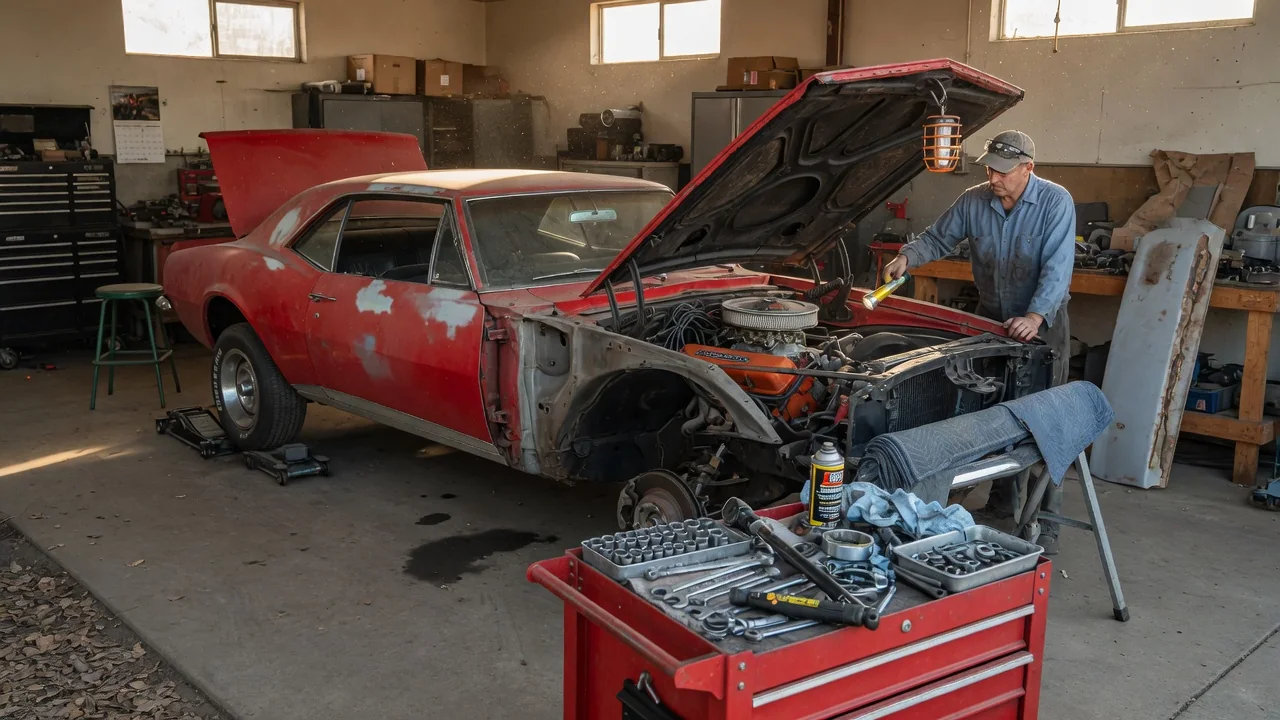
Defining the scope of a car restoration means deciding what will be repaired, replaced or left alone before any work starts. It also means setting the standard the finished car must meet. A clear car restoration project scope keeps the work from expanding piece by piece and gives every later decision a reference point. Three inputs shape it: an honest survey of the car's current condition, a clear idea of how the car will be used, and a budget range you can actually sustain.
Condition survey
The scope starts with what the car actually is today, not what it appears to be. A condition survey works through the vehicle system by system and records findings in writing, ideally with photos. Structure comes first: frame rails or unibody sections, floors, rocker panels, suspension mounting points and areas where water tends to collect. Corrosion or previous collision repair in these areas determines whether the project is cosmetic or structural. It is the finding most likely to change everything else. Surface rust on an outer panel and rot in a load-bearing member are very different problems, even when they look similar from a distance.
After structure, survey the mechanical and electrical systems. Check whether the engine turns over, runs and holds oil pressure, and whether the transmission engages all gears. Note how the brakes, steering and suspension feel, and whether wiring has been cut, spliced or damaged by heat or rodents. Record the condition of the interior, glass, trim and weatherstripping as well. Completeness matters too: missing trim, emblems or vehicle-specific parts can take longer to locate than worn parts take to rebuild, and availability varies widely from one vehicle to another. The factory service manual for the specific vehicle is the appropriate reference for inspection points and specifications.
The useful output of the survey is not a single verdict but a sorted list. Grouping each finding as safety-critical, functional or cosmetic makes it easier to see which items are mandatory and which are optional. Some things cannot be judged without disassembly, such as internal engine wear or corrosion hidden under paint or filler. Mark these as unknown rather than assuming the best case. Those unknowns are where restoration scope most often grows.
Target use
Two cars in identical condition can justify very different restorations depending on what the owner wants from them. Target use translates the survey into a finish standard. A car intended for regular driving needs dependable brakes, cooling, charging and fuel systems, but it can tolerate minor cosmetic flaws. A car prepared for judged shows may require correct finishes, period-appropriate components and attention to areas that never affect function. A weekend cruiser often sits between these, and a modified or restomod build follows its own goals rather than factory originality.
Writing the target use as a short, specific statement helps settle questions later. A line such as reliable for occasional highway driving, sound paint, original-style interior gives a shop or a home restorer a test to apply to every task. Without that statement, each component tends to be brought up to the highest standard simply because it is already apart. That is how projects drift from a refresh into a full frame-off restoration without anyone making a deliberate decision.
Target use also decides how originality is weighed against modern upgrades. Improved brakes, electronic ignition, updated wiring or modern tires can make a car safer and easier to live with, but they may not suit a car meant to be preserved or judged for correctness. Legal and practical requirements matter as well. Registration, inspection rules and insurance terms differ by location and should be checked locally before planning changes.
Budget range
A restoration budget is best expressed as a range rather than a single figure, because the survey always leaves unknowns. The lower end reflects the work you know is required; the upper end reflects what happens if the unknowns turn out badly. Building the range from the survey list, category by category, is more reliable than starting from a total you hope to spend. Real costs depend heavily on the vehicle, parts availability, local labor rates and how much work you do yourself. Estimates should therefore come from current quotes and parts catalogs for the specific car.
Labor is often the largest and least predictable part of the range. Bodywork and paint in particular are time-intensive, and the amount of hidden repair found after stripping can change the figure considerably. If a shop is involved, ask how it bills, how it reports findings discovered during disassembly and how changes are approved. If you are doing the work yourself, count tools, workspace, consumables and your realistic available time as part of the cost.
Set aside a contingency reserve that is not assigned to any task, and decide in advance what will be cut if the reserve runs out. It also helps to compare the upper end of the range with the expected value or personal worth of the finished car. That comparison does not decide the project on its own, since many restorations are done for reasons other than resale. It does make the trade-off visible before money is committed.
Practical implications and limits
In practice, the three inputs have to agree. Suppose the survey shows structural repair, the target use calls for a dependable driver, and the budget range only covers mechanical work. In that case the scope is not yet defined, and one of the three must change. Common resolutions include lowering the finish standard, completing the work in stages, or addressing safety and structure now and cosmetics later. Staging can work well, but sequence matters: paint should generally follow metal repair, and wiring is easier to replace while the interior is out. The order of phases therefore affects total effort.
A written scope document is a planning tool, not a guarantee. Disassembly will reveal conditions that no external inspection can show, and parts that seemed available may prove hard to source. Treat the scope as something to revisit at defined points, such as after teardown and after paint removal, rather than revising it each time a new issue appears. When a change is needed, update the survey, check it against the target use and adjust the budget range together, so that the decision is deliberate rather than gradual.