What Is a Donor Car in a Restoration? Parts, Condition, and Records
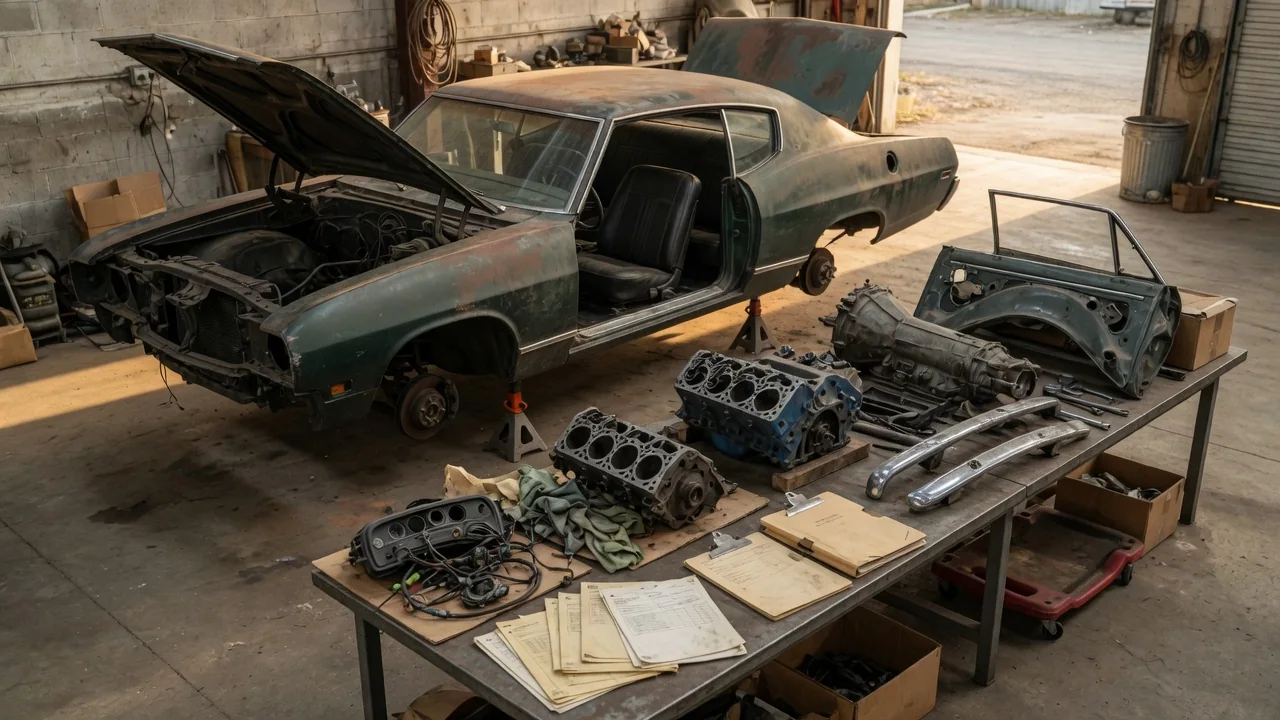
A donor car in a restoration is a separate vehicle bought mainly to supply parts for the car being restored, not to be restored itself. Restorers turn to a restoration donor vehicle when original components are hard to find, costly to buy one at a time, or needed in quantity. To use a donor well, you need to know what it can supply, how to judge its condition, and how to record what moves from one car to the other.
Parts source
The main job of a donor car is to be a parts source. One vehicle can supply body panels, glass, trim, interior pieces, suspension and steering components, drivetrain assemblies, and wiring that would otherwise have to be found separately. This matters most for older or low-volume vehicles. Catalog parts may no longer be made for them, reproduction parts may vary in fit or finish, and used parts may only turn up now and then. Buying a whole car can be the practical way to get many related components at once, all from the same production period and all aged under similar conditions.
Compatibility is not automatic, even when the donor appears to be the same model as the project car. Manufacturers often change parts during a production run, and components can differ by model year, trim level, engine and transmission choice, market, or factory option. A bracket, wiring harness, or interior panel that looks identical may use different mounting points or connectors. Before treating a vehicle as a donor, compare part numbers, casting or stamping marks, and the relevant pages of factory service or parts documentation where they are available. Do this for the specific components you expect to use. General resemblance between two cars is not proof that their parts interchange.
Donors are especially useful for small items that rarely appear for sale on their own. Examples include fasteners, clips, grommets, brackets, heat shields, vacuum lines, trim retainers, and short harness sections. These pieces are easy to overlook when planning a project, yet missing ones can stall reassembly. A donor that supplies a complete set of correct small hardware can save more time than one that supplies a single large part.
Condition
Judge a donor car by a different standard than a restoration candidate. Overall appearance, mileage, or whether it runs matters less than whether the specific parts you need are usable. A car with heavy damage at one end may still offer good components at the other. A car that looks clean may have hidden problems in exactly the areas you care about. Common reasons a vehicle becomes a donor include collision damage, advanced corrosion, flood or fire exposure, missing paperwork, or repair costs higher than the car is worth. Each of these affects parts differently. Flood exposure can harm electrical components and interior materials. Fire can weaken nearby rubber, plastic, and wiring. Collision forces can bend structural and suspension parts in ways that are not obvious at first glance.
A system-by-system inspection keeps the evaluation focused. For body parts, check panels for rust from the inside as well as the outside, along with prior repairs, filler, and distortion. For mechanical parts, look for signs of leaks, overheating, seized components, or missing internal parts. Keep in mind that a non-running engine or transmission often cannot be fully evaluated without disassembly. For electrical parts, check connectors and harness sections for corrosion, brittle insulation, and amateur splices. For interior parts, check for moisture damage, sun damage, and odors that suggest water intrusion. Wherever possible, record what you could not inspect, so you do not count on parts whose condition is unknown.
Even good donor parts are usually used parts. Seals, bushings, bearings, hoses, and other wear items may need replacement regardless of how well the rest of the component held up. Plan to clean, inspect, and refurbish removed parts before installation, and treat the donor's condition as the starting point for that work, not a substitute for it.
Recordkeeping
Recordkeeping matters because a donor car changes the history of the vehicle being restored. When parts move from one car to another, the finished car is no longer made entirely of its own original components. Whether that matters depends on the goals of the project. For a driver-quality build it may be of little concern. For a car where originality, factory-correct details, or matching numbered components affect how it is judged or valued, clear documentation of what was replaced and where the replacements came from becomes important. Honest records let future owners, buyers, or evaluators understand the car accurately rather than drawing wrong conclusions about its originality.
A practical record starts before anything is removed. Photograph the donor as acquired, including its identification number and any visible part markings, and keep the purchase and ownership paperwork. As parts come off, label them, photograph their condition, and note any part numbers or date codes. Keep a running log that lists each donor component, the date it was removed, what was done to refurbish it, and where it was installed on the project car. Store this log with the restoration file so the link between the two vehicles stays traceable long after the donor itself is gone.
Identification and administrative rules deserve separate care. Vehicle identification numbers and the plates or stampings that carry them belong to a specific vehicle. Moving them between cars is restricted in many jurisdictions. Requirements for titling, registering, dismantling, or disposing of a donor vehicle also vary by location. Check the rules that apply where you live before buying a donor or removing identifying parts, and keep any related paperwork with your records.
Practical implications and limits
A donor car brings costs beyond its purchase price. It needs storage space, often for months, while parts are removed as the restoration reaches each stage. Dismantling takes time and tools. Parts that are not needed right away have to be stored in a way that protects them from moisture and damage. When the useful parts are gone, the remaining shell, fluids, and unusable components still have to be handled properly. Some restorers offset part of the cost by selling surplus parts or keeping them as spares. Whether that works depends on demand for the specific vehicle and on the time available to sell them.
A donor also cannot solve every problem. It may share the same weak points as the project car, because both cars aged with the same design and materials. Some components, especially safety-related wear items such as brake hydraulics or rubber lines, are often better replaced with new parts than reused from any older vehicle. Before buying a donor, list the parts you expect to take from it and check that the donor actually has them in usable form. That keeps the decision tied to the project's needs rather than to the appeal of a low price or a complete-looking car.