Why Does a Car Workshop Need Good Lighting?
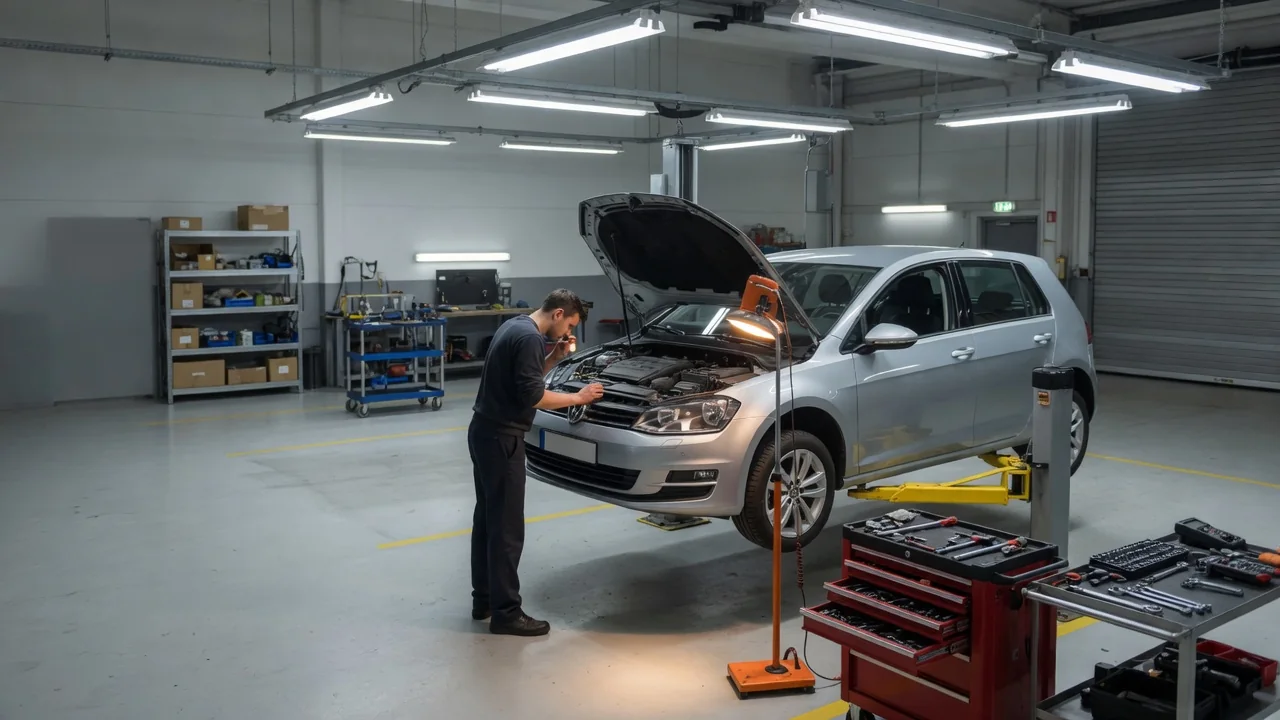
Most home garages are lit for parking, not for repair work. A single ceiling fixture may be enough to find the light switch and walk around the car, but it rarely shows what is happening inside a wheel well, under a dashboard, or beneath an engine. So why does a car workshop need good lighting? Nearly every repair depends on seeing clearly, and poor light makes jobs slower, mistakes more likely, and some hazards harder to notice.
Lighting the Whole Work Area
A car workshop is not a single work surface like a desk. Work happens at roof height when you inspect a sunroof drain, at waist height under an open hood, at floor level when you check tire wear, and overhead when the car is on stands or a lift. Car garage work lighting has to account for all of those zones. General overhead light provides the base level that lets you move safely, find tools, and see spills on the floor. Without it, the area around the car becomes a mix of bright spots and dark corners where dropped bolts, extension cords, and jack handles disappear.
Good overall lighting also supports accuracy. Reading small markings on fasteners, fuse labels, connector locks, and fluid reservoir level lines is much easier when the light is even and steady. Color matters too. Many diagnostic clues are visual: the shade of a fluid leak, discoloration from heat, corrosion on battery terminals, or the difference between a dry and a wet gasket edge. Light sources that render colors poorly can make brake fluid, coolant, and oil residue harder to tell apart, so the quality of the light is part of the question, not only its brightness.
A well-lit space also reduces time spent hunting for things. When the workbench, tool storage, and parts tray are visible from the car, it is easier to keep removed parts in order and notice a missing clip or washer before reassembly. That organizational benefit is easy to overlook, but it is one of the practical reasons the whole room, not just the engine bay, deserves attention.
Why Shadows Matter Under and Around the Car
A car body is very good at blocking light. With one ceiling fixture in the middle of the garage, the hood, fenders, doors, and the underside of the vehicle cast deep shadows exactly where most repairs take place. The engine bay is a crowded three-dimensional space in which components sit behind and below one another. Light coming from a single direction illuminates the top surfaces and leaves lower parts, such as hoses near the subframe or sensors on the back of the engine, in darkness.
Your own body adds another layer of shadow. Leaning over a fender or sliding under the car puts your head and shoulders between the light source and the work. This is why mechanics commonly combine fixed overhead light with movable task lights such as an underhood light bar, a magnetic or clip-on lamp, a headlamp, or a handheld inspection light. Light placed from more than one angle fills in shadows so that edges, threads, and connector tabs become visible instead of guessed at.
Shadows are more than an inconvenience. Working by feel in a dark area raises the chance of cross-threading a bolt, misrouting a hose or wiring harness, pinching a wire during reassembly, or missing a cracked component. Strong glare creates a similar problem from the opposite direction: a very bright point source reflecting off polished metal or painted panels can hide detail and cause eye strain. Diffused or indirect light, and aiming lamps so they do not shine straight into your eyes, usually reveals more than simply adding power.
Electrical Safety in Garage Lighting
A garage combines conditions that are hard on electrical equipment: concrete floors that can be damp, water from washing or melting snow, flammable liquids such as gasoline and solvents, metal tools, and moving parts. Lighting choices should reflect that environment. Fixtures, cords, and portable lamps should be rated for the conditions where they are used, and portable work lights should be kept in good condition, with intact insulation, secure plugs, and guards where the design calls for them.
In the United States, garage receptacles are generally expected to have ground-fault circuit interrupter (GFCI) protection, which is designed to cut power quickly if current leaks to ground, for example through a damaged cord or a wet hand. Older garages may lack it, and plugging several lights, a compressor, and a battery charger into one outlet or a chain of power strips can overload a circuit. If the wiring is old, outlets are scarce, or you plan to add permanent fixtures, a licensed electrician can assess the circuit, and local electrical codes determine what is actually required.
Heat and fuel vapors deserve separate attention. Traditional incandescent and halogen work lamps can run hot enough to burn skin or ignite a solvent-soaked rag, and a lamp that breaks near gasoline vapor is a fire risk. Cooler-running LED work lights reduce, but do not eliminate, that concern. Cords also become a tripping and snagging hazard when they run under jack stands, across creeper paths, or near belts and electric cooling fans, which on many vehicles can switch on without warning.
Practical Implications and Limits
In practice, good lighting is usually a layered setup rather than one perfect fixture: broad overhead light for the room, adjustable task light for the specific job, and a portable source for tight spaces. The right balance depends on the size of the garage, ceiling height, wall color, the kind of work you do, and whether the car sits on the floor, on stands, or on a lift. Light-colored walls and floors reflect more light back into the space while dark surfaces absorb it, so identical fixtures can perform quite differently in two garages.
Lighting also has limits. Better visibility does not replace correct procedures, proper jack stands, eye protection, or the service information for the specific vehicle. Some components remain hard to see regardless of light because of how a particular model is packaged, and an inspection mirror or borescope may help more than another lamp. Brightness figures on packaging are not always measured the same way, so comparing products by a single number can be misleading. The most reliable test is whether you can clearly see the area you are working on, from the angle you actually work from, without glare or deep shadow.