What Is a Courtesy Light on a Car?
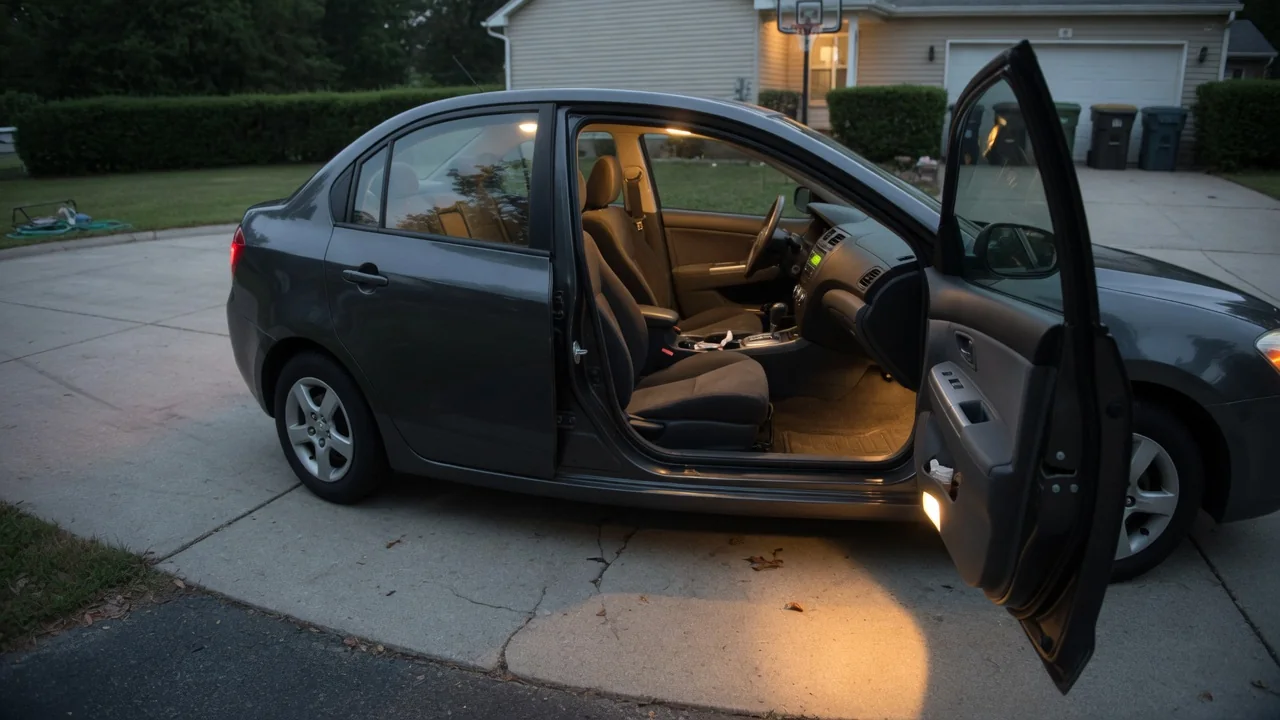
Anyone asking what is a courtesy light on a car is usually looking at a small lamp that comes on when a door opens. Courtesy lights are convenience lamps that illuminate the cabin, the door sills, or the ground beside the vehicle so occupants can see while getting in and out. They work automatically, which separates them from lamps a driver switches on deliberately.
Activation
Most courtesy lights are triggered by the doors. A switch in the door jamb or inside the latch assembly senses when a door is no longer closed and completes the circuit, either directly or by signaling a body control module that then powers the lamps. On many vehicles the same signal drives the door-ajar warning on the instrument cluster, so the two usually behave together. Opening any door, and on some vehicles the liftgate or trunk, normally brings the lights on within a moment.
Many vehicles also wake the lights before a door moves at all. Pressing unlock on the key fob, approaching with a proximity key, or removing the key from the ignition can start an illuminated entry sequence. Afterward the lamps often fade out gradually rather than snapping off, or go dark as soon as the ignition is switched on. A dome lamp switch with door, on, and off positions typically lets the driver override this behavior, though the exact logic and available settings depend on the manufacturer and trim level.
Common locations
The most familiar courtesy light is the dome lamp in the center of the headliner, often joined by map lights near the windshield and a second lamp for rear passengers. Lower in the cabin, footwell lamps under the dashboard light the floor and pedals area, while small lamps set into the bottom or trailing edge of the door panel shine on the sill and the ground. Some door-edge lamps use a red lens as well, so approaching traffic can see an open door at night.
Outside the cabin, puddle lamps mounted under the side mirrors or beneath the doors light the pavement beside the vehicle, and some project a logo or pattern. Illuminated sill plates, lit door handle pockets, and cargo area or trunk lamps often run on the same circuit or follow the same triggers. Glovebox and vanity mirror lamps are related convenience lights, but they usually have their own switches. Economy models may have only a single dome lamp, while well-equipped vehicles can have a dozen or more separate sources.
Battery considerations
Courtesy lights draw power directly from the battery with the engine off, which is what allows them to work before the key is turned. A single lamp uses little current, and LED versions use far less than older incandescent bulbs. The risk comes from time rather than intensity. A dome lamp left switched on, or a door that does not latch fully, can keep lamps burning for many hours, and an older or already weak battery may not have enough reserve left to crank the engine afterward.
To guard against this, many modern vehicles include a battery saver function that shuts interior lamps off after a set period, even if a door stays open. Older vehicles frequently lack that protection, and the timeout length on newer ones varies by manufacturer. A repeatedly drained battery with no obvious cause is worth investigating rather than assuming, because a lamp staying on in a closed trunk or glovebox is hard to spot. Checking the lamp positions and door closure is a sensible first look before suspecting the battery itself.
Everyday Use and Observations
In normal use the pattern is easy to watch. The lamps come on with the unlock button or the first opened door, stay lit while occupants settle in, and fade once the doors are shut or the engine starts. At the end of a trip they often return when the ignition is turned off, giving light for gathering belongings. Because the system is meant to be unobtrusive, most drivers only notice it when the behavior changes, such as lamps that stay dark or refuse to go out.
A few observations help make sense of odd behavior. If one lamp is dark while the others work, that lamp's bulb or LED unit is the likely place to look. If none respond to the doors but the dome lamp works from its own switch, the switch may simply be set to off, or a dimmer control may be turned to a position that disables door activation. Lights that come on while driving, paired with a door-ajar warning, suggest the vehicle thinks a door is open.
Limits and Next Steps
Courtesy lights are designed for orientation, not for work or visibility on the road. They are too dim to substitute for a flashlight during a roadside repair, and a bright cabin lamp left on while driving at night reflects in the glass and reduces what the driver can see outside. Puddle and door-edge lamps help others notice an open door, but they are not hazard lights and should not be relied on to protect a vehicle stopped near traffic.
When the lights misbehave, the owner's manual is the best starting point, since it identifies the switch positions, any settings menu for entry lighting, and the fuse that protects the circuit. Replacing an accessible bulb is often straightforward, but lens removal methods and bulb types differ by vehicle and should be confirmed first. Faults that involve door switches built into latches, a control module, or an unexplained battery drain are better handled by a qualified technician, who can test the circuit rather than replace parts on a guess.