Why Does a Car Door Not Stay Open on a Slope?
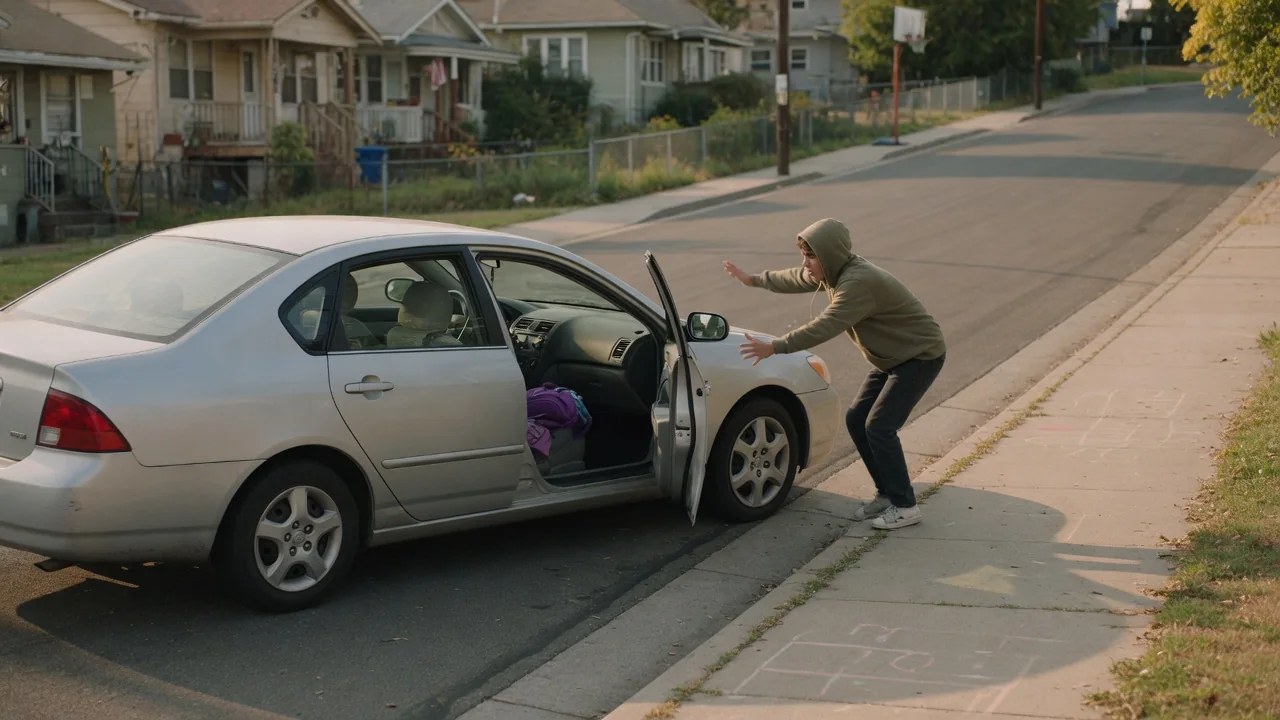
Anyone who has parked on a hill has probably wondered why does a car door not stay open on a slope when it behaves perfectly on level ground. The answer lies in how gravity acts on a heavy door, how the hinges are angled, and how much holding force the door check can provide before the weight of the door overcomes it.
Hinge geometry
A car door swings on two hinges whose pivot pins form an imaginary line called the hinge axis. On level ground that axis sits close to vertical, so the door's weight is carried by the hinges and has little tendency to swing the door either way. Tilt the whole vehicle, and the axis tilts with it. The door's center of mass, which sits well outboard of the hinges, now has a downhill direction to fall toward, and gravity produces a turning force around the pins.
The direction of that force depends on how the car is parked. Nose uphill, a front-hinged door tends to swing shut; nose downhill, it tends to swing wider open. Parked across a slope, the downhill-side doors want to fall open while the uphill-side doors want to close on your legs. Many manufacturers also build a slight tilt into the hinge axis for body styling and sealing reasons, so some vehicles show a mild bias even on flat pavement, and the effect differs between front and rear doors.
Check strap
The part that resists this gravity-driven swing is the door check, often called a check strap or door stay. It is usually a metal or reinforced arm that runs between the door and the body pillar, passing through a small housing containing spring-loaded rollers or friction blocks. Shaped notches or humps along the arm create detent positions, which is why most doors pause at one or two distinct stages of opening and require a small extra push to move past each one.
Those detents only supply a limited holding force. Designers balance it against how easy the door should be to open and close, so it is tuned mainly for flat or gently sloped ground. On a steep grade, the turning force from a long, heavy door can simply exceed what the detent can resist, and the door rolls out of its notch. Designs vary widely: some vehicles use a separate strap, others integrate the check into the hinge, and a few use stepless friction mechanisms that hold at any angle.
Repair signs
A door that will not hold on a steep hill is not automatically faulty, but certain symptoms suggest the check has worn. The clearest is a door that swings freely on level ground with no noticeable stopping points, as if the detents have vanished. Clicking, popping, or cracking noises while the door moves through its travel are another common clue, since they can indicate worn rollers, a dry or damaged arm, or movement where the check attaches to the pillar or door shell.
Looking at the mounting points is also informative. Cracked paint, distorted sheet metal, or visible looseness around the check bracket can mean the door has been forced past its stop, perhaps by wind or by someone leaning on it. Comparing one door with the matching door on the other side of the same vehicle is a useful reference, because both were built with the same holding force. A clear difference between them points toward wear rather than normal design behavior.
Everyday Use and Observations
In daily driving the effect shows up in predictable places: steep driveways, crowned roads, angled curbside parking, and multi-level garages with ramped floors. Longer doors on coupes and heavier doors packed with speakers, glass, and side-impact structure generate more leverage than short, light ones, so they are more likely to drift. Wind adds to the load as well, pushing on the door panel like a sail and sometimes tipping a door out of its detent when the slope alone would not.
A few habits reduce the risk of pinched fingers, bruised shins, or a door edge striking a neighboring car. Keeping a hand on the door while getting in or out on a hill is the simplest, especially when loading children or groceries. Opening the door fully to its final detent often gives a firmer hold than the intermediate position. Where there is a choice, parking so the vehicle sits as level as possible removes most of the turning force in the first place.
Limits and Next Steps
It helps to be realistic about what any door check can do. Even a new, properly functioning mechanism has a finite holding force, and no ordinary design is intended to lock a door open against a severe incline. If the door behaves normally on flat ground and only gives way on a pronounced grade, the vehicle is most likely working as intended. Holding force and the number of detent positions differ by make, model, and door, so behavior that seems weak on one car may be standard on another.
When a door drifts on level ground, makes noise, or shows damage near its mounts, an inspection by a qualified technician or body shop is the sensible next step. Replacing a check can involve removing interior trim and working near wiring, window mechanisms, and in some vehicles side airbag components, so the correct procedure depends on the specific vehicle. Sagging or misaligned doors may also involve hinge wear rather than the check alone, which is worth confirming before any parts are ordered.