What Is a Door Check Strap?
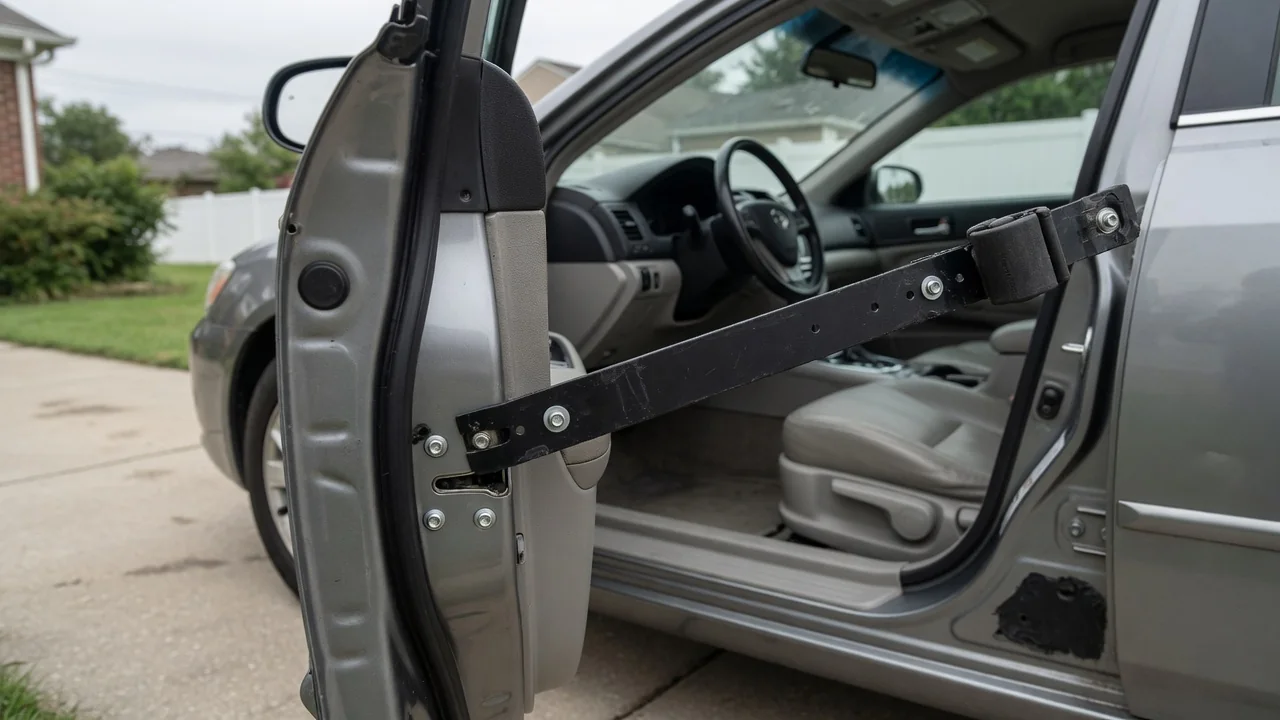
Anyone asking what is a door check strap is usually looking at the flat metal arm or link between a car door and the body pillar. Its job is simple but important: it limits how far the door swings and holds it at intermediate openings, so the door stays put instead of drifting shut or flying wide in a tight parking space.
Detents
Detents are the stopping points built into the check strap. On many designs, the arm has shaped notches or raised humps along its length, and spring-loaded rollers or sliding blocks inside a small housing in the door ride over them. When the rollers settle into a notch, the door resists moving in either direction. That resistance is what you feel as a distinct pause partway through the swing, and it is why a door can rest half open on level ground without being held.
The number and spacing of those positions vary by vehicle. Some doors have a single intermediate stop before the fully open position, others have two, and a few use a friction-style check that holds at almost any angle rather than at fixed points. Rear doors and long coupe doors often feel different from front doors on the same car. You can observe your own setup by opening the door slowly and noting where it settles and how much push is needed to move past each stop.
Wear
Because the rollers and arm rub together every time the door moves, the check strap gradually wears. The humps on the arm round off, the rollers or sliding blocks flatten, and the springs lose some of their force. The first sign is usually a door that no longer stays at its intermediate position, swinging closed on a slight slope or opening fully when you only wanted it part way. The holding effort fades slowly, so many owners do not notice until the door starts catching their legs.
Noise is the other common clue. A dry or worn check often clicks, pops or creaks as the door passes each detent, and the sound usually comes from the gap between the door and the pillar rather than from the hinges. Dirt and dried grease speed up the process, as does corrosion on vehicles used in wet or salted conditions. A sharp crack accompanied by movement at the mounting point deserves closer attention, since the bracket or surrounding sheet metal can be stressed as well as the strap itself.
Replacement
Once the detents no longer hold, the check strap is generally replaced as a complete unit rather than repaired, because the worn surfaces are inside a sealed or riveted housing. The part typically fastens to the pillar at one end and to the inside of the door shell at the other. Reaching the door end often means removing the interior trim panel, and sometimes a speaker or moisture barrier, so the job can be more involved than the small size of the part suggests.
The correct part depends on the vehicle, the door position and sometimes the body style, so it should be matched by the specific vehicle details rather than by appearance alone. Front and rear straps are rarely interchangeable, and left and right may differ. Doors with airbags, wiring and window mechanisms behind the trim call for care, and many owners prefer to leave the work to a workshop. Whoever does it should also inspect the mounting points, since a new strap fitted to cracked metal will not last.
Everyday Use and Observations
In daily driving, the check strap does its work without being noticed. It keeps the door steady while you load a child seat, lean in for shopping or step out in a narrow bay beside another car. On a sloping driveway, the detent is what stops the door swinging back onto your shins or rolling outward into a wall. A healthy strap gives a smooth swing with firm, quiet stops, and the door stays where you leave it until you push it deliberately.
A simple comparison between doors is a useful check. If the driver's door, which is opened most often, feels looser or noisier than a rear door on the same car, the difference points to wear rather than design. Try the doors on level ground and then on a gentle incline, and note whether each one holds. Remember that wind and steep slopes can overcome even a sound detent, so one door blowing open on a gusty day is not by itself evidence of a fault.
Limits and Next Steps
A check strap is a holding aid, not a restraint designed to withstand heavy force. Strong wind catching an open door, or someone leaning on it at full travel, can bend the arm, distort the pillar bracket or crease the door edge against the fender. It also plays no part in keeping the door latched while driving, and it does not carry the door's weight. A door that sags, drops when opened or needs lifting to close points toward the hinges, not the strap.
If a door will not hold, start by looking at the strap and its mounts with the door open, checking for looseness, rust, cracks or a dry, dirty arm. Cleaning and a suitable lubricant sometimes quiet a noisy check, though they will not restore worn detents. Persistent popping, visible damage around the mounts or a door that swings freely should be assessed by a technician, who can confirm whether the strap, the hinges or the body structure needs attention before the problem grows.