Why Do Prototype Seats Use Temporary Covers?
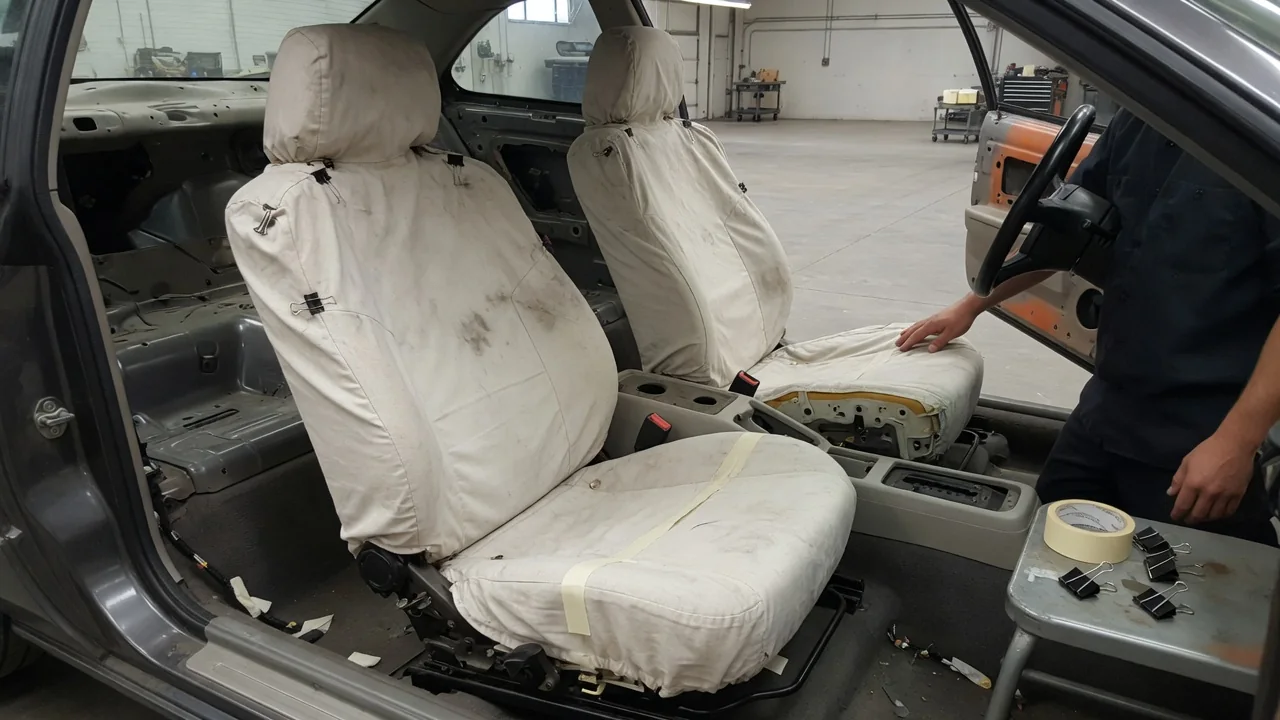
Look inside a disguised test car and the seats often look oddly plain: black fabric, loose-fitting covers, sometimes visible zippers or hook-and-loop strips. These test car seat coverings are not a sign of cost cutting. A seat under development keeps changing, automakers want to keep interior design details private, and engineers need to judge the seat's structure before the final trim exists. Those three reasons explain why prototype seats use temporary covers.
Changing shapes
A production seat is a stack of components: a frame, a suspension system such as springs or a support mat, molded foam pads, and a trim cover. During development, each layer may be revised several times. Engineers adjust bolster height, cushion length, lumbar shape and foam firmness to meet comfort targets and occupant packaging requirements, and to fit the seat with the rest of the interior. Each time the foam changes shape, a fitted cover made for the previous version stops fitting correctly.
Production trim covers are generally sewn from patterns cut for one specific foam shape. They are then attached with hardware such as hog rings, listing wires, clips or hook-and-loop strips that pull the material into trenches molded into the foam. Developing those patterns, sewing sequences and attachment points takes time and tooling. Repeating that work for every interim foam iteration would slow the program and add cost. A generic or loosely tailored temporary cover can go over several versions of a pad, so the team can keep refining the shape without waiting for new trim each time.
Systems built into the seat evolve as well, including heater mats, ventilation fans, occupant sensors and wiring routes. A temporary cover that opens with a zipper or hook-and-loop closure makes these parts easy to reach for adjustment, replacement or instrumentation. A finished cover, by contrast, is designed to stay tightly and permanently in place.
Concealment
The interior is one of the parts of a car that buyers look at most, so automakers often treat seat design as confidential until launch. Finished trim reveals a lot. It shows the choice between cloth, synthetic leather and leather, along with color schemes, stitching patterns, perforation, quilting and embroidered logos. Bolster shapes can also hint at a sport-oriented version. Prototypes are driven on public roads and parked in public places, where onlookers can photograph them through the windows. Plain dark covers make these details much harder to read.
Seat covers usually work alongside other interior disguises. On test vehicles, dashboards and door panels are sometimes covered with fabric, foam or add-on panels to hide shapes and screens, and seat covers follow the same approach. A uniform, baggy cover also hides the seat's true contour, so an observer cannot easily judge bolster size or cushion shape. Practice varies between manufacturers and development stages. A covered seat is therefore not always different from the eventual production seat. Sometimes the cover is only hiding the trim.
Evaluation
Temporary covers also help with engineering evaluation. Comfort, support and fatigue depend mainly on the frame, suspension and foam, so engineers often want to assess those elements before final trim decisions are made. Neutral covers keep appearance from influencing subjective ratings. That lets evaluators focus on how the seat holds the body on long drives, rough roads and hard cornering.
Protection is another reason. Development vehicles may cover long distances, with many different drivers climbing in and out and test equipment carried on board. A sacrificial cover shields the foam, and any costly prototype trim underneath, from wear, spills and abrasion, and it can be replaced cheaply. Engineers can also place and route sensors, pressure mats or temperature probes without worrying about damaging a finished surface.
There is a trade-off. The cover itself changes how a seat feels. Its stretch, its thickness and how tightly it is pulled into the foam all affect pressure distribution, breathability and heat transfer. For that reason, evaluations that depend on the final material generally require production-intent trim later in the program. These include thermal comfort, squeaks and rattles, wrinkling, appearance, seam strength and the behavior of seat-mounted airbags. Temporary covers support early decisions, but they do not replace validation with the real cover.
Practical implications and limits
If you are looking at a prototype, be careful about drawing conclusions. A plain cover tells you only that the manufacturer has chosen not to show the final trim. It says little about the material, color or comfort of the production seat, and it may hide or distort the seat's real shape. Any judgment about a future model's interior quality based on a covered seat is speculative.
Seat covers on everyday cars are a separate matter, and safety sets firm limits there. Many modern seats contain side airbags that deploy through a purpose-designed seam in the seat back, and the trim is part of how that deployment is engineered. An aftermarket cover over such a seat can interfere with the airbag unless it is specifically designed and labeled as compatible. The owner's manual is the place to check the manufacturer's guidance. Similar caution applies to seats with occupant classification sensors, heating or ventilation, because extra layers can affect how these systems work.
Finally, temporary covers are only one stage of development. As a program approaches production, seats normally move to production-intent trim so the fit, appearance and behavior of the complete assembly can be confirmed. How long a prototype keeps temporary covers, and how closely they resemble the final design, depends on the manufacturer, the vehicle and the purpose of each test car.