What Is a Car Durability Prototype? Repeated Loads, Test Routes, and Inspection
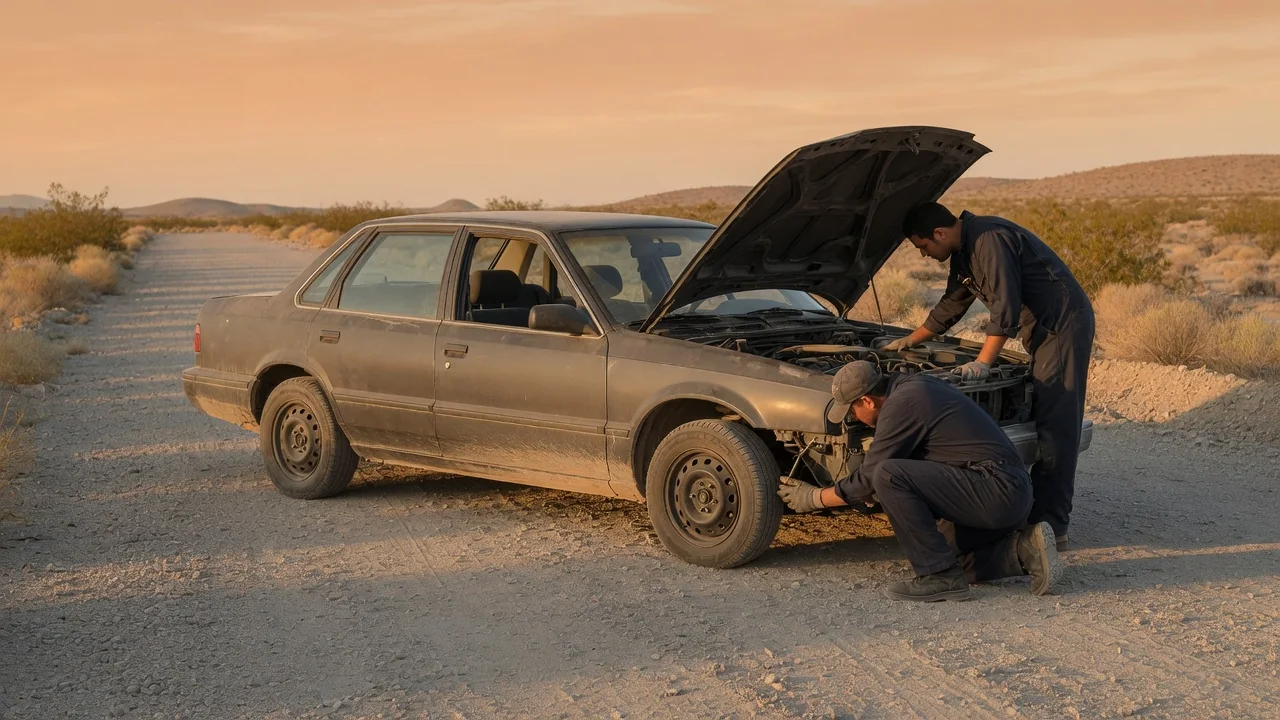
A car durability prototype is a pre-production vehicle built to answer one question: will the design hold up over a long service life? Unlike prototypes used for styling or performance tuning, a vehicle durability test car is driven, loaded, and shaken repeatedly so engineers can find wear, cracks, leaks, and loosening before customers do. Knowing how these cars are used helps explain why production vehicles are designed the way they are.
Repeated loads
Most mechanical failures in a car do not come from a single overload. They come from fatigue: a part is stressed slightly, released, and stressed again thousands or millions of times until a tiny crack forms and slowly grows. A suspension arm flexing over every bump, a weld seam working as the body twists, and a bracket vibrating at engine speed all experience this kind of cyclic loading. Each individual cycle may be well within the material's strength, yet the accumulated damage eventually matters. A durability prototype exists to expose the design to these repeated loads in a controlled way, so that weak points show up as cracks, looseness, or noise during development rather than during ownership.
The loads come from many directions at once. Wheels transmit vertical impacts and side forces into the suspension and body. The powertrain adds torque reversals during acceleration, braking, and gear changes, along with constant vibration. Doors, hoods, tailgates, seats, and switches face their own repeated cycles of opening, closing, and use. Heat and cold expand and contract materials, which stresses gaskets, hoses, plastic clips, and electrical connectors. Moisture and road salt add corrosion, which can weaken parts that would otherwise survive the mechanical stress alone. A useful durability program combines these influences, because a joint that tolerates vibration when new may behave differently once it has corroded or been heat-cycled many times.
Engineers cannot wait for a prototype to cover a normal owner's lifetime of driving at a normal pace, so durability work is usually accelerated. The idea is to concentrate the damaging events, such as large impacts, rough surfaces, and hard cornering, while removing the relatively harmless miles in between. By estimating how much fatigue damage different road types cause, a test plan can aim to reproduce the damage of long-term use in a much shorter period. The exact methods, targets, and correlation models differ between manufacturers and are generally proprietary, but the principle of compressing repeated loads into a shorter, harsher schedule is widely used across the industry.
Test routes
Much of a durability prototype's life is spent on a proving ground, a private facility with surfaces designed to produce specific kinds of stress. Many proving grounds include rough cobblestone-style tracks that shake the body and suspension, sections with potholes and sharp-edged bumps, washboard or corrugated stretches, gravel roads, steep grades, and high-speed loops. Some routes pass through water troughs, mud, or salt spray areas to drive moisture and corrosive material into seams and underbody components. Because the surfaces are repeatable, engineers can run the same route lap after lap and compare how different prototypes, or different versions of a part, respond to identical inputs.
Proving grounds are rarely the whole story. Durability prototypes are also commonly driven on public roads to capture real traffic, mixed speeds, and the irregular conditions that a test track may not reproduce. Programs may include hot, cold, dusty, or high-altitude regions, since climate affects fluids, seals, batteries, and cooling systems. In parallel, laboratory rigs can replay recorded road loads into a body or a complete vehicle, sometimes running continuously without a driver. Rigs are good for isolating a subsystem and running many cycles quickly, while driven routes show how everything interacts at once. A route plan typically blends these methods so that each covers gaps left by the others.
Inspection
Driving a durability prototype is only useful if someone looks closely at what the miles are doing to it. Throughout a program, test cars are usually inspected at set intervals. Technicians check for fluid leaks, worn or cracked rubber bushings, loose fasteners, chafed wiring, rattles, and changes in alignment or ride height. Bolts may be marked so that any rotation is visible, and critical areas such as weld seams and suspension mounts get particular attention. Many prototypes also carry data loggers or sensors that record loads, temperatures, and vibration, which helps engineers connect a problem found in the workshop with the conditions that caused it.
At the end of a test, a durability prototype is often partly or fully taken apart. This teardown lets engineers examine components that cannot be seen during routine checks: internal engine and transmission wear, bearing surfaces, hidden body joints, and corrosion inside closed sections. Findings are compared with design expectations. A crack that appears earlier than predicted, or wear that is uneven, may lead to a revised part, a different material, added reinforcement, or a change in the assembly process. Updated parts are then typically tested again, which is why durability development tends to run in several rounds rather than a single pass.
Practical implications and limits
For an owner, the main takeaway is that durability testing is designed around representative and severe use, not around every possible combination of conditions. It aims to make common failures rare, but it does not make a car immune to wear. Components such as tires, brake pads, wiper blades, and fluids are still expected to be replaced, and the maintenance schedule in an owner's manual reflects assumptions about how the vehicle will be used. Driving habits, local road quality, climate, and towing or heavy loading can all push a car toward the harsh end of what engineers planned for, which is why some manuals provide separate guidance for severe service.
There are also limits to what prototype testing can reveal. Prototypes may be built before final suppliers, tooling, and assembly methods are fully settled, so production cars can differ in small but meaningful ways. The number of test vehicles is limited, which means rare manufacturing variations may not appear until many cars are on the road. Manufacturers generally do not publish detailed durability results, so the fact that a model went through durability testing says little on its own about how reliable a particular vehicle will be. Real-world reliability information, maintenance history, and the condition of an individual car remain more useful guides when judging a specific example.