How Are Wheel Loads Tested? Fatigue, Impact, and Inspection
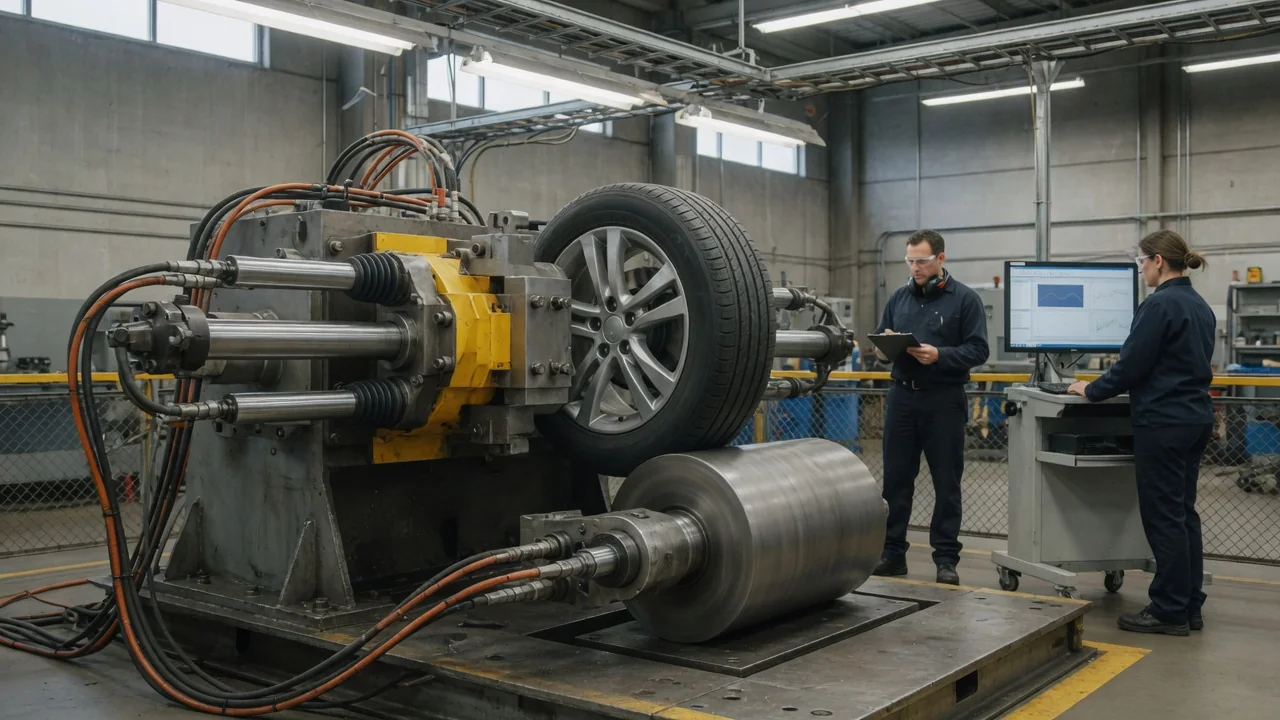
A car wheel carries the vehicle's weight, transmits braking and driving torque, and absorbs side forces every time the car turns. Engineers cannot wait for years of driving to learn whether a design will hold up, so wheel loads are tested in the lab with machines that compress years of stress into hours or days. Car wheel strength testing generally covers three areas: repeated forces that cause fatigue, sudden impacts, and the inspection that confirms whether a wheel survived.
Repeated forces: fatigue testing
Most wheel failures in service are not single overloads but fatigue cracks that grow slowly under a very large number of load cycles. Every rotation flexes the spokes, the hub mounting area, and the rim slightly, and each flex counts as a load cycle. Fatigue testing reproduces this pattern on purpose. The two classic laboratory methods are the cornering fatigue test and the radial fatigue test, both described in industry procedures such as SAE J328 for passenger car and light truck wheels and in comparable ISO test methods.
In a cornering, or rotary bending, fatigue test, the wheel is clamped by its rim to a fixture, and a long arm bolted to the hub mounting face applies a bending moment that rotates relative to the wheel. This mimics the side forces a wheel experiences when the tire grips in a turn, which concentrate stress around the bolt holes, the spoke roots, and the center disc. The test runs for a specified number of cycles, and the load level is calculated from factors such as the wheel's rated load and the tire's dimensions rather than chosen arbitrarily.
In a radial fatigue test, the wheel is mounted with an inflated tire and pressed against a large rotating drum, so the tire carries a constant vertical load while the assembly spins. This stresses the rim barrel, the bead seats, and the transition between rim and disc, which matter most for straight-line driving under load. Some laboratories also use biaxial test rigs that combine vertical and lateral loads on a tire running inside a drum, allowing a more realistic mix of straight driving and cornering forces in one program. The general aim in every case is the same: show that the design reaches its target cycle count without a fatigue crack or a meaningful loss of stiffness.
Impact: simulating potholes and curb strikes
Fatigue tests do not show what happens when a wheel meets a pothole edge or a curb. For that, wheels go through impact testing. The best-known version is an angled impact test, defined in procedures such as SAE J175 and ISO 7141. The wheel, fitted with an inflated tire, is mounted at a tilt so that a weighted striker dropped from a set height lands on the outer rim flange and the tire sidewall together. The striker mass is tied to the wheel's load rating, so a wheel intended for heavier loads faces a harder blow.
Passing an impact test does not mean the wheel comes out undamaged. A bent flange or some permanent deformation is often acceptable. The criteria generally focus on whether the wheel cracks through, whether the center disc separates from the rim, and whether the tire loses air rapidly. In other words, the test checks that a severe hit produces a controlled, visible form of damage rather than a sudden collapse. Many manufacturers also run radial impact tests, in which the striker hits the tread area head-on to mimic a pothole strike at the bottom of the rim, because that direction loads the wheel differently from the angled test.
Impact behavior depends heavily on material and construction. Cast aluminum, forged aluminum, and steel wheels absorb a hit in different ways: steel tends to bend, while aluminum is stiffer but can crack if the energy is high enough. The tire also absorbs part of the blow, which is why sidewall height and inflation pressure influence real-world outcomes even though the laboratory holds them fixed for consistency.
Inspection: confirming what the tests reveal
A test is only as useful as the inspection that follows it. During fatigue testing, rigs often monitor the deflection of the loading arm or the wheel itself; a sudden change in stiffness signals that a crack has started, sometimes before it is visible. After a test, technicians examine the wheel closely, frequently using dye penetrant, which seeps into fine surface cracks and makes them stand out under developer or ultraviolet light. Spoke roots, lug seats, and the rim-to-disc junction get particular attention because that is where fatigue cracks usually originate.
Inspection also happens before any wheel reaches a test rig or a customer. Cast wheels are commonly checked with X-ray imaging for internal porosity or shrinkage voids that can become crack starting points. Production wheels are measured for radial and lateral runout, checked for dimensional accuracy at the bolt pattern and center bore, and leak-tested to confirm the rim holds air. Material samples may be checked for hardness or tensile properties to confirm that heat treatment was done correctly, since a wheel with the right shape but the wrong material properties will not behave like the one that passed qualification testing.
Practical implications and limits
For an owner, the most useful takeaway is the load rating. Wheels are qualified for a maximum load per wheel, and that rating needs to meet or exceed what the vehicle places on each corner, including the more heavily loaded axle. Replacement or aftermarket wheels should carry a rating and test marking appropriate to the market where they are sold, such as markings associated with SAE J2530 in North America or the JWL mark in Japan. Fitment details such as offset, bolt pattern, center bore, and lug seat type also matter, because the tests assume the wheel is mounted the way it was designed to be.
Laboratory results have limits. The tests are standardized so wheels can be compared and qualified, but they use set loads, set angles, and new parts. They cannot cover every combination of speed, road edge, tire size, and inflation a car will encounter. A wheel that passed its tests can still bend or crack after a hard enough hit, and a wheel that has been straightened, welded, or refinished may no longer match the condition in which it was qualified. Incorrect lug torque, corrosion at the mounting face, or underinflated tires can raise stresses beyond what the design anticipated. Visible cracks, a bent flange, a slow leak, or new vibration after an impact are reasons to have the wheel inspected rather than assuming it is still sound.