What Is Metal Fatigue in a Car Part?
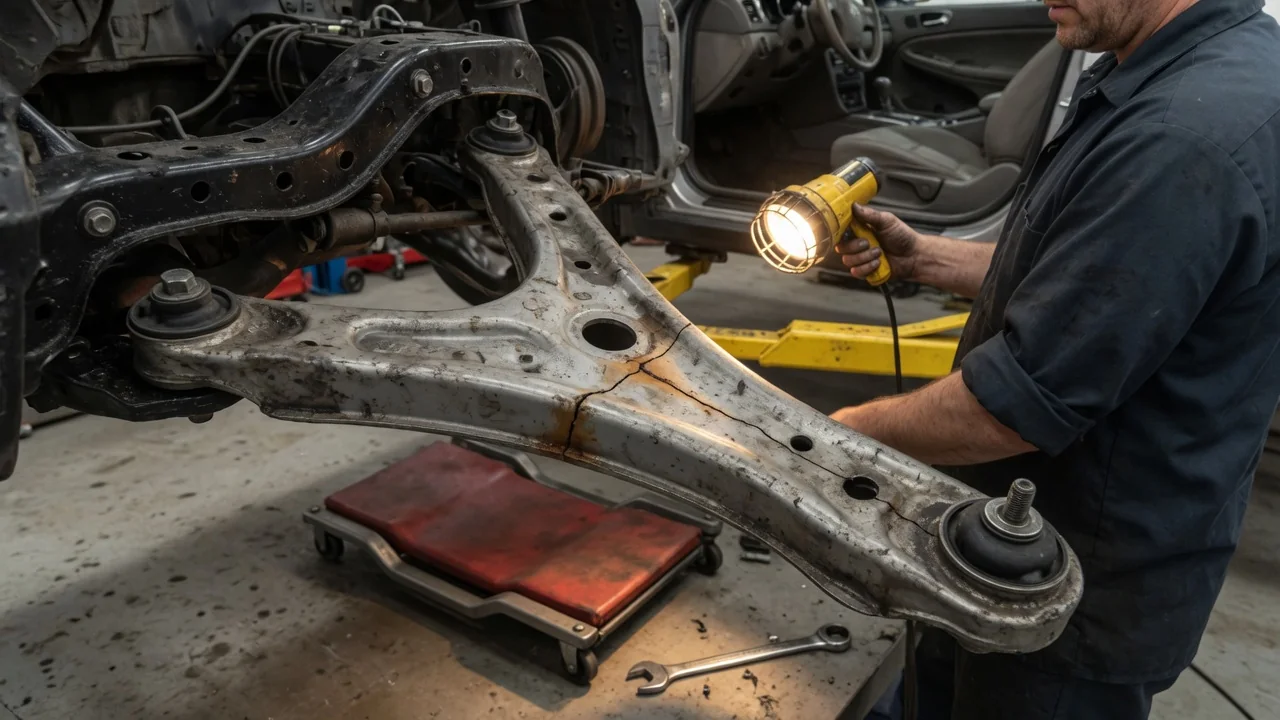
Metal fatigue is the gradual weakening of a metal component under loads that are applied and removed many times. Each individual load can be well below what would bend or break the part in a single event. In a car, almost every metal part experiences this kind of cyclic loading. Knowing what metal fatigue in a car part is helps explain why some failures appear suddenly after years of normal service. It also explains why inspection focuses on small cracks rather than obvious bending.
Repeated loads
A car is a machine built around repetition. The wheels roll over countless pavement joints, and the suspension compresses and rebounds. The engine fires its cylinders in a steady rhythm, and the drivetrain twists back and forth as the driver accelerates and lifts off. Each of these events puts a load into metal parts such as control arms, springs, axle shafts, wheel hubs, brackets, exhaust hangers and body panels near mounting points. The load rises, falls and often reverses direction. A single cycle may be harmless, but parts accumulate an enormous number of them over a vehicle's life.
Fatigue depends on how large each load is, how it varies and where it concentrates. Stress tends to collect at geometric features: sharp corners, holes, threads, weld toes and abrupt changes in thickness. Surface condition adds to the effect. Scratches, tool marks, corrosion pitting and rough weld beads all act as local stress raisers. Vibration also contributes, because a part that resonates at certain speeds can cycle very quickly with little visible movement. For these reasons engineers treat fatigue as a design concern from the start. They choose materials, shapes, surface treatments and welding methods meant to keep stress at critical spots low enough for the intended service life. The design margins and test procedures differ between manufacturers and components, and an owner cannot read them from the part itself.
Crack growth
Fatigue damage usually develops in stages. First, a microscopic crack initiates, most often at the surface and at a stress concentration. At this point the part looks and behaves normally. With continued cycling, the crack advances a tiny distance each time the load opens it. Because growth happens in such small increments, a fatigue crack can progress slowly over a long period of ordinary use.
As the crack lengthens, the intact cross-section of the part shrinks. The same load then produces higher stress in the material that is left, so growth tends to accelerate. Eventually the remaining section can no longer carry the load, and the part fractures. This sometimes happens during an everyday event like a pothole impact, a hard stop or a sharp turn. To the driver the break can feel sudden, but it is the final step of a process that may have been underway for a long time.
Fatigue fracture surfaces often have a characteristic appearance. A relatively smooth region marks where the crack grew gradually, sometimes with curved beach marks spreading out from the origin. A rougher, more granular area marks where the final overload occurred. Failure analysts use these features to locate where a crack started and to judge whether fatigue was involved. Corrosion can speed the whole process in parts exposed to road salt and moisture. It creates pits that start cracks and it attacks the material at the crack tip. Steel and aluminum parts are both subject to fatigue, so material choice changes the details of the process but does not remove it.
Inspection
Because fatigue cracks start small, visual inspection is most useful where stress concentrates. During routine service or with the car on a lift, attention goes to several areas. These include welds on subframes, trailing arms and exhaust systems, the metal around bolt holes and mounting brackets, and spring coils and their seats. Signs worth noting include fine hairline lines in metal or paint, rust staining that bleeds from a seam or line, and paint flaking along a weld. Bare, shiny metal where parts should not be rubbing is another sign. A fastener that keeps loosening can indicate joint movement, which can both cause fatigue and result from it.
Symptoms can also point to a developing problem. Examples include a new clunk or rattle over bumps, a change in steering feel, an alignment that will not stay set, an unfamiliar vibration, or an exhaust that suddenly sounds louder. None of these proves fatigue, because worn bushings, loose fasteners and many other faults produce similar effects. They do justify a closer look. Cleaning a suspected area first helps, because dirt and undercoating easily hide fine cracks.
Workshops and fabricators have additional ways to confirm a suspected crack. Dye penetrant testing draws a colored liquid into surface cracks so they become visible, and magnetic particle inspection can reveal cracks in steel parts. More specialized techniques such as ultrasonic testing belong mainly to industrial and failure-analysis work rather than routine car service. Which method suits a given part depends on its material, shape and accessibility.
Practical implications and limits
For an owner, the main implication is that a cracked structural or suspension component should generally be treated as a part to replace, not something to watch indefinitely. Once a fatigue crack exists, its remaining life is hard to predict. A sudden fracture in a steering, suspension or brake-related part can have serious consequences. The manufacturer's service information is the reference for what may be repaired and how.
Welding over a crack is a common instinct in fabrication work, but the approach has real limits. Welding heat changes the material's properties near the joint. The repair weld also brings its own toe, possible porosity and residual stress, and any of these can start a new crack. For some high-strength steels and heat-treated aluminum parts, manufacturers do not permit welding at all. Even where a repair is allowed, cracking may return if the loads or stress concentration that caused the original crack remain. Modifications deserve similar caution. Lowering a car, fitting different wheels, adding heavy accessories or towing beyond the intended use can change the load cycles that parts were designed to handle.
Any general explanation also has limits. Automotive metal fatigue basics apply across vehicles, but service life, inspection intervals and acceptable repairs are specific to each component and model. A visual check cannot rule out very fine or hidden cracks, and the absence of visible damage does not guarantee remaining strength. When a part has been through a significant impact, shows a confirmed crack or belongs to a safety-critical system, the next step is a qualified technician working from the vehicle's service documentation.