How to Pressure-Test an Engine Block for Cracks
The short answer
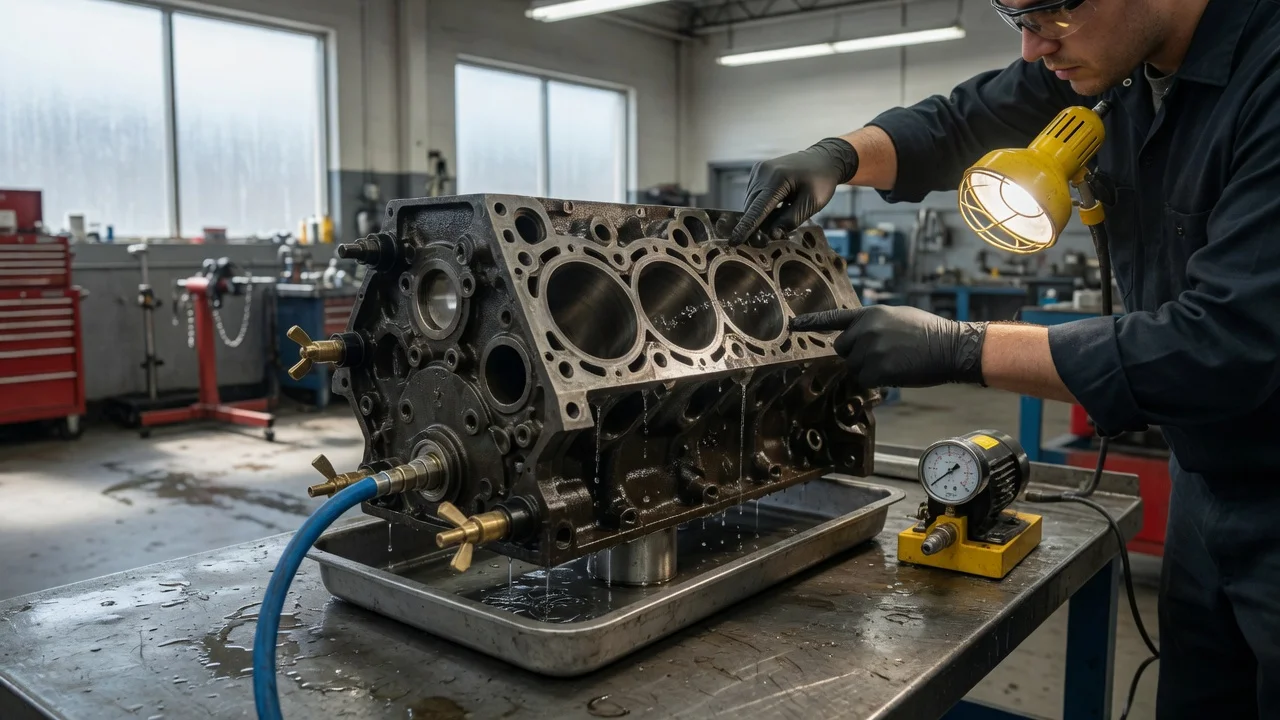
Pressure testing an engine block means sealing off the coolant passages (the water jacket), filling them with pressurized air or liquid, and watching for leaks that point to a crack. A true block pressure test is usually done with the engine disassembled and the bare block cleaned, and it is typically carried out by an engine machine shop with dedicated plates, fixtures and sometimes a heated test tank. With the engine still in the vehicle, you cannot pressure-test the block in isolation. You can only run indirect checks that suggest whether a crack, a failed head gasket or another fault is causing the symptoms.
Exact test pressures, temperatures and hold times are not given here. They depend on the engine design, block material and the shop's equipment, so follow the engine manufacturer's service information or the machine shop's procedure rather than a generic figure.
How a bench pressure test works
The general sequence below describes common machine-shop practice. Individual shops and engines differ in the details.
1) Strip and clean the block so that dirt, scale and old sealant cannot hide a leak or temporarily plug one. 2) Seal every coolant opening, including the deck-surface coolant ports, water pump openings and core (freeze) plug holes, using blanking plates, gaskets and plugs. 3) Connect a regulated air or fluid supply to one fitting and bring the water jacket up to the pressure the procedure specifies. 4) Look for leaks, either by spraying soapy water on suspect areas and watching for bubbles or by submerging the block and watching for a bubble stream. 5) Many shops also test the block hot, because some cracks only open once the metal expands with heat. Heated water or a heated tank is used for this. 6) Note where any leak appears, such as cylinder walls, the deck surface, between cylinders or near bolt bosses, because the location affects whether a repair is realistic.
Related crack-detection methods
Pressure testing finds cracks that connect to the coolant passages. It will not reliably show a surface crack that does not leak. Shops often combine it with other inspection methods:
Magnetic particle inspection (often called magnafluxing): fine iron particles gather at cracks in a magnetized part. It works only on ferrous materials such as cast-iron blocks. Dye penetrant inspection: a colored or fluorescent dye seeps into surface cracks and then shows up under a developer. It is used on non-magnetic materials such as aluminum blocks and heads. Visual inspection after cleaning, especially around the deck, cylinder bores and areas that suffered freeze or overheat damage.
Checks you can run with the engine in the car
If you suspect a cracked block but the engine is still installed, these tests narrow down the cause before you commit to a teardown. None of them proves on its own that the block, rather than the head or head gasket, is cracked.
Cooling system pressure test: a hand pump attached at the radiator or expansion tank pressurizes the cooling system to its rated cap pressure. If the gauge drops with no visible external leak, coolant may be escaping internally. Use the pressure printed on the cap or listed in service data. Combustion leak (block) test: a tester draws air from the coolant tank through a chemical fluid that changes color when it detects combustion gases. A positive result shows combustion gas is reaching the coolant but does not say whether the path is a head gasket, a cracked head or a cracked block. Cylinder leak-down test: each cylinder is pressurized with air at top dead center. Bubbles in the coolant or air escaping from a neighboring cylinder point to a breach between the combustion chamber and the water jacket or between cylinders. Oil and coolant inspection: milky oil, oil in the coolant, or unexplained coolant loss are warning signs that justify further testing.
Interpreting the result
A block that holds pressure hot and cold and shows no indications under particle or dye inspection is generally considered sound for rebuilding. If it leaks, whether to repair or replace depends on where the crack is and how large it is, the block material, and the cost and availability of a replacement block for that specific engine. Some cracks can be repaired by pinning, stitching or welding, while cracks through a cylinder wall or main bearing area are often treated as unrepairable. That judgment belongs to the machine shop inspecting the actual part, not to a general guide.
What this guide does not cover
No engine-specific test pressures, temperatures, hold times or repair costs were available for this article, and procedures vary by engine family, model year and block material. Before you test or decide on a repair, check the service manual for your engine or get the procedure from the machine shop doing the work.