Why Do Car Seat Seams Follow Curved Lines?
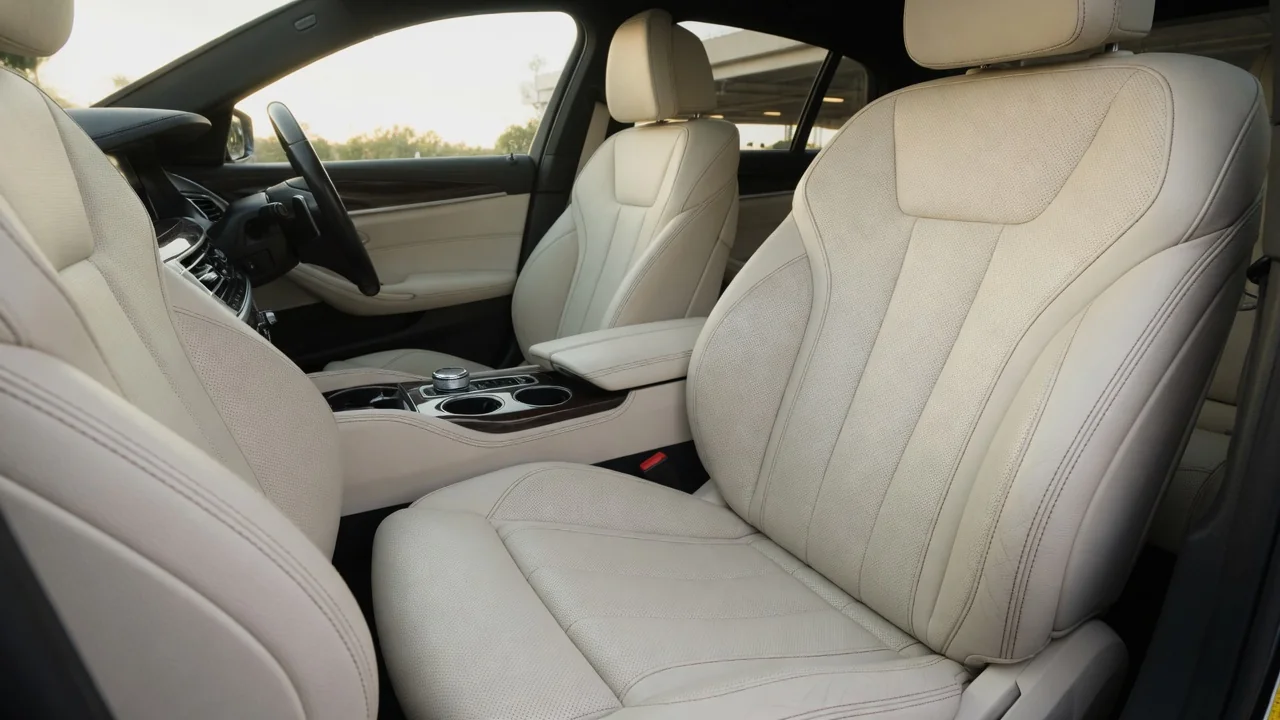
Look closely at almost any car seat and you will see that the seams rarely run in perfectly straight lines. They sweep around side bolsters, arc across the cushion, and bend where the backrest narrows toward the head restraint. These curves are more than styling. They come from how flat upholstery material becomes a three-dimensional cover, how that material stretches under load, and how designers want the finished seat to look. Automotive seat seam design explains why covers fit, wear, and age the way they do.
Panel shaping: turning flat material into a contoured cover
A seat cushion or backrest is built around molded foam with compound curves: raised side bolsters, a dished seating area, a rounded front edge, and often a gentle forward bulge for lower-back support. Upholstery leather, vinyl, and fabric, by contrast, start out as flat material. A single flat sheet cannot wrap a surface that curves in two directions at once without bunching, folding, or wrinkling. This is the same problem tailors face when making clothing fit a body. The solution is to cut the cover into several panels from patterns, giving each panel edges shaped so that, once sewn together, the assembled cover takes on the form of the foam underneath. When two panels with curved edges are joined, the seam between them is curved as well.
Seam placement usually follows changes in the foam's geometry, such as the boundary between a flatter center insert and a raised bolster, or the crease where the cushion turns down toward its front edge. Joining two edges of different curvature forces the panels out of the flat plane, much like darts in a garment. Many seats also anchor the cover into channels molded into the foam, pulling it down with listing rods, hog rings, clips, or hook-and-loop strips attached along the seam allowances. Because those channels follow the seat's contours, the seams tied to them must follow the same path.
Stretch: managing tension across the seat
Every upholstery material stretches to some degree, and few stretch equally in every direction. Knit fabrics, woven fabrics, natural leather, and coated vinyl each respond to tension differently, and even a single hide can vary from one area to another. A seat cover has to be installed under some tension to look smooth, yet it also has to give when an occupant sits down and the foam compresses, then recover when they get out. Seams play a central role in this balance. The stitched, folded edge of a seam stretches far less than the open material around it, so each seam acts as a boundary that limits how far the surrounding panel can move. Placing seams along curves divides the cover into zones where stretch can be controlled to suit the shape and load in each area.
A curved seam also spreads tension along its whole length instead of concentrating it at a sharp corner. If a straight seam were forced across a tightly curved surface, some sections would sit slack while others were pulled hard, leading to wrinkles in one place and overstretched material in another. Overstretching can thin the material, open up stitch holes, and strain the thread, while too little tension leaves loose, puckered areas. Pattern makers also orient each panel so that its direction of greatest stretch suits the way that part of the seat flexes, which is another reason panel outlines, and the seams joining them, tend to curve.
Appearance: how curves shape the look of the seat
Seams are among the most visible details in a car interior, so their path strongly affects how a seat is perceived. Curved seams trace the outline of the bolsters and cushion, emphasizing the seat's form and visually suggesting support and enclosure. Topstitching, double rows of stitching, and contrasting thread colors make these lines even more prominent. A straight seam laid across a contoured surface often looks off, because the eye notices the mismatch between the line and the shape beneath it.
Following the contours also helps the seat look consistent in production and over time. Small variations in foam or installation are less noticeable along a seam that already tracks the form than along a line that cuts across it. Curved seams frame decorative areas such as pleated, quilted, or perforated inserts, and they can echo shapes used elsewhere in the cabin. The underlying reasons are shared across seats, but the visual expression is a design choice that varies widely from one interior to the next.
Practical implications and limits
For owners, the seams along the outer bolsters deserve the most attention. Sliding in and out of a seat rubs and loads these areas repeatedly, and while a well-shaped seam spreads that load, it cannot eliminate it. Worn thread, abraded edges, and small separations often appear there first. Dirt and grit also collect in seam channels, so gentle cleaning along these lines, and conditioning where the material calls for it, can help slow wear.
Repairs and replacement covers depend on the same panel geometry. Because each section is a specifically cut shape, replacing a damaged panel generally means matching the original pattern rather than cutting a piece by eye. Universal aftermarket covers usually lack vehicle-specific panel shapes, which is why they may wrinkle, shift, or sit loosely over bolsters, while covers patterned to a particular seat are intended to follow its original seam lines more closely.
There are also limits to what general principles can tell you. Seats with side airbags mounted in the backrest commonly include a seam intended to open during deployment, and re-stitching it, changing the thread, or covering that area with an unsuitable cover could interfere with how it works. Seat construction, materials, and attachment methods also differ between vehicles. Before modifying or repairing a seat, consult the service information for that specific vehicle or a qualified upholstery professional.