How Are Seat Upholstery Covers Attached? Hooks, Clips, Seams and Repair
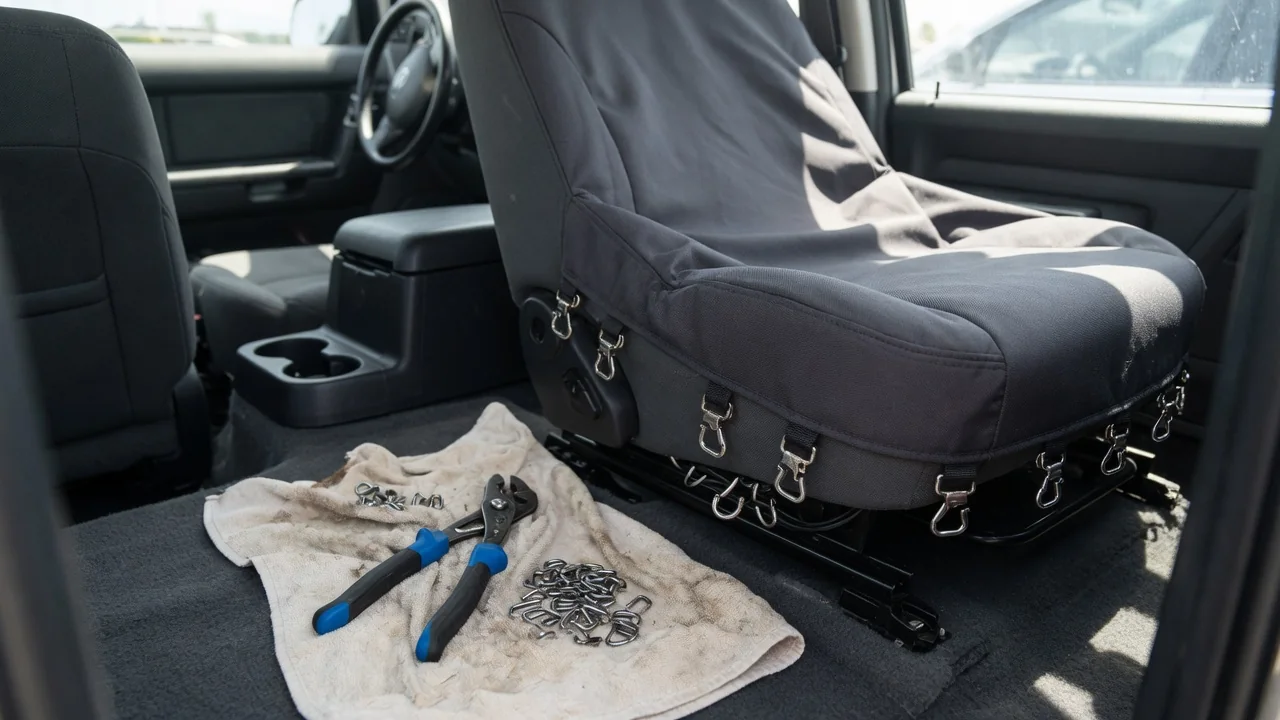
Most factory seat upholstery covers are not glued to the foam. They are stretched over a molded cushion and held by hooks, clips, rings and sewn-in channels that pull the fabric or leather into the shape of the seat. Knowing how seat upholstery covers are attached explains why seats wrinkle, why some covers come off easily while others resist, and what a careful repair involves.
Hooks and clips
Around the outer edges, the cover usually ends in a stiff plastic strip sewn into its hem. This strip is often shaped like a J or a hook and snaps over the edge of the seat frame, the seat pan or a plastic trim panel. On many seatbacks, the lower edge of the cover finishes in such a strip that hooks onto the frame or a rod beneath the seat, while the top is held around the headrest guides. Some designs use separate plastic clips or push-in retainers that pass through holes in a back panel instead. These edge attachments keep the whole cover under tension, so the order in which they are released and refitted matters.
Inside the seat, the cover has to follow the contours of the foam, including the grooves that form bolsters and decorative panels. A traditional way to do this is with hog rings, small open metal rings that are crimped closed with dedicated pliers. A wire or plastic rod, often called a listing rod, runs through a fabric channel on the underside of the cover. Hog rings link that rod to a matching wire molded into or laid in a trench in the foam. When the rings are closed, the cover is drawn down into the groove, creating the sharp, defined lines seen on many seats.
Hog rings are not the only option. Many seats use plastic clips or hook-and-loop strips bonded into the foam trenches, which grip a matching strip or rod on the cover. Zippers, elastic straps and simple plastic retainers also appear, especially on removable sections and headrests. Aftermarket slip-on covers are a separate category: these car seat cover attachments typically rely on elastic straps, S-hooks under the seat, and tabs or tubes pushed through the gap between the cushion and backrest. They sit over the factory upholstery rather than replacing it.
Seams
A seat cover is assembled from many separately cut panels sewn together, and its seams decide where the cover bends and how closely it matches the foam beneath. Visible seam lines are usually placed directly over the trenches in the cushion, so the attachment points pulling the cover down are hidden along the seam rather than in the middle of a panel. Topstitching, piping and double-stitched seams add strength and a finished look, but they also make any shift out of alignment immediately obvious.
Some of the most important seams are the ones nobody sees. A strip of fabric, often called a listing or tie-down strip, is sewn into the seam allowance to form a pocket for the listing rod. This is how the cover connects mechanically to the hog rings or clips inside the seat. If that strip tears or its stitching fails, the cover can lift out of its groove even though the visible seam looks intact, which is a common reason a seat panel suddenly starts to bag or wrinkle.
Seats with side airbags in the backrest add an important complication. The airbag is designed to deploy through a specific seam in the cover, and that seam is built to separate in a controlled way. Covers for these seats are often labeled to show the airbag location. Changing the thread, reinforcing that seam, adding layers or fitting an incompatible cover over it can affect deployment, so this seam should be treated as a safety component rather than an ordinary sewn joint.
Repair
Repairing a seat cover usually starts with removing the seat or the affected cushion. The vehicle service information should guide this step, because seats can contain wiring for heating elements, power adjusters, belt buckle switches, occupant detection systems and airbags. Manufacturers commonly specify precautions such as disconnecting the battery and waiting before unplugging airbag connectors. With the seat out, the perimeter hooks and clips are typically released first, then the internal rings or clips are cut or unfastened while noting which listing rod connects to which anchor in the foam.
When refitting a cover, the internal attachments generally go in before the perimeter is pulled tight. Hog rings are normally treated as single-use and replaced with new ones; some people substitute plastic cable ties, which can hold but may not provide the same tension or durability. Plastic retainers can become brittle and break during removal, so replacements may be needed. Gently warming vinyl or leather can make it easier to stretch evenly, and working from the center outward helps avoid trapped wrinkles.
Small seam failures away from airbag areas can often be restitched with heavy upholstery thread, while a damaged panel may call for replacing that section or the complete cover. Collapsed foam under a worn cover is a separate problem: a new cover over compressed foam will still sag. For any damage on or near an airbag deployment seam, replacing the cover with one specified for that seat is the conservative choice rather than sewing a repair.
Practical implications and limits
Because a cover depends on tension from many points, one failed clip or broken listing strip usually shows up as a localized wrinkle or loose spot rather than a general failure. That makes it possible to narrow down many problems by feeling which groove has released. It also means a cover rarely returns to its exact original fit after repeated removal, since materials stretch and retainers lose grip with handling.
The exact combination of fasteners varies between manufacturers, models, trim levels and even front and rear seats in the same vehicle, so no general description replaces the procedure for a specific seat. Hidden parts such as heating mats bonded to the foam or occupant sensors under the cushion can be damaged by careless removal, and some faults trigger warning lights that need professional diagnosis. For aftermarket covers on seats with side airbags, compatibility should be confirmed with the cover maker and the vehicle documentation before installation.