Why Do Car Factories Deburr Metal Parts?
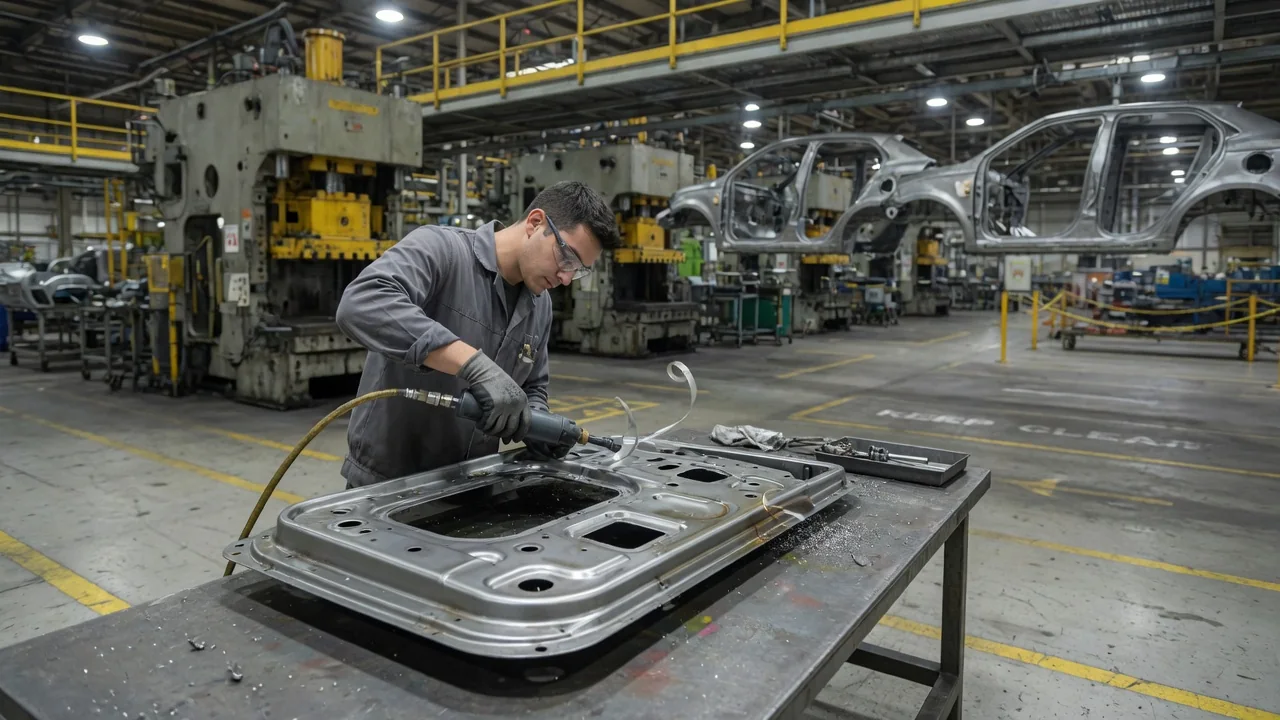
Cutting, punching, drilling, and machining metal rarely leaves a perfectly clean edge. A thin ridge or flake of displaced material, called a burr, often remains where the tool exited the part. So why do car factories deburr metal parts instead of using them as they come off the press or machine? There are three main reasons: safety around sharp edges, accurate assembly fit, and reliable coating. Each one affects how a vehicle is built and how well it holds up over time.
Sharp Edges: Protecting People, Wires, and Hoses
A burr forms because metal does not separate cleanly. When a press punches or shears sheet steel or aluminum, the material first deforms and then fractures. This often pushes a thin lip of metal past the cut on the side where the tool exits. Drilling, milling, and turning leave similar raised edges where the cutter breaks through. These burrs can be thin enough to be hard to see yet sharp enough to slice skin. On a production line, workers may handle the same type of part many times per shift, so even small burrs become a repeated injury risk. Burrs can also catch and tear gloves, which reduces the protection the gloves are meant to provide.
Workers on the line are not the only concern. Many sheet-metal brackets, panels, and frame members have holes and edges that sit close to wiring harnesses, brake and fuel lines, rubber hoses, and weatherstrips. A vehicle vibrates constantly while driving, and a sharp edge in contact with a soft component can slowly wear through it. Chafed wire insulation can cause electrical faults, and a worn hose can leak. Removing burrs, along with using grommets, clips, and routing guides, lowers the chance that an edge becomes a wear point years later. It also makes the finished vehicle safer for technicians and owners who reach into engine bays, door cavities, or the area under the dashboard during service.
Assembly Fit: Flat Surfaces, True Holes, and Clean Threads
A burr is extra material in a place the design did not plan for. When two parts are meant to sit flat against each other, a raised edge around a hole or along a cut can hold them apart. The gap may be small, but it can shift alignment, compress a gasket unevenly, or let a bracket rock under load. Holes are affected in a similar way. A burr at the entrance or exit of a hole effectively narrows it, so a bolt, dowel, or locating pin may bind instead of sliding in. On threaded holes, a burr at the first thread can make a fastener start crooked or add friction. Assembly torque is typically used to reach a target clamping force. Extra friction from a burr can therefore mean the torque value is reached while the joint is clamped less tightly than intended.
Precision components raise the stakes further. Engine, transmission, steering, and brake parts often contain machined bores and drilled oil or fluid passages, including holes that intersect inside a casting. A burr left in one of these spots may break loose after assembly and travel with the fluid. Loose metal particles can scratch bearing surfaces, score bores, or lodge in small orifices and valves. For this reason, manufacturers of such components generally treat burr removal as part of overall cleanliness control, not just a cosmetic step.
Automation adds another reason. Robotic welding, fixturing, and inspection depend on parts arriving with consistent geometry. A burr can keep a panel from seating against its locating pins, change the contact between sheets being joined, or interfere with sensors that check whether a part is present and positioned correctly.
Coating: Why Paint and Corrosion Protection Need Clean Edges
Coatings are a major reason automotive part deburring matters over the long term. As liquid coatings such as primers and paints flow and cure, they tend to pull away from sharp edges, because surface tension draws the film toward flatter areas. This leaves a thinner layer right at the edge, and a burr is essentially a sharp edge with an even thinner tip. Car bodies typically receive a pretreatment and an electrocoat primer intended to reach inside panels and cavities, but sharp edges can still end up with less coating than the surfaces around them. A slightly rounded edge holds a more even film, which gives corrosion less of an opening.
Burrs cause other coating problems as well. A burr that is only partly attached can be painted over and later snap off, exposing bare metal beneath the finish. The folded or rough area at the base of a burr can trap oil, cleaning residue, or pretreatment chemicals, which may weaken adhesion in that spot. Sharp edges are also more likely to chip when struck by stones or tools, and once the coating is broken, moisture and road salt can reach the metal. The same concerns apply to smaller parts that are plated, powder coated, or otherwise finished before assembly.
Practical Implications and Limits
Deburring is not a single operation applied the same way everywhere. Manufacturers generally decide where it is needed based on what an edge does: whether people touch it, and whether it seals, mates with another part, carries fluid, or will be coated and exposed to weather. Some burrs are minimized at the source through tool design, sharp cutting edges, and correct die clearance, since worn tooling tends to produce larger burrs. Others are removed afterward by brushing, grinding, tumbling or vibratory finishing, or abrasive blasting. Internal passages may call for thermal or electrochemical methods. An edge hidden inside a structure may be held to a looser requirement than one near a harness or a sealing face. Deburring has its own limits, too: removing too much material can change dimensions, so the amount is controlled rather than maximized. Edge requirements differ between manufacturers and parts, so no single standard applies to every vehicle.
For owners and home mechanics, the same principles apply whenever metal is cut or drilled outside the factory. Drilling a body panel to mount an accessory, cutting exhaust tubing, or trimming a bracket leaves fresh burrs and bare metal. To reduce the chance of corrosion, remove the burrs, clean the area, and protect the exposed edge with a suitable primer or sealant. Routing any wiring through a proper grommet prevents chafing. Aftermarket parts can vary in edge finish, so it is worth checking their edges before installation. Rust that appears at panel edges or around holes may relate to thin coating at an edge. However, damage, trapped moisture, and age are also common causes, so the edge alone does not explain every case.