Why Do Car Makers Seal Hemmed Panel Edges?
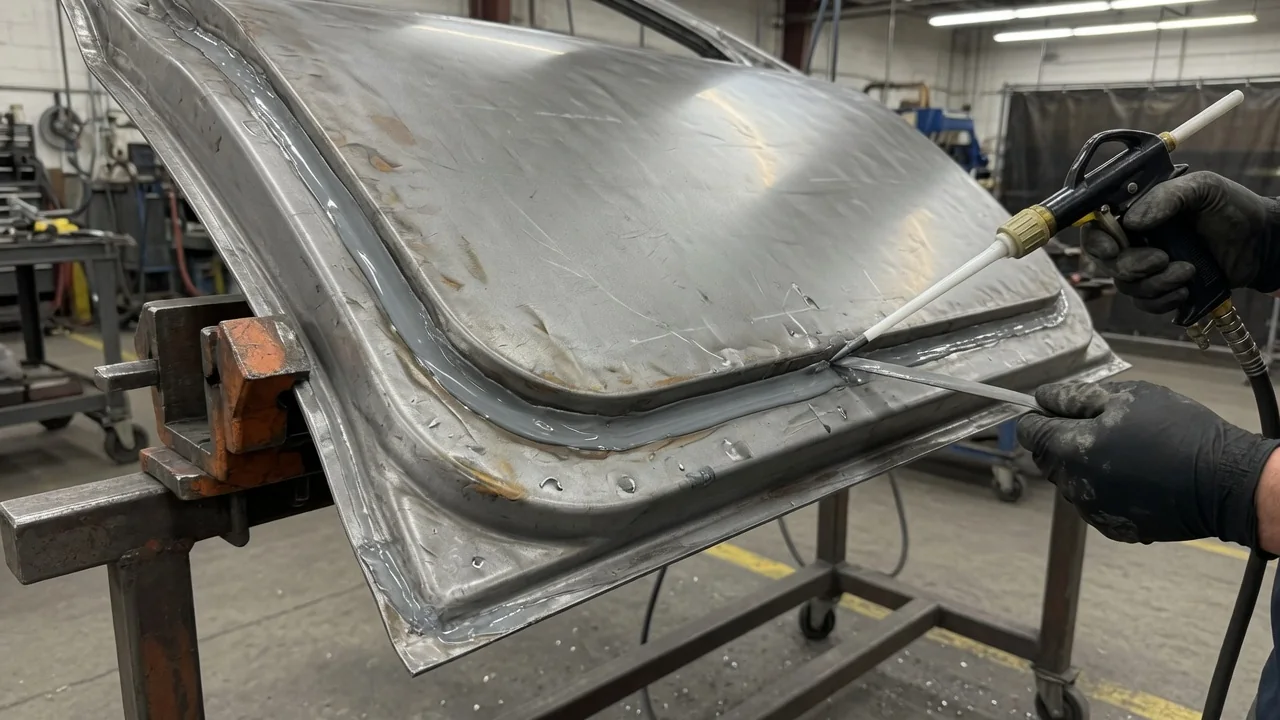
Doors, hoods, and trunk lids are usually built from an outer skin folded tightly over an inner frame. This joint is called a hem flange. Car makers commonly put adhesive inside the fold and run a bead of sealer along its edge. There are three practical reasons. The sealer keeps water out of a narrow metal crevice, slows corrosion where it tends to start, and gives the exposed edge a clean, consistent finish. This article explains each of these in general terms.
Water protection
A hemmed edge is made by bending the edge of the outer skin back over the inner panel and pressing it flat. The result is strong and compact, but it also creates a long, narrow seam where two metal surfaces sit very close together. Gaps like that draw in water by capillary action, the same effect that pulls liquid into a thin tube. Rain, car wash spray, and slush from the road all reach the lower and outer edges of doors, hoods, and liftgates. An open hem would wick that water along its entire length.
Car makers deal with this in two places. A hem adhesive or sealing compound is usually applied to the inner panel before the skin is folded, so the fold squeezes it into the joint and it fills much of the space between the layers. A separate bead of seam sealer, often called hem flange sealer, is then commonly run along the exposed edge of the fold to close the entry point. Together they aim to keep liquid from getting between the metal layers at all, rather than relying on it to drain out later. The panel's interior cavity still has drain openings for water that gets past window seals or other openings, but the hem itself is meant to stay dry.
Corrosion
Water trapped in a tight seam causes corrosion because it cannot evaporate quickly. Moisture between two layers of steel, especially moisture carrying road salt, sets up crevice corrosion: the confined space and limited oxygen speed up attack on the metal. Hems are also where protective coatings are hardest to apply evenly. Electrocoat primer and later paint layers cover open surfaces well, but they may not reach as thoroughly inside a closely pressed fold. The sheared edge of a stamped panel can also carry less coating than the flat surface around it.
Sealing the hem keeps water and dissolved salts away from those weaker areas. The adhesive inside the fold pushes out air and moisture. The outer bead covers the edge so it can be primed and painted as one continuous surface. This matters because corrosion that starts inside a hem is often invisible at first. By the time it shows as bubbling paint or rust stains along the bottom of a door or the edge of a hood, the metal inside the fold may have been deteriorating for some time. Where a vehicle uses different metals in or near a joint, a sealing layer can also limit the moisture that lets galvanic corrosion develop between them. How this is handled depends on the specific design.
Appearance
The edge of a hemmed panel is visible every time a door, hood, or tailgate is opened, so its finish affects how well built the vehicle looks. A bare fold can show small variations in the gap between layers, slight waviness from forming, or small ridges where the metal was pressed. A bead of sealer smooths that transition into a uniform line. It is typically applied before the body goes through paint, so it ends up in the body color and blends into the panel instead of looking like a separate part.
Sealing also protects appearance over the long term. Rust inside an unsealed hem tends to leak out as orange streaks or lift the paint along the edge, one of the more noticeable signs of age on a body panel. Keeping the seam closed helps the paint stay intact and the edge stay clean. The adhesive inside the fold helps too. It bonds the skin to the inner panel along the hem, which keeps the two layers tight together. That supports a consistent edge profile and can reduce the chance of the fold opening slightly over time.
Practical implications and limits
For owners, hem sealing is factory protection that can be checked but not easily improved on. Look along the bottom and rear edges of doors, the front edge of the hood, and the lower edge of a liftgate or trunk lid. Watch for cracked sealer, chipped paint at the fold, or small blisters. These are worth catching early, because damage at the edge lets moisture back into the seam. Also keep the drain openings at the bottom of doors and tailgates clear. A cavity that holds standing water keeps the inside of the hem constantly wet.
Sealers are not permanent. They can harden and crack with age, temperature swings, and the repeated flexing of a panel that is opened and closed many times. Stone chips, minor impacts, and careless use of scrapers or pressure washers near the edge can also break the seal. Once that happens, the original protection stops working as intended, and corrosion can begin even on a vehicle that was well protected when new. Some owners and shops spray cavity wax inside doors and panels as extra protection, but that adds to the factory seal rather than replacing it.
Repair work is where hem sealing is most often lost. Replacing a door skin, straightening a damaged edge, or refinishing a panel can disturb the adhesive and sealer. A repair that skips these steps may look correct at first but leave the seam exposed. The materials, bead locations, and application methods vary between manufacturers and even between panels on the same vehicle. The factory repair information for that vehicle is the right reference, not a general rule. A sealed hem reduces the risk of water entry, corrosion, and visible edge damage, but it does not guarantee that a panel will never rust.