Hydroforming of Automotive Parts
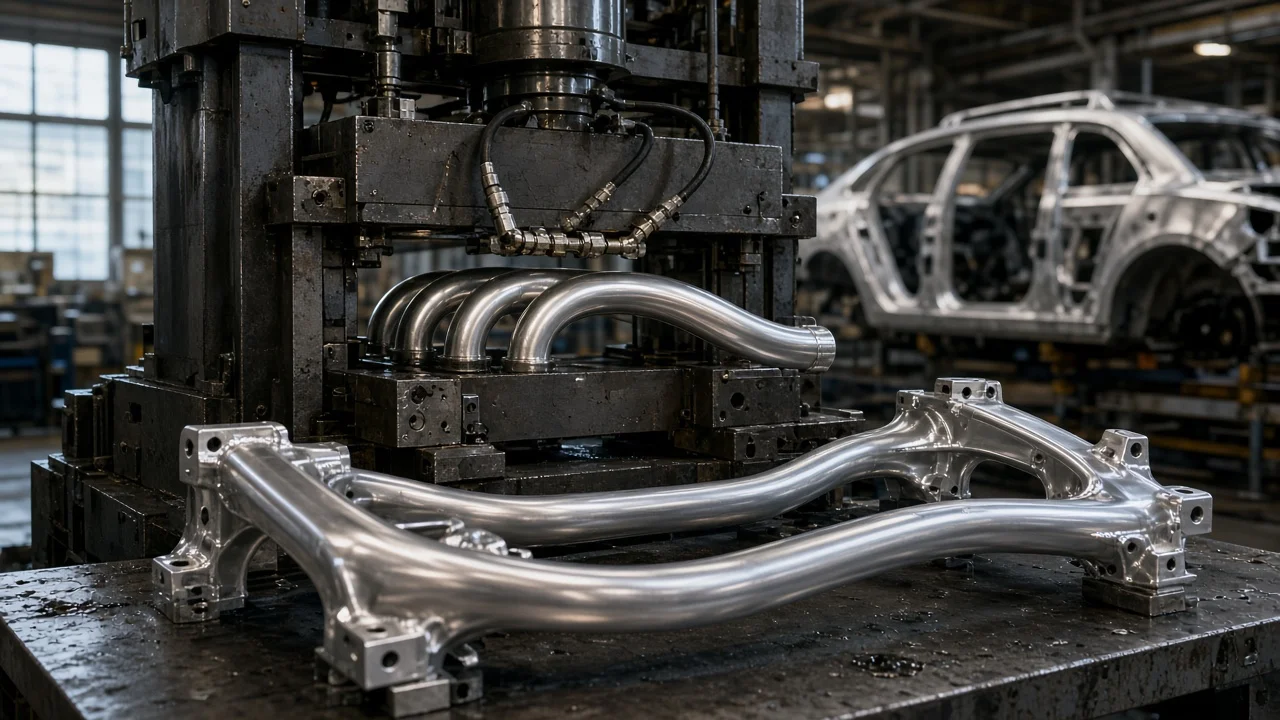
Hydroforming automotive parts uses high-pressure hydraulic fluid inside a tube or sheet blank to force metal into a die cavity. Unlike conventional stamping that pushes the outside with a solid punch, this process supports the inside so the metal stretches more evenly. The result is a hollow or shaped component with complex geometry, often lighter and stiffer than a welded assembly. Understanding fluid pressure, material strain, forming limits, and wall thickness helps explain why automakers choose this method for structural and exhaust applications.
Essential answer
Hydroforming is a manufacturing process for shaping metal automotive components using pressurized liquid inside a closed forming die. For tubular parts, fluid fills the interior and pushes outward while the die closes. For sheet blanks, fluid pressure can replace part of the solid tooling. This distinction matters because the fluid acts uniformly on the surface, reducing concentrated stress and allowing deeper or more complex part geometry than a rigid punch alone would permit.
The scope includes chassis cradles, roof rails, exhaust pipes, and other hollow or structural pieces. A key qualification is that the method works best where a component needs variable cross-sections, bends, or flanges without multiple stampings and welds. It is not a universal replacement for stamping. Thin panels with simple flat contours may still be cheaper to make conventionally. Hydroforming becomes more valuable when part geometry would otherwise require joining several smaller formed sections into one assembly.