What Is Hydroforming in Automotive Parts? Fluid Pressure, Tube Shapes, and Uses
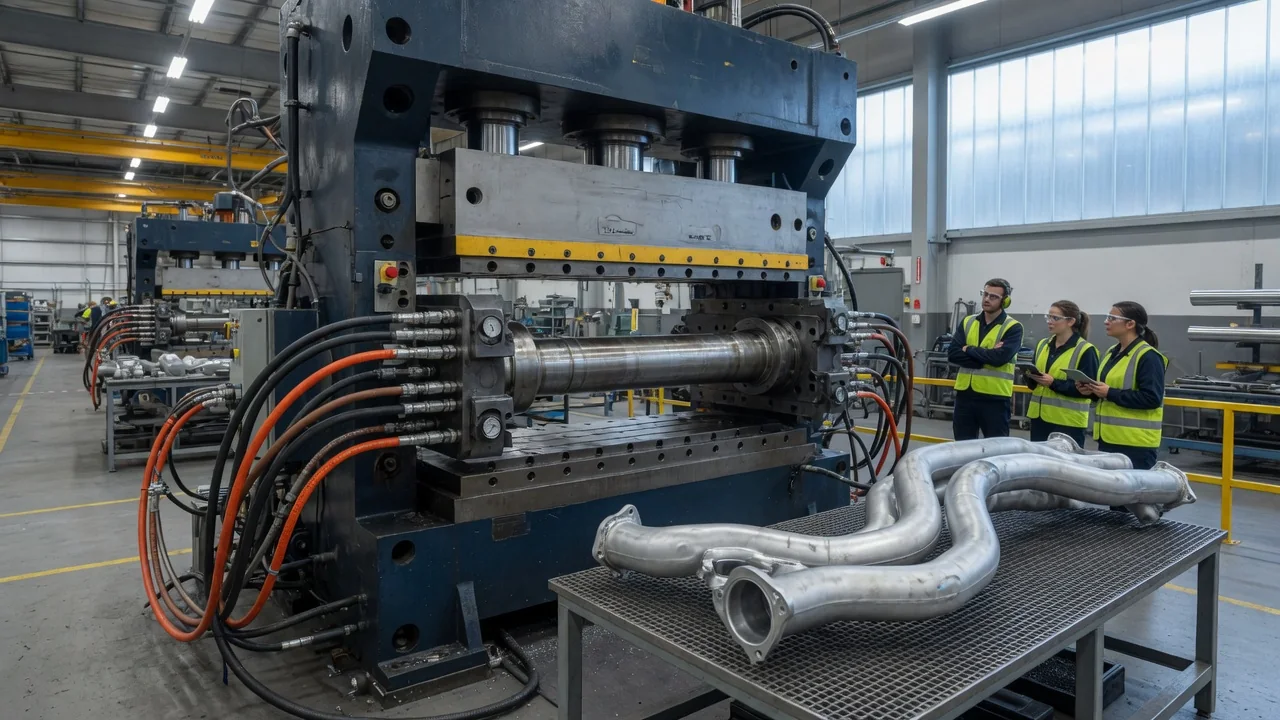
Hydroforming is a metal-forming process that uses pressurized fluid, rather than a solid punch alone, to push metal into the shape of a die. In automotive parts, it is most often applied to tubes, turning a simple length of steel or aluminum tubing into a complex, closed structural member. Understanding what hydroforming is helps explain why many modern frames, subframes, and roof structures look smooth and seamless, and why repair guidance for automotive hydroforming parts tends to be specific and conservative.
Fluid pressure: how hydroforming shapes metal
In tube hydroforming, a pre-cut tube is placed inside a two-piece die whose cavity matches the finished part. The die closes, and sealing punches press against both open ends of the tube. The tube is then filled with a fluid, typically water mixed with additives for lubrication and corrosion protection, and the internal pressure is raised to a very high level. Because fluid pressure acts evenly in every direction, the tube wall is pushed outward until it meets the die surface and takes on its shape. The die must be held shut by a large press, since the same pressure that expands the tube also tries to force the die halves apart.
Pressure alone would simply stretch and thin the wall until it split, so the end punches do more than seal. They push the tube ends inward while pressure rises, feeding extra material toward the areas that expand the most. Getting this balance right is the core skill of the process. Too much pressure too early can cause the wall to thin locally and burst; too much axial feed without enough pressure can cause wrinkling or buckling. Production processes therefore follow a controlled schedule of pressure and end feed, often finishing with a higher calibration pressure that forces the metal into tight corners and sets the final dimensions.
A related method, sheet hydroforming, applies fluid pressure to a flat blank, with the fluid acting as one half of the tooling. It has automotive uses as well, but tube hydroforming is the version most people mean when they talk about hydroformed vehicle structures.
Tube shapes: what hydroforming can produce
The starting tube is usually round and of uniform wall thickness. Before it reaches the hydroforming die, it is often bent on a tube bender to follow the general path of the finished part, and sometimes partially crushed in a preforming step so it fits inside the die cavity without being pinched when the die closes. Hydroforming then turns this rough preform into the final cross-section.
The key advantage is that the cross-section can change along the length of a single piece. One end of a part can stay nearly round while the middle becomes rectangular, and another area can widen, narrow, or take on an irregular polygon shape where a mounting point or clearance is needed. Bulges, flattened zones, and side branches such as T-shaped or Y-shaped outlets are also possible within limits. Holes can be pierced while the part is still pressurized inside the die, using the internal fluid as support so the wall does not collapse around the punch.
There are practical boundaries on these shapes. Each material can stretch only so far before it thins excessively, so the amount of expansion relative to the original tube is limited, and very sharp corners are hard to fill. Wall thickness ends up uneven, thinner where the metal expanded most. Common materials include mild and high-strength steels, stainless steel, and aluminum alloys, and each has different forming limits. Engineers design the part shape, the starting tube, and the process together rather than treating hydroforming as a way to make any geometry.
Applications in vehicle structures and systems
Hydroforming is used most often where a part needs to be a long, closed, stiff section with a complex path. Typical automotive hydroforming parts include frame rails and cross members on body-on-frame vehicles, engine cradles and front or rear subframes, roof rails and roof bows, pillar reinforcements, radiator support structures, and the cross-car beams that support the instrument panel. In the exhaust system, the process can form manifolds, branched pipes, and other tubular components. Some suspension arms, axle parts, and seat frames are also made this way. Whether a given vehicle uses hydroformed components depends on its design and manufacturer, so their presence in a particular model should be confirmed from that maker's technical information.
Manufacturers choose hydroforming for several reasons. A single hydroformed tube can replace an assembly of several stamped panels welded together, reducing the number of parts, welds, and flanges. A closed tubular section is generally stiffer for its weight than an open or spot-welded section of similar size, which helps with crash structure and overall body stiffness. Because the metal is shaped against one rigid die surface under uniform pressure, parts can be produced with consistent dimensions, which simplifies assembly. The process also work-hardens the metal as it stretches, which can add strength in the formed areas.
Practical implications and limits for owners and repairers
For vehicle owners, hydroforming is mostly invisible, but it matters after a collision or when corrosion appears. A hydroformed rail or subframe is one continuous closed section, often made from high-strength steel whose properties depend on how it was formed. Applying heat to straighten it, cutting it at arbitrary points, or welding in generic patch sections can change those properties and the way the part absorbs energy in a crash. For this reason, manufacturers frequently publish specific repair procedures for these parts, sometimes allowing sectioning only at defined locations and sometimes calling for replacement. The vehicle's official body repair information is the authority here, not general shop habit.
Closed sections also have trade-offs in service. Their interiors are hard to inspect, and moisture or debris that gets inside can cause corrosion that is not visible from outside until it is advanced. Drain holes and factory coatings are part of the design, so keeping them clear and undamaged helps. On the manufacturing side, hydroforming tooling and high-pressure equipment are expensive, and cycle times are usually longer than conventional stamping, which makes the method best suited to higher-volume parts where the savings in welding and assembly pay off.
Finally, hydroforming is a method, not a guarantee of quality or strength on its own. A hydroformed part is only as good as its design, material choice, and process control. It can enable lighter and stiffer structures, but conventional stampings, castings, and welded assemblies remain common and appropriate for many components.