Why Do Car Designers Test Different Wheel Designs?
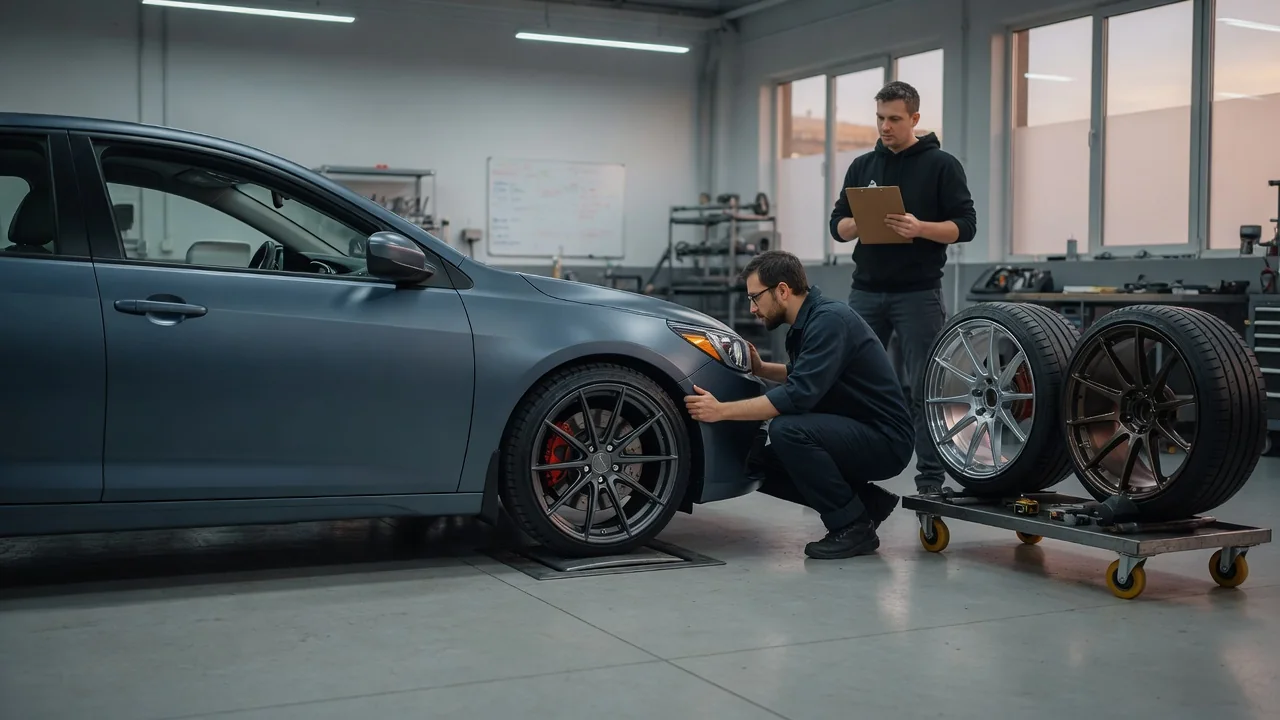
Wheels look like a pure styling detail, but they sit in one of the most turbulent zones of a moving car. Each wheel rotates, churns air, creates a wake, and either feeds or blocks airflow to the brakes behind it. That is why car designers test different wheel designs instead of picking one on looks alone. Wheel design aero tests generally weigh three linked concerns: spoke exposure, brake cooling, and styling.
Spoke exposure
A moving wheel does two things at once: it travels forward with the car and spins around its hub. Relative to the body, the upper part of the wheel moves forward into the oncoming air while the lower part moves backward toward the road. Open spokes behave a little like the blades of a fan in this situation. They scoop and churn air, pump it out of the wheel well, and push it sideways into the flow running along the body. That disturbed air adds turbulence, widens the wake behind each wheel, and raises aerodynamic drag. On many passenger cars, the wheels and wheel wells are a noticeable contributor to total drag.
Spoke exposure describes how much open area the wheel presents to the airflow and how the spokes are shaped. Designers compare options such as open multi-spoke patterns, flatter faces, partially filled designs, and covers or inserts that close off some of the gaps. They also look at details that are easy to miss: whether the outer face sits flush with the tire sidewall, whether the spokes are angled or twisted in a way that drives air inward or outward, and how deeply the wheel is recessed into the arch. In general, a flatter and more closed face lets air pass along the side of the car with less disruption, while deep, open spokes tend to churn more air.
These options have to be tested rather than simply assumed because the wheel never works alone. Its effect depends on the shape of the wheel arch, the front bumper, any air curtains or deflectors ahead of the tire, the tire profile, and ride height. A wheel that helps noticeably on one body can make little difference on another. Development teams therefore evaluate candidate designs with computer simulation and in wind tunnels, ideally with the wheels rotating, because a stationary wheel does not reproduce the airflow that a spinning one creates.
Brake cooling
Every stop turns the car's kinetic energy into heat at the brakes, and that heat has to go somewhere. Part of it is carried away by air moving around the rotor and caliper, and the wheel sits directly in that path. Openings between the spokes let hot air escape and allow cooler air to circulate, and the rotation of the wheel helps move that air. If heat cannot leave quickly enough, brake components and fluid get hotter, which can reduce braking consistency under repeated hard use and add thermal stress over time.
This creates a direct conflict with the drag goal. A closed wheel face that smooths airflow along the body can also restrict the airflow the brakes rely on. Designers test different wheel designs to find the balance a particular vehicle needs. A heavy vehicle, one expected to tow, or one intended for performance driving places more demand on its brakes than a light commuter car, so it generally needs more effective cooling paths. The placement and shape of openings can matter as well as their total area, which is another reason the result has to be measured rather than estimated.
Electrified vehicles add another variable. Regenerative braking lets the electric motor handle much of the routine slowing, so the friction brakes often work less in everyday driving. That can give designers more freedom to use closed, low-drag wheels. The friction brakes still have to manage emergency stops, long descents, and situations where regeneration is limited, such as when the battery is full or cold, so cooling cannot simply be ignored.
Styling
Wheels are among the most visible parts of a car's design. Their diameter, spoke count, finish, and depth strongly influence whether a vehicle looks planted, sporty, rugged, or elegant, and they often carry distinctive brand cues. Designers test several wheel designs against the body proportions to see which ones suit the stance and character of the vehicle. A wheel that looks striking in isolation can appear too busy, too small, or out of place once it is fitted under a particular wheel arch.
Styling decisions also have to coexist with airflow and cooling requirements. One common approach is to create the appearance of open spokes while keeping much of the surface closed, using contrasting finishes, dark inserts, or shallow sculpting that suggests depth. Size is another trade-off: larger wheels paired with lower-profile tires may give a sportier look, but wider tires increase frontal area and heavier wheels add unsprung mass, both of which can work against efficiency and ride comfort.
Because one model may offer several wheel options across trim levels, each choice can change how the car performs on the road, not only how it looks. Wheel and tire combinations can alter measured efficiency or electric range, so manufacturers commonly evaluate the offered designs individually. Practical details also enter the styling discussion, such as how visible brake dust will be, how easy the wheel is to clean, and how well the finish resists curb damage.
Practical implications and limits
For owners, the main takeaway is that a wheel change is not only cosmetic. Replacing factory wheels with a different design can shift aerodynamic drag, brake cooling, and efficiency, and the direction of the change depends on the specific design rather than on a simple rule. Because aerodynamic drag grows roughly with the square of speed, any difference tends to matter more at sustained highway speeds than in slow city traffic, where weight and rolling resistance play a larger role.
There are also clear limits to what can be concluded. A wheel's aerodynamic effect cannot be judged reliably by eye, and published results apply to the specific car, wheel, and tire combination that was evaluated. Tire width, sidewall shape, and even tread pattern influence the outcome, so the same wheel on a different tire may behave differently. Nor does a closed wheel automatically mean overheated brakes; whether cooling is adequate depends on the brake system, the vehicle, and how it is driven.
When considering different wheels, the owner's manual and the vehicle's tire placard are the reference points for approved wheel and tire sizes and load requirements. Clearance around the brake calipers matters, especially on vehicles with larger brakes. If a car came with snap-on aero covers or inserts, removing them may change its efficiency, while adding covers to a wheel not designed for them may affect brake airflow.