What Is a Light Guide in a Car Lamp? Function, Styling and Repair
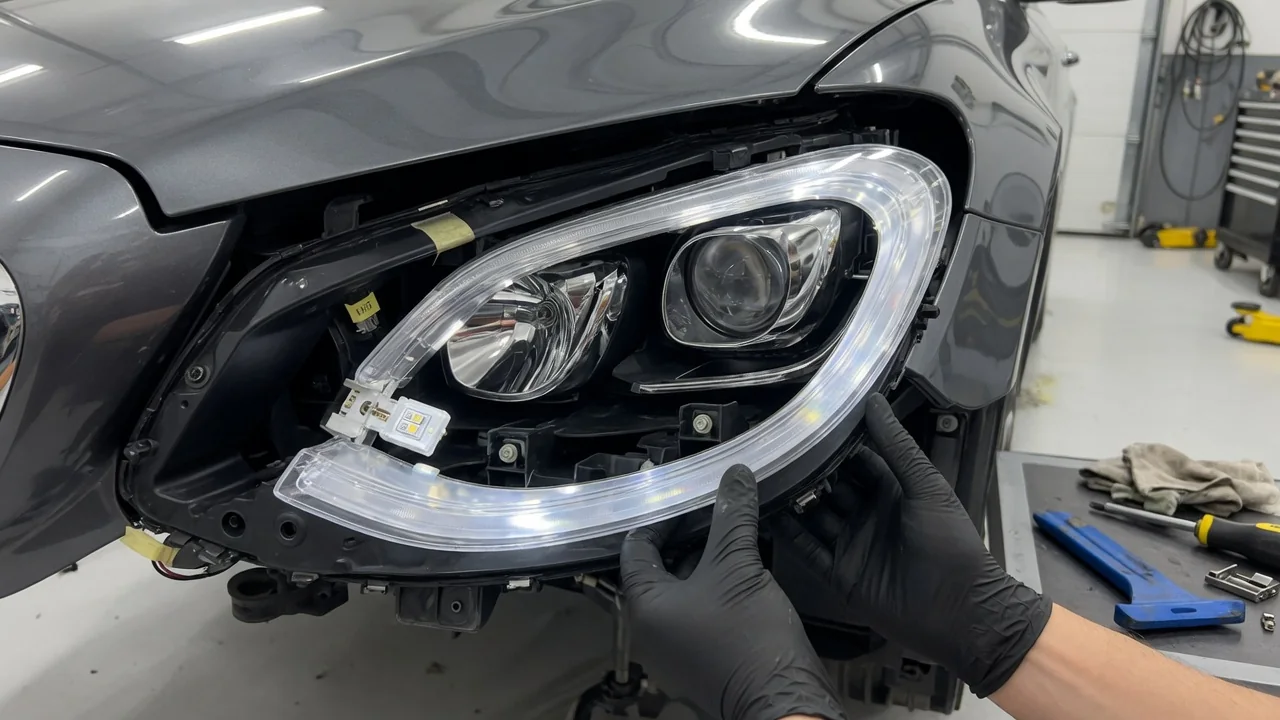
A light guide in a car lamp is a clear plastic optical part that carries light from one or more LEDs and releases it along a line, ring, or surface. Instead of showing a bright point source, the lamp glows as an even strip. Automotive light guides are common in daytime running lights, position lamps, turn signals, and taillights. This article explains how they distribute light, why designers use them, and what they mean for repair.
Light distribution in an automotive light guide
A light guide works on total internal reflection. Light from an LED enters one end or edge of a transparent component, usually made from an optical-grade plastic such as acrylic (PMMA) or polycarbonate. As long as the light strikes the inner surface at a shallow enough angle, it reflects back inside rather than escaping, so it travels along the guide much as light travels through an optical fiber. Bends are possible, but tight curves let more light leak out, which is one reason guide shapes are carefully engineered rather than freely drawn.
To make the guide glow where it should, designers add out-coupling features: small prisms, steps, notches, or textured patches molded into the back or side surface. When light hits one of these features, its angle changes enough to exit through the front face toward the viewer. Because light intensity drops as it travels away from the LED, the features are often spaced or sized differently along the length, sparser near the source and denser farther away, to keep brightness looking uniform. Some lamps add a diffuser film, frosted section, or reflective backing to smooth out remaining variation and recycle light that would otherwise be lost.
A light guide generally serves signal and marking functions rather than forming a road-illuminating beam. Low and high beams need precise cutoffs and controlled intensity, which are typically produced by reflectors, projector lenses, or dedicated LED optics. Signal lamps still have to meet the photometric and visibility requirements of the applicable regulations, so the guide, LEDs, and any supplementary optics are designed together as one system.
Styling and lighting signatures
Light guides let a manufacturer turn a handful of small LEDs into a continuous, recognizable graphic. Thin lines, rings, brackets, and floating shapes that would be hard to achieve with discrete bulbs become practical because the guide, not the light source, defines what the eye sees. This is why lighting signatures have become a major part of how vehicles are recognized at night and during the day, and why the same basic technology appears across many brands and price levels.
Shape and finish give designers further control. A guide can be curved in three dimensions to follow the body contour, split into segments that light in sequence for a sweeping turn signal, or textured so it looks clear when off and evenly lit when on. Color usually comes from the LED itself, from a tinted guide material, or from the outer lens. In some lamps a single guide serves two functions, such as a white daytime running light that changes to amber for the turn signal when dual-color LEDs are used. Similar principles are applied inside the cabin for ambient lighting strips.
Styling goals still have to coexist with engineering limits. Long, thin, or sharply curved guides lose more light, can show bright spots near the LEDs, and may need more power or extra sources to look even. Plastic optics also have to tolerate heat, ultraviolet exposure, and vibration over the vehicle's life, so materials and mounting are chosen as much for durability as for appearance.
Repair: common faults and options
In most modern lamps the light guide is sealed inside the housing together with the LEDs, circuit boards, and reflectors. The guide itself has no filament to burn out, so when a lit strip goes dark the cause is usually electrical: a failed LED, a damaged driver or control module, a corroded connector, a blown fuse, or a wiring fault. Partial dimming, a dark section, flickering, or a color shift can point to individual LEDs or the driver. Many vehicles also monitor lamp circuits and may display a warning or store a fault code, which makes a scan tool a useful starting point before removing anything.
The guide can also deteriorate physically. Moisture entering through a damaged seal or cracked lens can leave condensation or deposits on the optics, heat and age may yellow or haze the plastic, and impact or stress can cause cracks that create bright leaks or dark gaps. Contaminants on the guide surface interfere with total internal reflection, so even a fingerprint or a film of residue inside the housing can produce visible blotches.
Repair options depend on how the lamp was built. Some assemblies have replaceable LED modules or drivers that can be swapped without opening the housing, and the vehicle's service manual indicates which parts are serviceable. Others are bonded or welded shut, and only the complete lamp is supplied. Opening a sealed lamp by heating or cutting is possible in some cases, but it risks damaging the guide, breaking the seal, and creating future moisture problems, and any reassembled lamp must still work correctly and meet legal requirements. When in doubt, a replacement unit with the correct part number and connector is the more predictable route.
Practical implications and limits
For everyday ownership, the main implication is that a light guide changes how a lighting fault is handled. There is usually no bulb to swap at the roadside, so a dark daytime running light or tail strip may require a workshop visit, a module, or a full lamp assembly. Repair cost varies widely by vehicle and lamp design, and even minor body damage that cracks a lamp can lead to replacing the entire unit.
Owners should also be cautious with modifications. Tint films, smoked covers, or aftermarket lamps can disturb the even glow a guide is designed to produce, reduce output in directions that regulations care about, and in some places make the vehicle non-compliant. Brightness cannot simply be raised by fitting stronger LEDs, because the guide geometry, heat limits, and control electronics were matched to the original sources, and some systems flag a change in current draw as a fault.
Finally, it helps to know what is normal. Slight brightness variation at extreme viewing angles, or a modestly brighter area near an LED, can be part of the design rather than a defect. Behavior such as sequential operation, welcome animations, or automatic switching between functions is vehicle-specific and set by the manufacturer, so the owner's manual and service documentation remain the best references for how a particular lamp should look and operate.