How Does an LED Headlight Work?
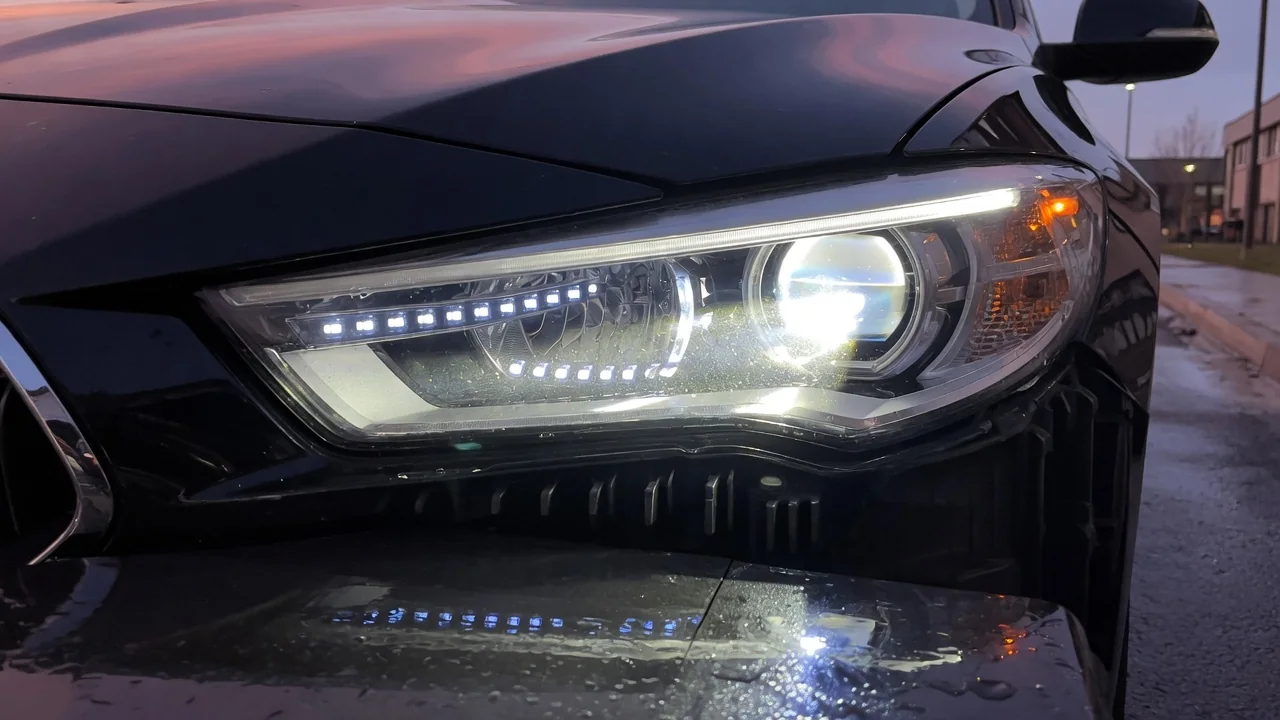
An LED headlight makes light without a glowing filament or an electric arc. Instead, it depends on three cooperating parts: a semiconductor chip that emits light, an electronic driver that feeds the chip a controlled current, and a thermal path that carries heat away. Together they form the LED automotive headlight basics that explain how an LED headlight works and why it behaves differently from a halogen lamp. The principles are general; exact designs vary by vehicle.
Semiconductor light
At the heart of every LED headlight is a light-emitting diode, a tiny chip built from layers of semiconductor material. One layer is treated so it carries extra electrons, while the neighboring layer is treated so it has a shortage of electrons, often described as holes. The boundary between them is called the p-n junction. When the driver applies voltage in the forward direction, electrons and holes are pushed into a thin active region and recombine. Each recombination releases a small packet of energy, and in materials chosen for lighting, much of that energy leaves as a photon. This process is called electroluminescence. The energy gap of the semiconductor, known as the band gap, sets the wavelength, which is why a bare LED chip naturally emits a fairly narrow band of color rather than white light.
White headlight output is usually produced in two steps. The chip itself, commonly based on gallium nitride, emits blue light. A phosphor layer on or near the chip absorbs part of that blue light and re-emits it at longer wavelengths, mostly in the yellow range. The blend of remaining blue and converted yellow light reaches the eye as white, and the phosphor formulation strongly influences whether the beam looks bluish or warmer. The conversion is not perfectly efficient, and energy that does not become visible light turns into heat inside the chip and phosphor.
An LED emitter is also physically different from a filament. Instead of glowing in nearly all directions from a coiled wire, it emits from a flat surface into roughly one hemisphere. Headlamp designers place one or more emitters at precise positions relative to reflectors, projector lenses or light guides, which shape the output into a low beam with a defined cutoff or a broader high beam. The optics and the light source are engineered as a matched set, and that relationship matters whenever a light source is changed.
Driver
An LED cannot simply be wired to the battery the way a halogen bulb can. Its brightness and heat depend on the current flowing through it, and above its forward voltage a small change in applied voltage can cause a large change in current. A vehicle's electrical supply is not steady: it shifts between battery-only operation and charging, sags during engine cranking, and can carry brief spikes when heavy loads switch off. Without regulation, the LED would flicker with those changes or be driven into damaging overcurrent. The driver solves this by converting the vehicle supply into a controlled, essentially constant current matched to the LED string.
Most automotive LED drivers are switching power converters that step the supply voltage up or down as the LED string requires. Around that core, drivers typically add filtering to limit electromagnetic interference that could disturb radio reception or other electronics, plus protection against reverse polarity, voltage transients and overheating. Drivers also manage brightness. One set of LEDs can serve more than one function, such as a daytime running light and a position light, by lowering the current or by switching it rapidly on and off, a technique called pulse-width modulation. In more complex headlamps, the driver may communicate with other vehicle modules, report faults or control individual LED segments for adaptive beam functions. The driver itself may sit inside the headlamp housing, in a separate nearby module or, for aftermarket bulbs, in the bulb base or an inline box.
Heat
LEDs convert electricity to visible light more efficiently than halogen filaments, but a significant share of the input power still becomes heat. The difference is where that heat goes. A halogen bulb runs extremely hot and sends much of its waste energy forward as infrared radiation along with the light. An LED emits very little infrared in its beam, so most of its waste heat stays concentrated in the small chip and must be conducted out through the back. Because the source area is tiny, the heat density at the junction is high even when total power is moderate.
Junction temperature directly affects performance. As the chip gets hotter, light output drops, color can shift, and the semiconductor and phosphor degrade faster, shortening useful life. To keep temperatures under control, the chip is mounted on a thermally conductive substrate and circuit board, often a metal-core board, joined to a heat sink through thermal interface material. Heat sinks are commonly aluminum and may use fins, the headlamp housing itself or a small fan to move heat into surrounding air. Many drivers also monitor temperature and reduce current when the lamp gets too hot, a protective behavior known as thermal derating.
Practical implications and limits
Because LEDs usually fade gradually rather than failing at once like a broken filament, a weak or uneven beam may reflect aging emitters, a struggling cooling system or a driver problem. Flicker, intermittent operation or one segment going dark more often points to the driver, wiring or connectors. In many factory LED headlamps the emitters, driver and heat sink are integrated into the assembly, so a repair may involve replacing a module or the complete headlamp rather than a bulb. The vehicle's service information is the reliable guide to what can be replaced separately.
Retrofit LED bulbs placed in housings designed for halogen filaments face several limits at once. The emitter position and shape rarely match the filament the reflector or projector was designed around, which can scatter light, blur the cutoff and increase glare for other drivers. Space behind the headlamp may restrict the heat sink or fan, raising chip temperature and triggering derating. Some vehicles monitor bulb current and can show warnings, flicker or fast turn-signal blinking when the much lower LED load is detected. Road-legal status depends on local regulations and how the lamp was approved, so a retrofit that physically fits is not automatically compliant.
Seasonal conditions matter too. Since little heat reaches the front lens, an LED headlamp may not melt snow or ice from its surface the way a hot halogen lamp often can, so clearing the lens in winter remains the owner's job unless the vehicle has a dedicated countermeasure. Keeping lenses clean, headlamps correctly aimed and any cooling vents or fans unobstructed helps the semiconductor, driver and thermal system work as intended.