Why Do LED Car Lights Need Heat Management?
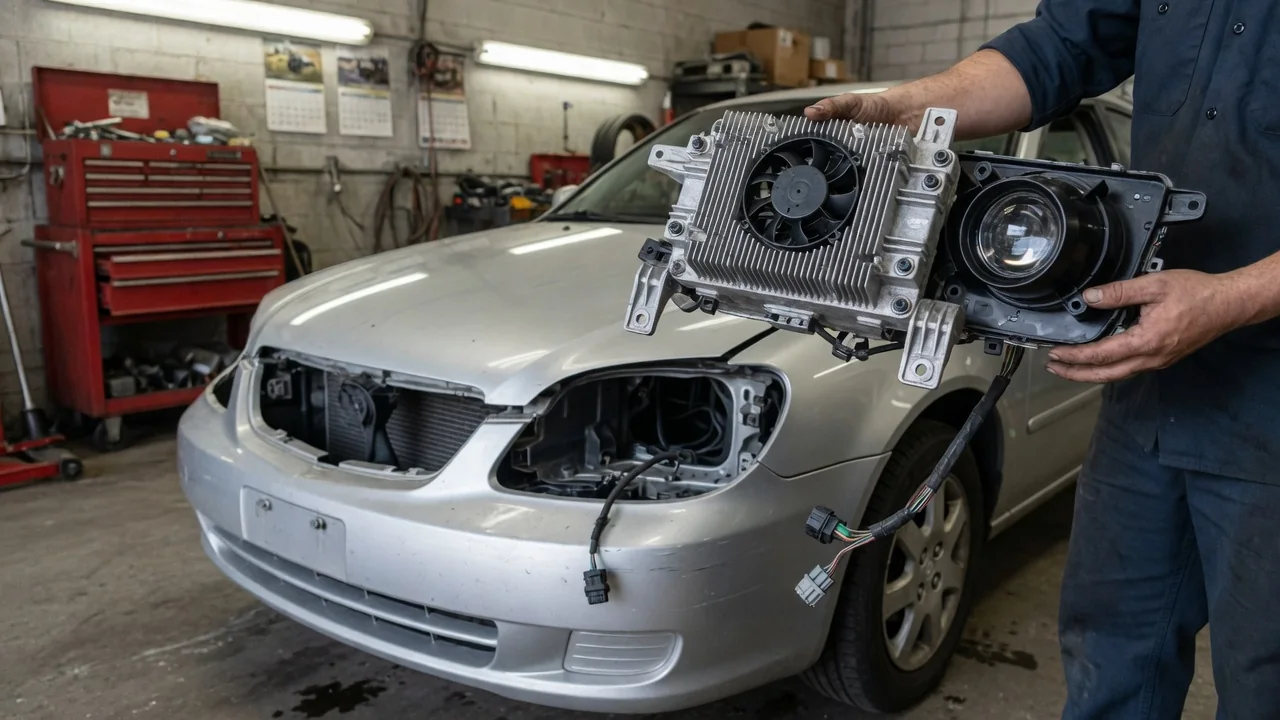
LED headlights and tail lamps feel cooler at the lens than halogen bulbs, yet they depend far more on thermal control. Understanding why LED car lights need heat management comes down to how a semiconductor makes light, where its waste heat goes, and what happens to brightness, color, and lifespan when that heat has nowhere to escape.
LED junction heat
An LED produces light at a tiny semiconductor junction inside the chip, and only part of the electrical energy fed to it leaves as light. The rest becomes heat concentrated in an area far smaller than a fingernail. A halogen filament throws most of its waste heat forward as infrared radiation, but an LED radiates very little heat in the beam. Instead, nearly all of it must travel backward by conduction through the chip, its solder joints, and the circuit board behind it.
When the junction runs hotter than intended, light output falls, the color can shift, and the phosphor coating and encapsulant age faster. Heat also stresses the driver electronics that regulate current, which often sit in the same sealed housing near a warm engine bay. Drivers may notice little at first because the decline is gradual. How close a given lamp operates to its limits depends on the chip, housing design, and placement, so behavior differs between vehicles and between factory and aftermarket assemblies.
Heat sinks
A heat sink gives junction heat a path and a surface to leave from. In most automotive lamps the LED is mounted on a metal-core circuit board bonded to a cast or extruded aluminum body, with a thermal interface material filling microscopic gaps between the parts. Fins increase the surface area exposed to air, so heat conducted away from the chip can be carried off by convection. Every layer in that chain adds thermal resistance, which is why mounting quality matters as much as fin size.
Designs vary widely. Many factory headlamps rely on passive finned castings hidden inside the housing, while some higher-output units add a small fan or use heat pipes to move heat to a cooler spot. Retrofit LED bulbs made to fit halogen sockets often carry a fan, braided copper straps, or a bulky finned base behind the reflector. Looking behind the lamp, you may see that hardware pressed against a dust cap or wiring, which restricts airflow and undermines the cooling the design assumed.
Repair
Thermal problems often show up as a lamp that dims after several minutes, flickers when hot, or shuts off and returns once cooled. Many drivers include thermal protection that deliberately reduces current, so these symptoms can be the system protecting itself rather than a dead LED. Some vehicles also log a lighting fault code or show a bulb warning. A code points to a circuit or module worth investigating, not to a confirmed failed part, and its meaning should be checked against information for that specific vehicle.
A sensible inspection looks at what stands between the heat and open air: a seized or noisy cooling fan, fins packed with dust, a missing or forced-on rear cover, moisture inside the housing, or a retrofit bulb seated poorly. Many factory LED assemblies are sealed, and the light source or its control module may be serviced only as a unit, while others allow separate replacement of a driver or fan. Because these circuits tie into vehicle electronics, diagnosis by a qualified technician is the safer route.
Everyday Use and Observations
In daily driving, conditions around the lamp change constantly. Highway speed pushes air through the engine bay, while slow traffic on a hot afternoon leaves the housing sitting in still, warm air next to the radiator and engine. Daytime running lights and low beams may be on for hours. A well-designed lamp tolerates all of this, but a marginal one may look slightly dimmer near the end of a long summer drive than it did in the first few minutes.
One side effect surprises drivers in winter. Because so little heat reaches the lens, snow and ice may not melt off an LED headlamp as they would on a halogen unit, and some vehicles add lens heaters or washers to compensate. Condensation can also linger longer inside a cool housing. Useful things to watch for are uneven brightness between left and right, a bluish or yellowed tint on one side, or a fan that hums after the lights are switched on.
Limits and Next Steps
Heat management cannot be judged reliably by touch or by appearance. A heat sink that feels hot may be doing its job, and a cool one may simply mean heat is trapped at the chip. Junction temperature is not something an owner can measure directly, and published lifespan claims assume the lamp is installed and cooled as designed. Swapping in a brighter retrofit bulb also raises the thermal load, and the original housing was not necessarily built to shed that extra heat.
If a lamp shows repeated dimming, flicker, or warnings, note when it happens, such as after long drives or in hot weather, and share that pattern with whoever inspects it. The owner's manual and manufacturer service information explain whether the assembly is serviceable and which parts are approved. When choosing replacements, favor units built for that housing, with clearance behind the lamp and intact covers and seals. Good thermal control is ultimately what keeps output steady, beam pattern consistent, and electronics alive over years of use.