Why Do LED Headlights Need Drivers?
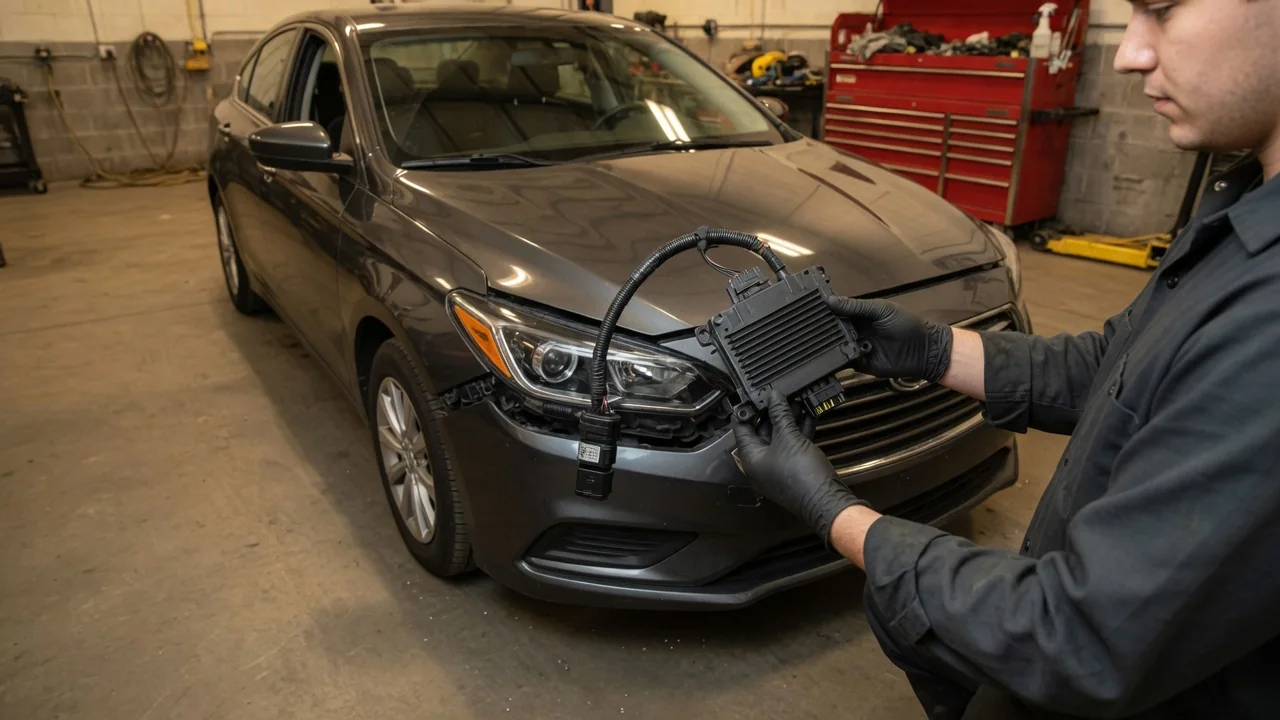
An LED headlight is more than a bright chip behind a lens. Between the vehicle's wiring and the light-emitting diodes sits an electronic driver, a small power-conversion circuit that sets how much current the LEDs receive at every moment. Without it, the LEDs would be connected to an electrical supply that is too unstable for them. This article explains why LED headlights need drivers by looking at three jobs an automotive LED driver circuit performs: regulating current, dimming, and handling faults.
Current Regulation: Why LEDs Cannot Run Straight From the Battery
An LED is a current-driven device. Its light output depends mainly on the current flowing through it, not on the voltage applied across it. The relationship between the two is steep: once the voltage passes the diode's forward voltage, a small increase in voltage can produce a large increase in current. Halogen bulbs behave very differently, because filament resistance rises as the filament heats, which naturally limits current. An LED has no built-in brake of that kind, so something outside it has to set the current.
The vehicle's electrical system makes that job harder. A nominal 12-volt system actually runs at different voltages depending on conditions: lower with the engine off, higher while the alternator is charging, and with brief dips during engine cranking. Short voltage spikes and transients can also appear when large loads switch on or off. Temperature adds another variable. As an LED warms up, its forward voltage tends to fall, which, without regulation, would let current rise and heat the chip further. That feedback loop can shorten LED life considerably.
The driver solves this by delivering a controlled, roughly constant current regardless of supply swings. Higher-power headlamp drivers generally use switching converters, which step voltage up or down efficiently to suit the number of LEDs connected in series, while simpler low-power circuits may rely on linear regulators or resistors. Many drivers also include protection against reverse polarity and voltage transients, filtering to limit electromagnetic interference, and thermal monitoring that reduces current if the assembly gets too hot.
Dimming: Controlling Brightness Without Damaging the LEDs
Because brightness follows current, the driver is also the natural place to control light output. Headlamps often need more than one brightness level. A single LED module may serve as a daytime running light at one output and as a position lamp at a lower output, and some designs share LEDs between functions within the same housing. The driver receives a command from the vehicle, either as a dedicated control signal or through which supply lines are energized, and adjusts the LED current accordingly.
Two general dimming methods are common. Pulse-width modulation, or PWM, switches the LED current fully on and off very rapidly and varies the proportion of on-time; the eye averages the pulses into a steady perceived brightness. Analog dimming, sometimes called constant-current reduction, lowers the current itself. PWM keeps the LED at a consistent current whenever it is on, which helps keep color stable, but the switching frequency must be high enough to avoid visible flicker or stroboscopic effects when the eye or a camera moves. Analog dimming avoids pulsing but can shift color slightly at low currents. Some drivers combine both approaches.
More advanced lighting systems, such as adaptive or matrix-style headlamps, extend this idea by controlling individual LEDs or segments separately so that parts of the beam can be dimmed or switched off. That level of control depends on dedicated driver electronics and communication with vehicle control modules, and its exact behavior varies by system and manufacturer.
Faults: How Drivers Fail and How They Report Problems
The driver is often a more likely failure point than the LEDs themselves. It contains components that are sensitive to heat, vibration, moisture, and electrical stress, and electrolytic capacitors in particular can degrade over time at elevated temperatures. Water entering through a damaged seal or connector can cause corrosion or short circuits. Typical symptoms of driver-related trouble include a headlamp that does not light at all, intermittent operation, flickering, or one lighting function working while another does not.
Drivers also take part in fault detection. Many automotive LED driver circuits can sense an open or shorted LED string and either report the condition or shut the output down to protect the remaining components. Depending on the vehicle, that information may be passed to a body or lighting control module, which can display a lamp-failure warning or store a diagnostic trouble code. Not every symptom points to the driver, however. A blown fuse, poor ground, damaged connector, or a problem in the controlling module can produce similar effects, so the circuit supplying the lamp needs attention as well.
Some apparent faults are actually protective behavior. If a driver detects excessive temperature, it may lower output to protect the LEDs, which can look like a weak headlight. Aftermarket LED replacement bulbs can also cause problems in vehicles designed for halogen bulbs: the vehicle may interpret the lower current draw as a burned-out bulb, or a pulsed supply from the vehicle may make the retrofit's own driver flicker.
Practical Implications and Limits
For owners, the main implication is that an LED headlamp is a system, not just a light source. On many vehicles the LEDs and driver are integrated into the headlamp assembly or a module attached to it, and repair may mean replacing that module or the whole assembly rather than a single bulb. Whether a driver can be replaced separately, and whether it needs coding afterward, depends on the specific design, so the vehicle's service information is the correct reference before ordering parts or opening a housing.
Diagnosis benefits from a scan tool when the vehicle supports lighting diagnostics, because stored codes can help separate a supply problem from an internal lamp fault. Basic checks of fuses, connectors, and grounds remain worthwhile, but probing driver outputs with an ordinary test light or improvised load can give misleading results, since a switching driver does not behave like a simple bulb circuit. Mismatched replacement parts can trigger warnings or prevent features such as adaptive beam functions from working.
There are also limits to what a driver can do. It can regulate current and protect the LEDs, but it cannot make up for poor heat dissipation, a damaged lens, or optics that were never designed for an LED source. Aftermarket retrofits vary widely in driver quality, and their beam control depends on how closely the LED placement matches the original reflector or projector. Local lighting regulations may also restrict which modifications are permitted for road use.