Why Can One Bad Module Affect Several Car Features?
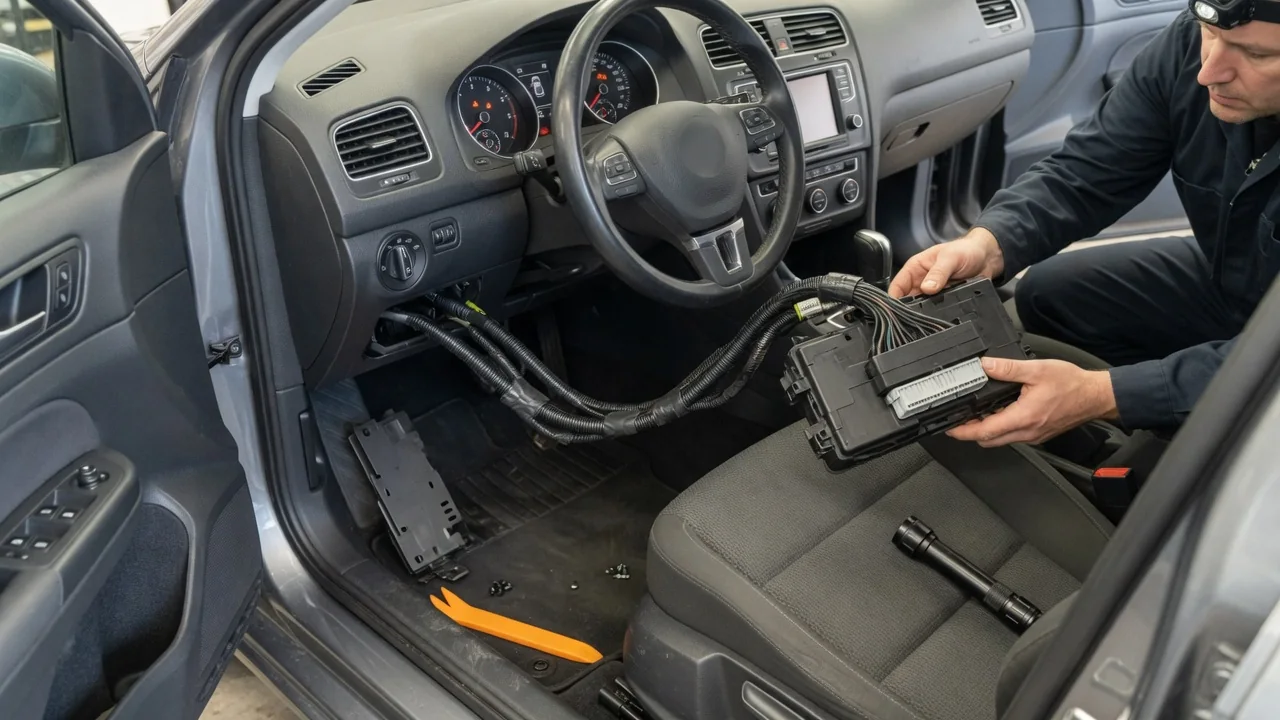
Modern cars spread their functions across many electronic control modules that talk to each other constantly. Because of that, a single failing module rarely fails alone. A fault in one unit can switch off gauges, disable driver aids, confuse other systems and trigger a cluster of warning lights at once. Understanding why one bad module can affect several car features helps owners make sense of confusing symptoms and avoid replacing parts that are actually working fine.
Shared communication between vehicle modules
Most modern vehicles use one or more in-vehicle data networks instead of a dedicated wire for every signal. The most widely used is the Controller Area Network, or CAN. It is often supplemented by slower networks such as LIN for simple devices and, in some designs, other protocols for infotainment or high-bandwidth data. Each module on a network shares the same wires with its neighbors. A module broadcasts messages, and any other module that needs that information listens for it. This saves wiring and weight, but it also makes the network a shared resource. When one participant misbehaves, every module connected to that segment can feel it.
Shared communication creates dependencies that are not obvious from the dashboard. A single reading is often measured by one module and used by several others. Wheel speed, for example, is commonly measured by the braking or stability control module and then shared with systems that may include the instrument cluster, transmission control, cruise control and driver assistance features. Exactly which modules use which signals varies by manufacturer and model, but the principle is the same: if the source module stops sending valid data, every feature that relies on that data may switch itself off or fall back to a limited mode.
Many vehicles also use a gateway module that links separate networks and passes selected messages between them. A gateway fault can cut off communication between entire groups of modules even though each group still works internally. Modules may also share power feeds, fuses, grounds and wiring routes. A failing module that draws excessive current, shorts its network wires or floods the bus with erroneous messages can disrupt other modules that have nothing wrong with them. In those cases the symptom pattern reflects the network layout more than the feature that seems most affected.
Symptoms of a vehicle module network failure
The most recognizable sign of a network-related problem is several unrelated-looking faults appearing at the same time. An owner might see multiple warning lights on the instrument cluster, gauges that drop to zero or freeze, a message saying stability control or driver assistance is unavailable, and perhaps an infotainment screen that restarts or loses some functions. Individually these look like separate failures. Together they often point to a shared cause.
Other common symptoms include features that work intermittently, especially right after startup, over bumps, or when temperature or humidity changes. Problems may appear only with certain accessories switched on, or they may clear after the car is shut off and restarted, then return later. Some vehicles enter a protective or limited mode, such as restricting transmission behavior or disabling convenience functions, when expected data stops arriving. A no-start condition can occasionally have a network cause on vehicles where starting depends on modules confirming each other, for example during an immobilizer authorization exchange.
Not every multi-symptom fault is a network fault, though. A weak battery, poor charging voltage or a bad main ground can produce very similar behavior, because many modules react badly to low or unstable supply voltage. That overlap is one reason the symptom list alone is not enough to identify the faulty part.
Diagnosis: finding the cause, not the casualties
Diagnosis usually starts with a full scan of all modules using a tool that can read more than engine codes. Network-related trouble codes in the standardized code system typically begin with the letter U and describe lost communication with a specific module or invalid data received from it. The pattern matters. If several modules all report lost communication with the same unit, that unit, its power supply or its wiring becomes the prime suspect. If many modules report problems with many different partners, the issue may lie in the shared network wiring, a gateway, or a module disrupting the whole bus.
A sound diagnostic process checks the basics before blaming electronics. Technicians commonly verify battery condition, charging voltage, and the power and ground circuits feeding the suspect module. They then check whether that module responds to the scan tool at all. On many networks, the wiring and termination can be tested with a multimeter or examined with an oscilloscope, and modules can sometimes be disconnected one at a time to see whether communication on the remaining network recovers. The correct test points, expected readings and connector locations come from the vehicle's service information, which should be followed rather than general assumptions.
Physical inspection also plays a role. Water intrusion, corroded connectors, chafed harnesses and aftermarket devices spliced into network wiring are frequent contributors to communication faults. Recent repairs, collision damage or a battery that was allowed to go completely flat can also be relevant clues. The goal is to separate the module that is actually causing the disruption from the modules that are simply reporting it.
Practical implications and limits
For owners, the key implication is that the most visible symptom is not necessarily the failed part. A dark speedometer or a disabled driver assistance feature may be a victim of missing data rather than a broken component in its own right. Replacing the module behind the loudest symptom can cost money without fixing anything, and a replacement module may also need programming, configuration or security setup before it works in a particular vehicle. Noting when symptoms appear, which warnings show up together and what changed recently gives a technician useful starting points.
There are also limits to what a general explanation can tell you. Network layouts, which modules share which data, and how each system reacts to missing information differ widely between manufacturers, models and model years. Some vehicles tolerate a lost module with only a warning, while others restrict operation more noticeably. Warnings involving braking or stability systems deserve prompt professional attention even when the car still seems to drive normally. Basic checks such as battery condition are reasonable for an owner, but pinpointing a network fault generally requires model-specific information and proper diagnostic equipment.