Why Are Vehicle Aero Results Tested on a Road?
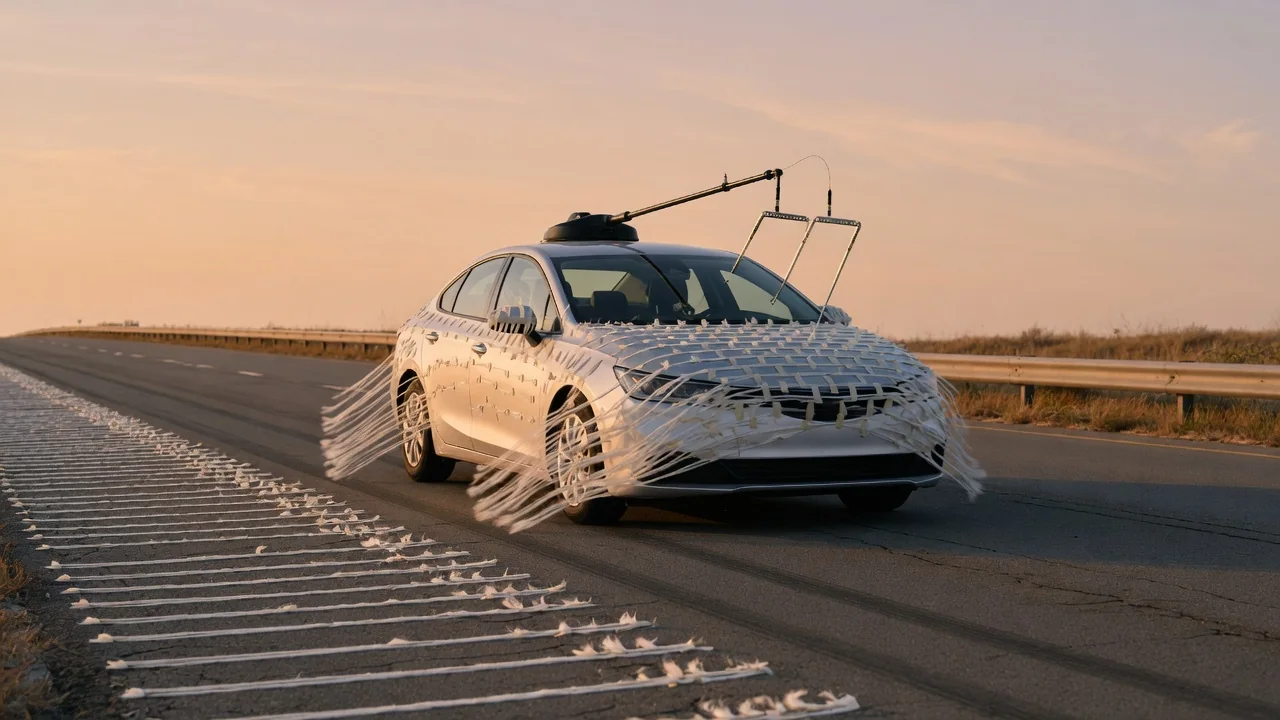
Wind tunnels and computer simulation give engineers controlled, repeatable aerodynamic data, but a car spends its life on real roads. On-road aerodynamic validation checks whether the drag, lift, and stability predicted during development still hold up against gusting wind, a moving road surface, changing ride height, and traffic. This article explains why vehicle aero results are tested on a road. It focuses on real wind, ride height, and how road data compares with tunnel results.
Real Wind: The Air a Car Actually Meets
In a wind tunnel, air usually arrives smooth, steady, and aligned with the vehicle's centerline. On a road, the car moves through the lowest layer of the atmosphere. There, wind speed rises with height above the ground and wind direction shifts from moment to moment. Terrain, buildings, trees, and other vehicles also make the flow turbulent. Even a light crosswind changes the effective yaw angle, which is the angle between the car's direction of travel and the oncoming airflow. As a result, the car rarely meets the air perfectly head-on.
Yaw matters because many vehicle shapes produce more drag and side force when air arrives at an angle. Some tunnels can rotate the car on a turntable to test a range of yaw angles. A fixed yaw setting is still not the same as gusts that build and fade within seconds. Unsteady flow can affect the wake behind the car, its sensitivity to crosswinds, wind noise around mirrors and pillars, and how often the driver has to correct the steering. Road testing exposes the vehicle to all of these effects at once. That helps engineers judge whether a design that looks efficient in straight-on airflow stays efficient and composed in ordinary driving.
Real wind also includes the disturbed air left behind by other vehicles. Following or passing a large truck, or driving next to a wall or barrier, changes the local flow around the car. These situations are difficult to reproduce in a controlled facility, which is one reason road evaluation stays part of development.
Ride Height: Why Vehicle Attitude Changes the Numbers
Underbody airflow is very sensitive to the gap between the car and the ground. A small change in ride height or pitch alters how much air passes beneath the vehicle, how fast it moves, and how it exits at the rear. Those changes in turn affect drag and the balance of front and rear lift. In a tunnel, the car is usually held at a fixed attitude, often at a static ride height chosen for the test.
On the road, ride height is never truly constant. Fuel level, passengers, cargo, braking, and acceleration all change how the body sits. At higher speeds, aerodynamic forces can compress or extend the suspension, so the car may sit differently in motion than it does when parked. Tire behavior at speed and uneven road surfaces add further variation. Aerodynamic balance depends on this attitude, so a measurement taken at one fixed height may not represent the full range a car actually experiences.
Road testing can use instrumentation such as ride height sensors to record how the body moves under real loads. Engineers then check whether aerodynamic behavior stays predictable across that whole range of positions.
Tunnel Comparison: Controlled Data Versus Real Conditions
Wind tunnels remain essential because they offer control. Air speed, temperature, and yaw can be set and repeated, so a change such as a different mirror shape or underbody panel can be compared directly against the baseline. Computational fluid dynamics adds detail about airflow that is hard to measure physically. Road testing does not replace either tool. It checks how well they represent reality.
Every tunnel involves compromises, and ground simulation is a major one. On the road, the ground moves relative to the car and the wheels rotate. In a tunnel with a fixed floor, a slow-moving layer of air builds up along the floor and can distort the flow under the car. Facilities address this with moving belts, suction systems that remove that slow layer, and rotating wheel setups, with differing degrees of accuracy. The size of the test section, the space the car occupies within it, the supports that hold the car, and the unusually smooth incoming air can also influence results. Engineers apply corrections for these effects. Comparing road data with tunnel data helps confirm whether those corrections are reasonable.
Road measurement has its own weaknesses. Weather varies, results scatter more, and separating aerodynamic drag from rolling resistance and drivetrain losses takes careful methods. One example is coastdown testing, where runs are made in opposite directions to average out wind and slope. Because of this scatter, road data is generally used to confirm overall totals and trends rather than to detect small design differences. The two approaches complement each other: the tunnel offers precision, and the road offers realism.
Practical Implications and Limits
For owners, the main takeaway is that a published aerodynamic figure describes a specific test condition. A drag coefficient is measured or calculated under defined circumstances, and everyday driving rarely matches them. Headwinds, roof racks, open windows, modified suspension, and heavy loads can all shift a car's real aerodynamic behavior. As a result, highway fuel economy or electric range can differ from what a single number suggests.
The same reasoning calls for caution with modifications. Changing ride height, adding a spoiler, removing underbody covers, or fitting wider wheels and tires can alter airflow in ways that are hard to predict without testing. A change that helps at one speed or wind angle may do nothing, or even hurt, at another. The actual result depends on the individual vehicle's design, so general principles show the likely direction of an effect, not its size.
Road validation also has limits of its own. It confirms behavior only under the conditions that were tested, not under every combination of weather, load, and traffic. That is why aerodynamic development combines simulation, tunnel work, and road evaluation, with each method covering gaps the others leave.