What Is a Wind Tunnel Test for a Car? How Engineers Measure Airflow
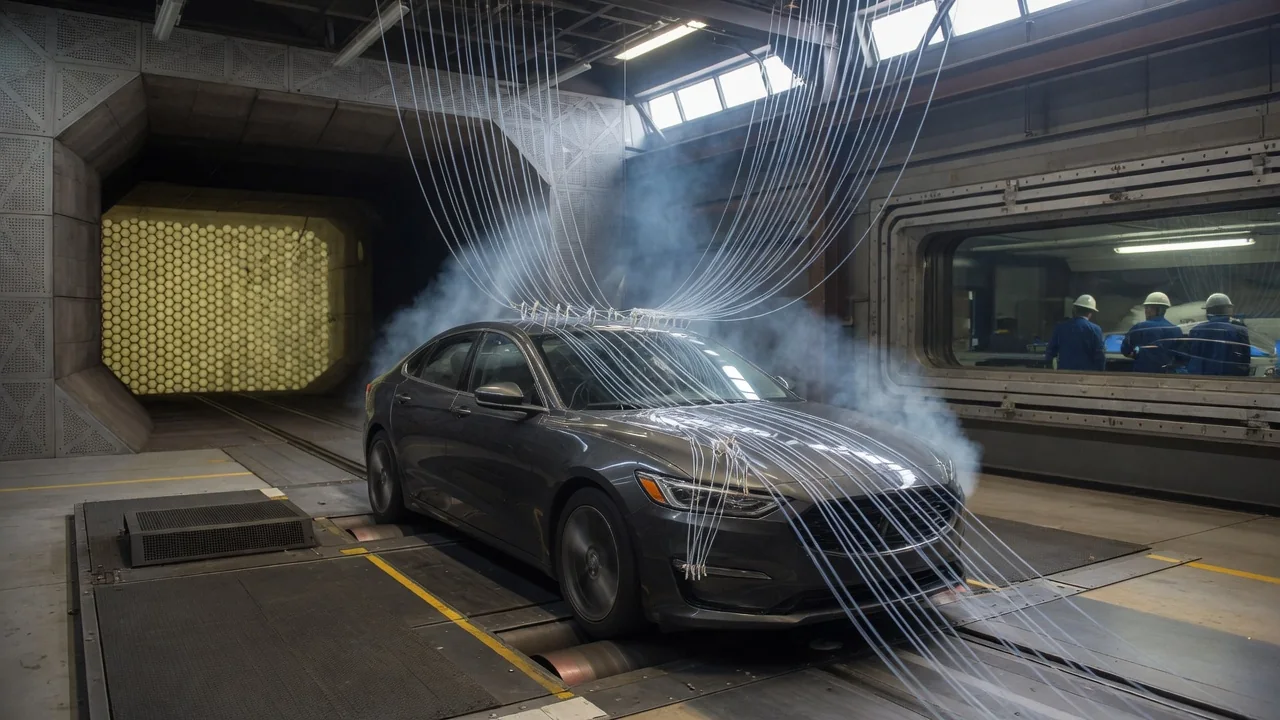
A wind tunnel test for a car is a controlled experiment in which air is blown over a vehicle or a scale model while instruments record how the air flows and what forces it creates. Engineers use car wind tunnel testing to understand drag, lift, stability and cooling airflow during development. This guide explains how the airflow is simulated, how forces are measured, and how the results shape design changes.
Airflow Simulation: Recreating the Road Indoors
The basic principle is relative motion. On the road, a car moves through still air; in a tunnel, the car stays stationary and the air moves past it. Aerodynamically, the two situations are largely equivalent, as long as the airflow approaching the car is smooth, uniform and moving at a controlled speed. To achieve that, a tunnel typically uses a large fan to drive the air, a settling chamber with screens and honeycomb sections to straighten it, and a contraction that accelerates the flow before it reaches the test section where the vehicle sits. Many automotive tunnels recirculate the air in a closed loop, while others draw fresh air through an open circuit.
The ground is the hardest part to simulate. On a real road, the pavement moves relative to the car at the same speed as the air, and the wheels rotate. A fixed tunnel floor builds up a slow-moving layer of air that does not exist in real driving and can distort underbody results. Advanced facilities address this with moving belts under the car, rotating wheel drives, and suction or blowing systems that remove that layer ahead of the vehicle. Tunnels without these features still produce useful comparisons, but flow under the car and around the wheels is represented less faithfully.
Engineers also make the airflow visible. Smoke wands reveal where flow separates from the body, wool tufts taped to panels show whether air is attached or turbulent, and oil or paint mixtures applied to surfaces leave streak patterns after a run. Pressure taps and probes measure how pressure varies across the body and in the wake. Testing may use full-size vehicles, clay models or reduced-scale models; smaller models are cheaper to modify, but matching full-size behavior requires care because airflow does not always scale perfectly. Some facilities add climate control for cooling tests or low-noise construction for measuring wind noise.
Force Measurements: Turning Airflow Into Numbers
The central instrument in most car wind tunnels is the balance, a measuring system mounted beneath the test section floor that the vehicle rests on or is attached to. It records the forces and moments the moving air applies to the car, usually in six components: drag along the direction of travel, lift or downforce vertically, side force laterally, and the pitching, yawing and rolling moments about the car's axes. Lift is often split into front and rear values, because the balance between the two axles affects how stable a car feels at speed.
Raw forces depend on air speed and vehicle size, so engineers convert them into dimensionless coefficients. The best-known is the drag coefficient, often written Cd, which relates measured drag to the dynamic pressure of the airflow and the car's frontal area. Multiplying the coefficient by frontal area gives a drag area figure, which is more directly tied to the total aerodynamic resistance a vehicle experiences. Lift and side force coefficients are calculated in a similar way. Because aerodynamic force rises roughly with the square of speed, coefficients let results from different test speeds be compared on a common basis.
Tests are not limited to air coming straight from the front. The vehicle can be rotated on a turntable to set a yaw angle, simulating crosswinds, and forces are measured across a range of angles. Data also needs correction: the tunnel walls restrict the flow around a large vehicle, an effect called blockage, and facilities apply established correction methods to account for it. Repeat runs check that differences between configurations are larger than normal measurement scatter, so small changes are not mistaken for real improvements.
Design Changes: How Test Results Shape a Car
Wind tunnel work is usually iterative. Engineers run a baseline configuration, change one detail, and run again to see how the coefficients move. Early in development this often happens on clay or modular models, where surfaces can be reshaped, taped or fitted with temporary add-on parts between runs. Typical areas of attention include the front bumper and air intakes, the angle and edges of the rear window and trunk, side mirror housings, wheel and wheel-arch geometry, and underbody panels that smooth the flow beneath the car. Small details such as a sharper trailing edge or a sealed gap can affect where the airflow separates and how large the wake becomes.
Every change involves trade-offs. Openings that bring air to the radiator, brakes and engine add drag, so designers balance cooling demand against resistance, sometimes with adjustable grille shutters that close when less cooling is needed. A spoiler that reduces rear lift may slightly increase drag. A shape that lowers drag might raise wind noise, change how dirt and water collect on windows, or conflict with styling, packaging, visibility and safety requirements. The tunnel helps quantify these compromises so the final design reflects a deliberate balance rather than guesswork.
Computational fluid dynamics, or CFD, now works alongside physical testing. Computer simulations can screen many shape options before parts are built and can show flow details that are difficult to measure directly. Wind tunnel testing then confirms the most promising options on physical hardware and helps validate the simulation methods. Development programs use different mixes of the two approaches, so the role of the tunnel varies from one project to another.
Practical Implications and Limits
For drivers, the most tangible effect of aerodynamic development is energy use at highway speeds. Aerodynamic drag matters little in slow city traffic but becomes a large share of the resistance a car must overcome as speed increases, which is why fuel consumption or electric range is typically affected most on fast highway trips. Lift balance and crosswind behavior influence how settled a vehicle feels on exposed roads. The tested shape is the car as delivered; roof racks, cargo boxes, open windows, aftermarket body parts and modified ride height all change the airflow, and their effect on a specific vehicle is unknown unless it has been measured.
Wind tunnel results also have limits. A tunnel provides steady, clean airflow, while real roads bring turbulence from other vehicles, gusting wind, rain, temperature changes and uneven surfaces. Facilities differ in ground simulation, size and correction methods, so published drag coefficients from different sources may not be directly comparable, and a coefficient alone ignores frontal area. Engineers therefore treat tunnel numbers as one piece of evidence, combined with simulations and on-road measurements, rather than a complete prediction of how a car will behave in every condition.