Why Do Side Mirrors Matter in Aero Testing?
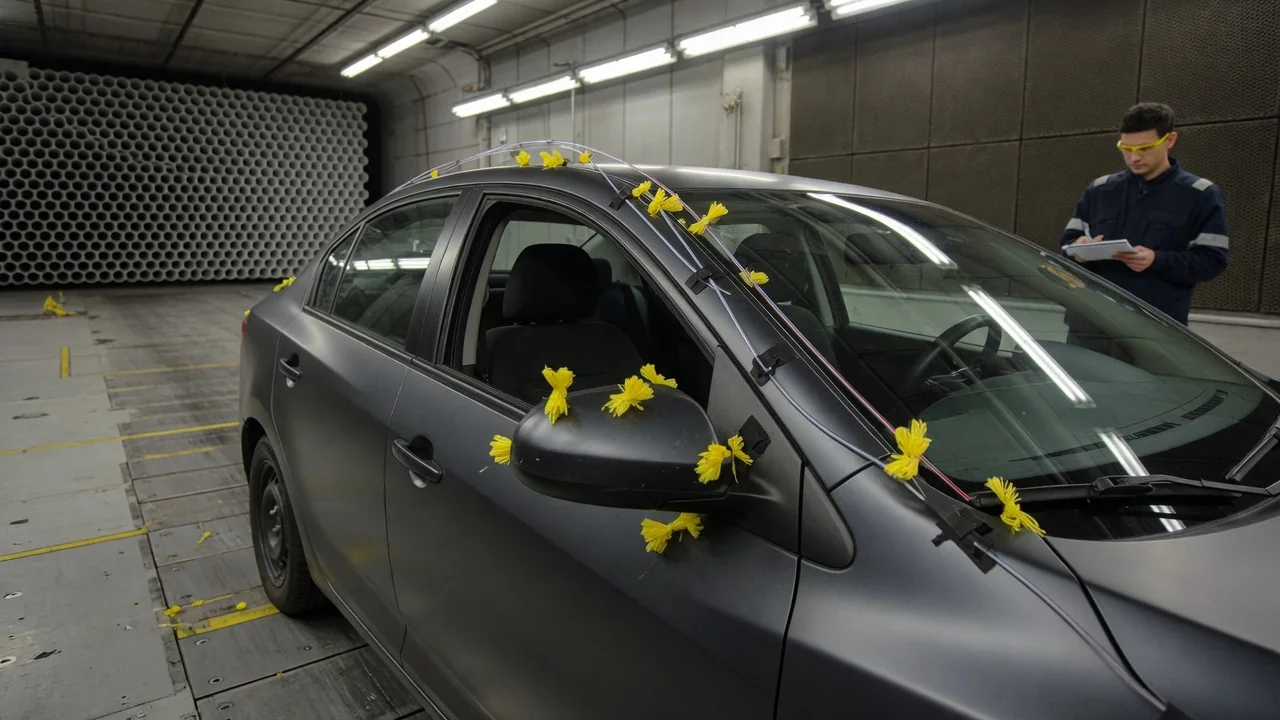
Side mirrors look like small add-ons, but they get a lot of attention in aero testing for their size. A mirror housing sits in fast-moving air near the front of the cabin. There it disturbs the flow along the side of the car, adds drag, and makes sound right next to the driver's ear. Understanding why engineers focus on this one part explains a lot about how side mirror aerodynamic testing works. It also shows why camera-based replacements keep coming up.
Turbulence
A side mirror is what aerodynamicists call a bluff body. Its housing is rounded at the front, but the glass faces backward and the trailing edge ends abruptly. Air speeds up as it wraps around the housing. It cannot follow that sharp rear edge, so it separates and leaves a wake of swirling, low-pressure air behind the glass. The pressure difference between the front of the housing and that wake is pressure drag. The arm that attaches the mirror to the door adds its own disturbance, especially where it meets the side glass and A-pillar.
The wake does not stay where it forms. It travels rearward along the side windows and mixes with the vortex that rolls off the A-pillar. It can also change how air flows along the doors toward the rear of the car. Because of these interactions, a mirror's effect on total drag is not just the drag it would produce on its own. It depends on the body around it. The same turbulence also carries rainwater and road grime onto the side glass. So engineers watch where the wake deposits water as well as how much force it creates.
That is why side mirror aerodynamic testing is done on the complete vehicle. In a wind tunnel, a force balance can compare runs with different mirror shapes, or with the mirrors removed as a reference. Smoke, tufts or surface paint show where the flow separates. Computational fluid dynamics lets engineers study the wake in detail before parts exist. Testing also looks at unsteady behavior. If the wake sheds vortices in a regular rhythm, the housing can vibrate and blur the reflected image. That matters as much to the driver as a drag figure.
Wind noise
Wind noise is often the bigger reason mirrors get attention. The mirror sits a short distance from the driver's ear, and the turbulent flow it creates washes directly over the front side window. Pressure changes in that flow push on the glass, and the glass passes them into the cabin as sound. The noise can come from several places at once. It may start at separated flow off the housing edges, where the mirror wake meets the A-pillar vortex, or at small gaps around the mirror base. Edges and cavities can also produce a narrow, tonal whistle.
Engineers usually split wind noise into two kinds. Broadband noise is the steady rushing sound that grows with speed. Tonal noise is a whistle or hum at one particular pitch, which people tend to find more irritating. Aeroacoustic wind tunnels are built to be quiet enough to measure these effects. Microphones inside the cabin record what occupants hear, and microphone arrays outside the car pinpoint where the sound starts. The fixes are often small-looking: a revised edge radius, a better seal at the mirror base, a change in how the housing meets the door, or a different mount position.
Mirror design is a compromise, not a pure aerodynamic exercise. The glass must give the rearward view that regulations and drivers require. The housing also often holds turn signals, heaters, folding motors, blind-spot indicators and cameras for surround-view systems. Each feature sets a minimum size and shape. A housing with the lowest drag is not automatically the quietest one. So development usually balances drag, noise, visibility, water management and packaging rather than chasing any single target.
Camera alternatives
Camera monitor systems replace mirror glass with a compact camera on a slim arm and show the image on displays inside the cabin. From an aerodynamic point of view, the appeal is clear. A smaller pod has less frontal area and creates a smaller wake. That can reduce drag and change the noise made near the side window. Some production vehicles use these systems in markets whose rules allow them. Other markets still require conventional mirrors, so availability depends on regional regulations as much as on engineering.
A camera pod is not automatically an aerodynamic win, and it brings its own things to test. It still disturbs the flow, and a thin arm or small housing can make tonal noise of its own. The lens must stay clear in rain, spray and dirt. Engineers study where water and grime travel around the pod, much as they do for mirror glass. They may add heating or reshape the pod to keep the view clean. Testing therefore covers dirt buildup and visibility, not just forces and sound levels.
There are human factors as well. Drivers need time to get used to judging distance on a screen instead of in a mirror. Where the display sits affects how naturally the eyes move to check behind. The image must also stay usable in glare and at night. For aero development, the result is that the rear-view system becomes a design choice in its own right. Teams may evaluate both a conventional mirror and a camera version of the same vehicle when different markets or trim levels call for each.
Practical implications and limits
For owners, the main takeaway is that anything added to or changed on a mirror alters the flow engineers tuned. Mirror covers, clip-on extensions, towing mirrors and accessories mounted on the housing can raise wind noise and drag. Aerodynamic drag grows roughly with the square of speed, so these effects are most noticeable on the highway. A new whistle after a mirror replacement, body repair or door adjustment often points to a misaligned housing or a damaged seal at the mirror base. It is worth having that checked.
There are clear limits to what general explanations can tell you. How much of a car's total drag comes from its mirrors depends on the vehicle's shape, size and mirror design. It cannot be turned into a fuel economy or range figure without data for that specific vehicle. Any figure a manufacturer publishes applies only to the configuration it tested. Removing mirrors is not a sensible way to save fuel. They are a safety device, and road rules in most places require adequate rear vision. Camera systems, too, should be judged on visibility and reliability in daily use, not only on aerodynamics.