Why Do Engineers Seal Body Gaps During Aero Development?
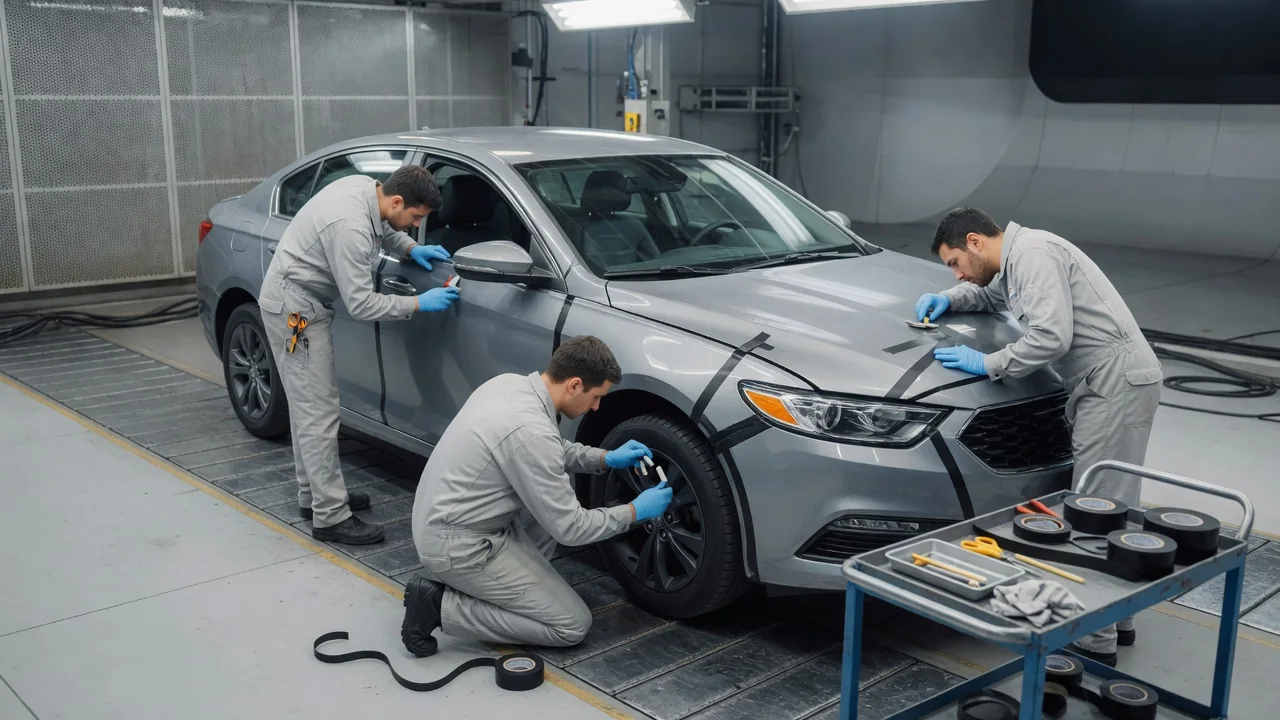
In many automotive wind tunnel sessions, the prototype is covered in strips of tape along the hood, doors, lamps and grille. It looks crude, but sealing body gaps is a deliberate method. It shows engineers how much drag, lift, noise and cooling behavior comes from air leaking through openings rather than from the main body shape. They can then decide which gaps deserve a fix on the production car.
Leak paths: where air escapes around the body
A moving car creates different pressures around its surface. Pressure is generally higher where the flow slows against the front of the vehicle and lower where air speeds up along the sides, over the roof and behind the body. Any gap that connects two regions of different pressure becomes a small channel, and air is pushed through it. Shut lines around the hood, fenders, headlamps, bumper joints and grille are common examples. Air that leaks through them can enter the engine bay, wheel arches or hidden body cavities and come out somewhere else, often as a small jet. That jet can disturb the smooth flow over the outer surface and add drag the body shape alone would not create.
Cooling airflow is one of the most important leak paths. Air that enters the front openings is supposed to pass through the radiator and other heat exchangers. If there are gaps around those components, some of that air bypasses them. It still loses momentum, which shows up as drag, but it does little cooling. Sealing the area around the heat exchangers during testing shows how much air goes around them instead of through them. Leakage into the engine bay or underbody can also change pressure under the car and therefore affect lift.
Other leak paths matter more for refinement than for drag. Door, window and tailgate gaps can let air move between the outside flow and the cabin seals, producing wind noise, whistles or pressure fluctuations. Open cavities and joints in under-panels or around wheel arches can create their own disturbances. How much each path matters depends heavily on the specific vehicle's shape, openings and internal layout, which is why it has to be investigated rather than assumed.
Measurement: how taping turns gaps into data
In car body gaps airflow testing, the basic tool is comparison. Engineers often measure a reference configuration with the relevant gaps taped closed, then remove tape from one area at a time and measure again. The difference between runs is attributed to that area. Gaps can interact, so the order of removal and combinations of opened gaps may also be tested. A wind tunnel force balance records drag and lift, but the change from one small gap can be close to what the measurement can reliably detect. Repeat runs, careful control of tunnel conditions and consistent vehicle setup are therefore part of the method, so a real effect is not confused with scatter.
Force data is usually combined with other evidence. Surface pressure measurements show where leakage changes the pressure distribution. Flow visualization techniques such as smoke, tufts or surface oil help reveal jets and separated regions near gaps. Probes or flow measurements near the heat exchangers indicate how much cooling air passes through them. In aeroacoustic facilities, microphones measure the noise gaps produce. Taping also matters for computer simulation: early CFD models often use idealized, sealed surfaces, so a taped physical vehicle gives a closer comparison. Gaps can then be modeled explicitly once their importance is known. The tape itself must be applied smoothly, because thick or lifting edges can create their own small aerodynamic effect.
Production fit: from tape to real parts
A production car cannot be taped shut. Gaps exist for practical reasons. Panels must open and close. Parts expand and contract with temperature. Assembly needs clearances. Service access must be possible. Water has to drain. Manufacturing tolerances also stack up, so the actual gap on a finished car varies within an allowed range. Engineers use the taped tests to rank which leaks are worth addressing. Where the measured benefit is meaningful, the fix may be a rubber seal, a foam block, a closeout panel, a deflector, ducting around the radiator, or a tighter gap target in the body design.
Each fix has trade-offs. Seals and extra parts add cost, weight and assembly steps. Rubber and foam age and compress over time, so a seal has to keep working through the vehicle's life. Closing one path must not trap water, block cabin ventilation outlets or cut off airflow that brakes or other components need. Some openings are intentionally left or designed as vents for exactly those reasons. The final production configuration is a balance between aerodynamic gain and these requirements. Its performance is confirmed on production-representative vehicles whose gaps match what customers will actually receive.
Practical implications and limits for owners
For owners, the main lesson is that the seals, foam pieces, under-panels and air-guide parts around the radiator and bumper are functional, not just trim. They are easy to leave out after collision repair, bumper removal or cooling system work. If they are missing, the possible consequences include more wind noise, changed cooling airflow and, in some cases, a small change in efficiency. Panel misalignment after a repair can have similar effects. The sensible step is to reinstall the original parts and restore correct panel fit. The repair manual for the specific model shows which pieces belong where.
Taping gaps on your own car is not a reliable upgrade. Development tests run under controlled conditions with instruments that can detect small changes. On the road, an owner usually cannot measure the effect, and on a given vehicle it may be negligible. Tape can also block drainage paths, ventilation outlets or cooling flow, hold moisture against the paint and leave residue or damage when removed. A single gap is typically a small contributor compared with the overall body shape, wheels, underbody and cooling system. Results found on one vehicle should not be assumed to apply to another.