What Is a Coastdown Test in Vehicle Development?
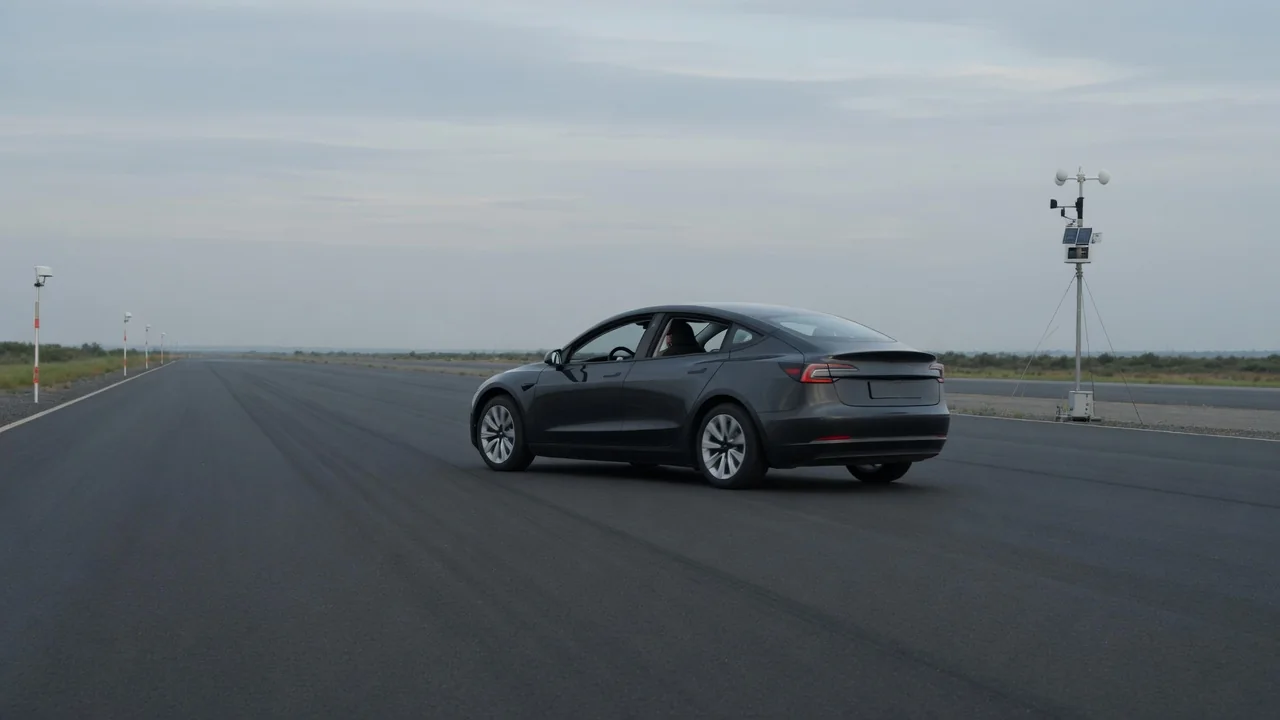
A coastdown test is a measurement in which a vehicle is brought up to speed on a level road or track, shifted out of drive, and allowed to slow down on its own while its speed is recorded over time. The rate at which it loses speed shows how much force the road and air exert against it. Knowing the purpose of a vehicle coastdown test helps explain how engineers quantify drag, set up laboratory testing, and judge whether design changes actually reduce resistance.
Road resistance: what a coastdown measures
When a car rolls without power, the only things slowing it are the forces that normally oppose motion. Engineers group these into road load: tire rolling resistance, aerodynamic drag, and mechanical losses in parts that keep turning, such as wheel bearings, brake pads lightly touching rotors, and portions of the driveline. Because the vehicle is not being driven, these forces act directly against its momentum, and the deceleration they cause can be observed with accurate speed and time data. Newton's second law links the two: the resistance force at any moment equals the vehicle's effective mass multiplied by its deceleration. Effective mass includes not only the weight of the car and its load but also the rotational inertia of wheels, tires and other spinning components.
Each component behaves differently with speed. Rolling resistance and most bearing and seal friction change relatively little, so they dominate at low speed. Aerodynamic drag grows roughly with the square of speed, so it becomes the largest share at highway speeds. For this reason, road load is commonly expressed as a polynomial with a constant term, a term proportional to speed, and a term proportional to speed squared. These are often called road load coefficients. The constant and quadratic terms usually carry most of the physical meaning, while the linear term absorbs effects that do not fit neatly into either category. Fitting this curve to coastdown data turns a simple deceleration record into a compact description of how hard the vehicle must work to hold any given speed.
Test conditions that make results usable
A coastdown only produces meaningful numbers when outside influences are controlled or cancelled. Tests are normally run on a long, straight, smooth surface with minimal grade, because even a slight slope adds or removes force that would be mistaken for resistance. Wind is a major concern: a headwind inflates apparent aerodynamic drag, a tailwind hides it, and crosswinds change the airflow around the body. To manage this, runs are typically made in both directions along the same stretch and the results are averaged, and testing is limited to calm conditions, often with wind measured on site. Air temperature and pressure affect air density and tire behavior, so they are recorded and used to correct results to standard reference conditions.
Vehicle preparation matters as much as the weather. Tires are set to specified pressures and warmed up, since cold tires generally roll with more resistance than tires at operating temperature. The drivetrain is also warmed so lubricants reach normal viscosity. The vehicle is loaded to a defined test mass, windows and other openings are closed, and brakes are checked so pads are not dragging more than normal. During the coast itself, the transmission is placed in neutral or, where that is not possible, in a mode that disconnects propulsion as fully as the design allows. Published industry recommended practices and regulatory test procedures spell out these requirements in detail, including how many valid runs are needed and how much variation between them is acceptable.
Speed is sampled frequently from a precise source, such as a satellite-based or wheel-speed system, as the vehicle coasts from a higher starting speed down to a lower one. Some procedures measure the time needed to pass through a series of shorter speed intervals, which reduces sensitivity to small disturbances along the track.
How engineers use coastdown data
One of the most important uses is configuring a chassis dynamometer. Fuel economy, emissions and electric range testing for certification is generally performed indoors on rollers rather than on public roads, so the dynamometer must apply the same resistance the car would feel on a real road. The road load coefficients from a coastdown give the dynamometer its target. The equipment is then adjusted, often by performing a coastdown on the rollers, until the vehicle decelerates there the way it did on the track. Without this step, laboratory results would not reflect real driving resistance, and a vehicle could appear more or less efficient than it truly is.
Coastdown data also supports aerodynamic and chassis development. Wind tunnels and computational fluid dynamics predict drag under idealized conditions, while a coastdown captures the whole vehicle on an actual surface, including rotating wheels, underbody flow and real tire behavior. Comparing the two helps engineers check whether simulation and tunnel results translate to the road. Repeating coastdowns before and after a change, such as a different tire, wheel design, underbody panel or brake caliper, can show whether total resistance went down. The curve fit gives an approximate split between aerodynamic drag and rolling resistance, but because those terms can trade off against each other in the regression, engineers usually combine coastdown results with other measurements when they need a precise breakdown.
Practical implications and limits
For drivers, the main takeaway is that official efficiency figures rest partly on coastdown-derived road load. Those figures describe a vehicle in a specific configuration, at a specific mass, with specific tires and inflation. Changes that seem minor, such as larger wheels, wider or more aggressive tires, roof racks, low tire pressure or added cargo, alter road load and can move real-world consumption away from the published value. Aerodynamic additions tend to matter more as speed rises, while extra mass and underinflation affect efficiency across the whole speed range.
The method also has inherent limits. Results are sensitive to small errors in wind, grade, temperature and tire condition, so two well-run tests of the same vehicle on different days can differ, and correction formulas reduce but do not eliminate that scatter. A coastdown represents straight-line rolling in mostly calm air; it says little about crosswind behavior, cornering losses, or resistance on rough or wet pavement. Vehicles with regenerative braking, automatic transmissions or other systems that do not naturally freewheel need special test modes, and any residual drag from those systems becomes part of the measurement. Finally, coastdown values belong to the vehicle as tested rather than to a model name in general, and wear, maintenance and modifications can shift them over the life of a car.