Why Does Dirt Build Up in Certain Aero Areas?
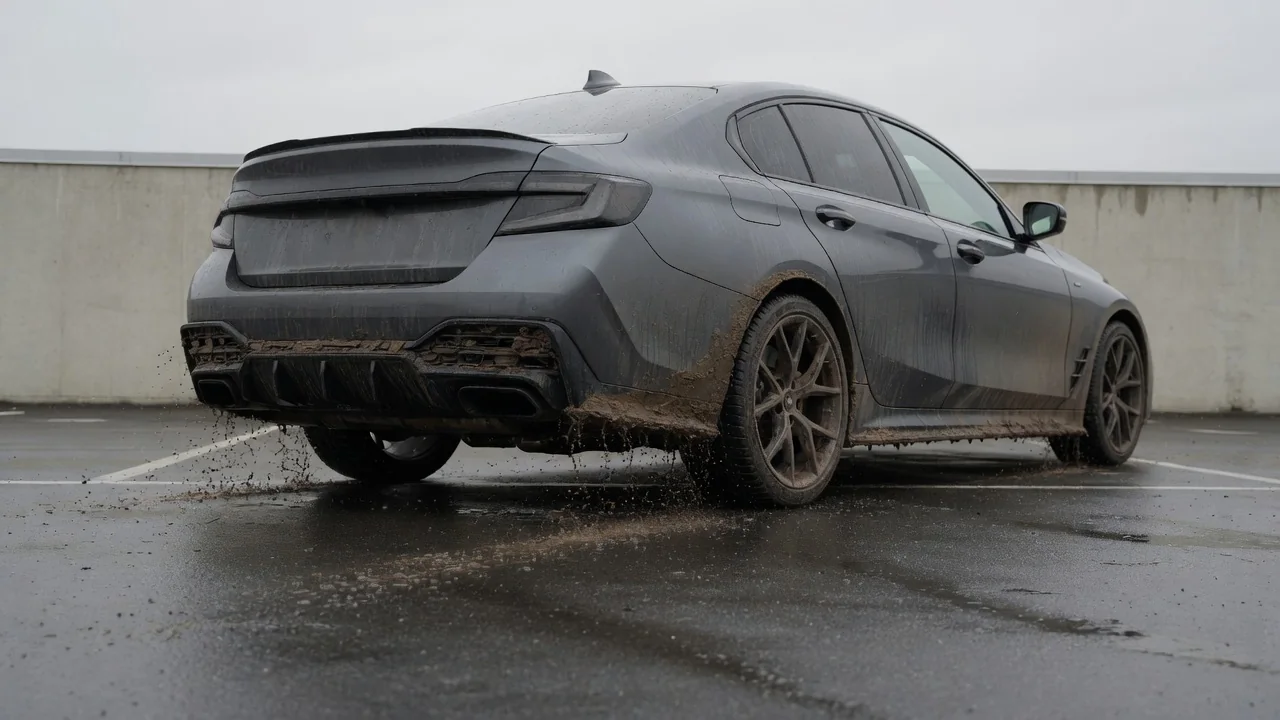
Drive through a wet winter or a dusty season and grime rarely coats a car evenly. The tailgate, lower door edges, mirror backs and the panels behind the wheels often turn gray long before the hood or roof. These car dirt patterns follow airflow and spray behavior. This article explains why dirt builds up in certain aero areas, how water and particles travel around a moving vehicle, and what owners can sensibly do about it.
Flow separation: where air stops following the body
Air passing over a smoothly curved surface tends to stay attached, following the contour of the hood, windshield and roof. Attached flow moves quickly along the panel, so most fine particles in it are carried past rather than settling. Forward-facing surfaces still collect impact deposits such as insects and road film thrown up by traffic ahead. Even so, the thin, even layer of grime that builds up on a car usually comes from somewhere else: the regions where the flow has separated.
Flow separation happens when air cannot follow the shape of the body, typically at sharp edges, abrupt changes in contour and the rear of the vehicle. Behind these points the air forms a turbulent, recirculating wake with lower pressure and slow, sometimes reversed, movement. Fine mist and dust caught in that wake are drawn back toward the body and deposited on it. This is why near-vertical rear surfaces, which sit directly in the wake, so often collect a coating over the rear glass, taillights and license plate area. Vehicles with a squared-off rear generally show this more clearly than those whose rooflines taper gradually, although the exact result depends on the individual design.
Smaller separation zones produce smaller dirty patches. The back faces of mirror housings, the trailing edges of door handles, the areas behind roof rails and the underside of rear spoilers can all host local wakes. Designers use features such as defined trailing edges, spoilers, pillar shaping and rear wipers to manage these zones, but no single rule predicts the result for every vehicle, speed or wind condition.
Spray paths: how water and grit reach the body
On a wet or dirty road, the tires are usually the main source of contamination. A rotating tire picks up water and slurry and throws it off the tread, with some of it breaking up into fine mist. Wheel arch liners, mud flaps and the shape of the arch contain part of this spray. The rest escapes around the wheel opening and lands on nearby surfaces, which explains the familiar streaks along lower doors, rocker panels and the corners of the bumpers just behind each wheel.
What happens next depends on droplet size. Heavier droplets and grit follow fairly direct, ballistic paths and hit the panels closest to the wheels, leaving coarse splashes. Fine mist is light enough to be carried by the airflow wherever it goes, including up into the rear wake, where it settles as a smooth film. Traffic adds to this: driving behind other vehicles means passing through their spray clouds, which coat the front and sides with road film as well. Air moving under the car also carries spray along the underbody, and salt and mud collect on ledges, crossmembers, inner bumper lips and other spots where the flow slows down.
Not every dirty streak is purely aerodynamic. When the car is parked, rainwater runs off the body and carries settled dirt with it, leaving trails below trim pieces, door seams, mirror bases and window edges. Distinguishing runoff streaks from airflow deposits helps explain why some marks appear only after the car has sat in the rain.
Owner cleaning: dealing with the dirtiest zones
Because the dirtiest areas collect different kinds of grime, they benefit from different handling. The fine film in the rear wake can contain abrasive particles, so a thorough rinse or presoak before any contact reduces the chance of dragging grit across the paint. Lower panels behind the wheels usually carry the coarsest material, so many owners wash them last, or with a separate mitt, to avoid spreading that grit onto upper panels. Working from the top of the vehicle downward follows the same logic.
Several dirt traps are easy to miss: wheel arches and liners, the underside of rocker panels, inner bumper edges, the license plate recess, the tailgate sill and the back of mirror housings. Where roads are salted, rinsing the underbody and wheel arches periodically helps remove deposits that would otherwise stay there. Rear cameras, parking sensors and other driver assistance sensors often sit in exactly these dirty zones, so cleaning them gently with suitable products matters for their function. The owner's manual is the right reference for any cautions about pressure washer use near sensors, cameras, seals, badges or wrapped surfaces.
Paint sealants and coatings can make grime release more easily during washing, but they do not change the airflow that delivers it, so the same areas will keep getting dirty. Mud flaps can reduce some side spray where they are designed to fit the vehicle, though they cannot address the fine mist that ends up in the rear wake.
Practical implications and limits
A dirt pattern can serve as a rough visual record of how air and spray behave around a particular car. A sudden change, such as a new heavy streak on one side, can be a reason to check for a loose or missing arch liner, a damaged mud flap or detached trim. It is a prompt for inspection, not a diagnosis, since driving conditions alone can also change how dirt is distributed from one week to the next.
There are clear limits to what an owner can change. The basic wake behind a vehicle is a product of its overall shape, and aftermarket add-ons tend to move dirt rather than remove it, sometimes with side effects on wind noise or fit that are hard to predict. Manufacturers balance soiling against drag, styling, cooling, cost and other priorities, so a design that keeps the rear cleaner is not automatically the one chosen. Speed, crosswinds, road surface and traffic density also shift the patterns, which means a general explanation cannot forecast exactly where a specific vehicle will get dirty.
The most practical consequence is safety and visibility. On long wet or salty trips, lights, rear glass, the license plate and camera lenses can lose effectiveness as grime accumulates in the wake and spray zones. Wiping these surfaces at stops keeps the vehicle visible to others and keeps its rear view and sensor systems working as intended.