Why Are Some Car Panels Made With Different Metal Thicknesses?
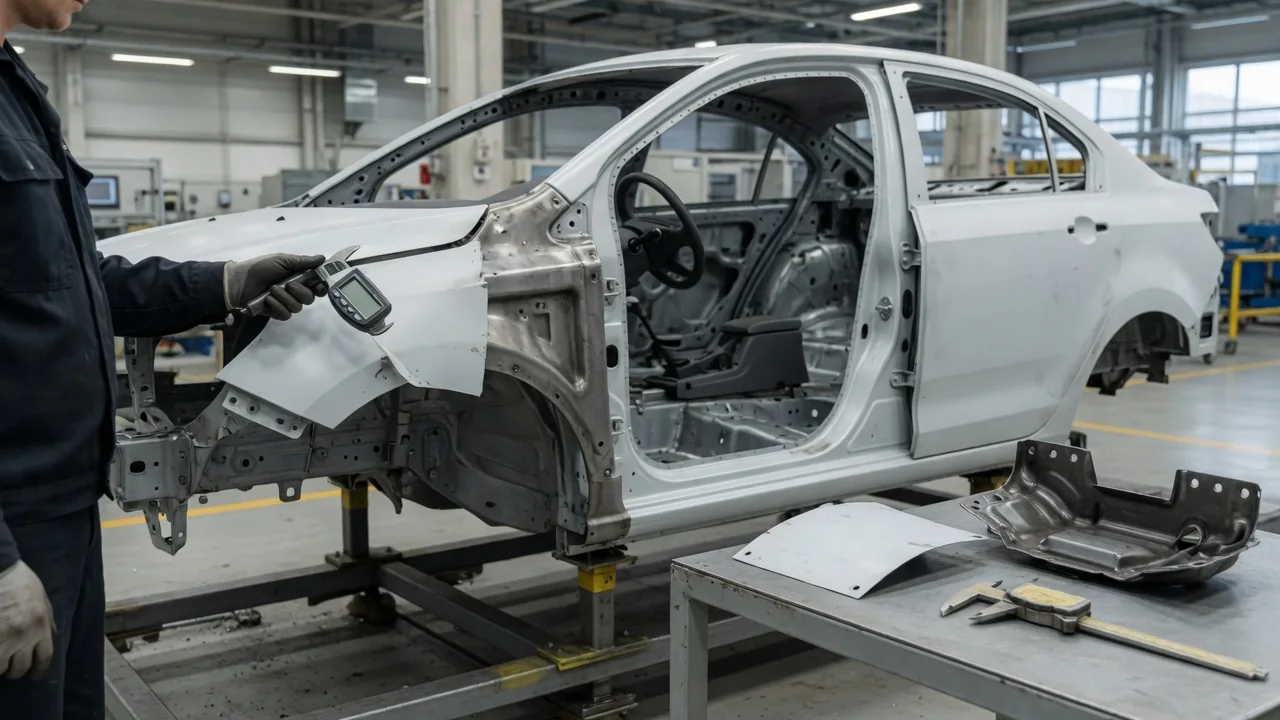
Look closely at a car body and you will find that the metal is not one uniform sheet. Outer skins, inner reinforcements, pillars and floor members are often formed from different thicknesses, and sometimes different grades, of steel or aluminum. This car panel gauge variation is deliberate. It reflects three competing priorities: carrying loads safely, keeping weight under control, and allowing the body to be manufactured and repaired. Here is how each one shapes the choice.
Load needs: matching thickness to the job
Every part of a body shell is asked to do something different. A door skin or front fender mainly needs to hold its shape, resist small dents and provide a smooth surface for paint. A rocker panel, door pillar, roof rail or frame rail is part of the load path that carries forces from the suspension, the engine mounts and, in a collision, the impact itself. Those structural members need far more resistance to bending, buckling and tearing than a cosmetic skin, so engineers generally give them thicker metal, stronger alloys, or both.
Thickness matters disproportionately because of how sheet metal behaves under bending. For a flat panel, bending stiffness rises roughly with the cube of thickness, while mass rises only in direct proportion. A modest increase in gauge can therefore make a panel much stiffer. That relationship explains why mounting points for seat belts, hinges, strikers, suspension towers and towing hardware are commonly backed with thicker reinforcement plates even when the surrounding panel is thin. Local loads concentrate around bolts and welds, and extra thickness spreads them out and reduces the risk of cracking or pull-through.
Crash design adds another layer. Some zones are intended to fold progressively and absorb energy, while others, especially around the passenger compartment, are intended to resist intrusion. Varying thickness along a single part helps control where and how it deforms. Manufacturers can use tailor-welded or tailor-rolled blanks for this purpose: a single stamping that combines thicker sections where strength is needed with thinner sections elsewhere. Exact gauges and placements differ by vehicle and are set by each manufacturer's engineering targets.
Weight: putting metal only where it earns its place
If load were the only concern, the simplest answer would be to make the whole body from thick metal. That would add a great deal of mass, and mass affects nearly everything a car does: fuel or energy consumption, acceleration, braking distance, handling, tire wear and the size of the components needed to support it. Using thinner sheet for panels that carry little load is one of the most direct ways to keep the body lighter without compromising the parts that matter for strength.
Material choice interacts with thickness here. Higher-strength steels can deliver the required strength with less metal, so a structural part made from such steel may be thinner than an equivalent part in mild steel while performing at least as well. Aluminum is lighter but less stiff for the same thickness, so aluminum panels are often made thicker than the steel parts they replace yet can still weigh less overall. As a result, thickness alone is not a reliable indicator of how strong or heavy a panel is; the alloy and its treatment matter just as much.
There is also a practical lower limit. Outer panels that are too thin can feel flimsy, show waviness, vibrate and transmit noise, or dent from hail, door contact and hand pressure. Manufacturers balance weight savings against dent resistance and perceived quality, which is why outer skins are thin but not as thin as weight targets alone might suggest. Inner braces and sound-deadening treatments often supplement a lightweight outer panel.
Repair: why mixed thicknesses change the approach
Different thicknesses behave differently when a body shop straightens, cuts or welds them. Thin outer panels can often be reshaped with hand tools, stud pullers or paintless dent repair, but they distort easily under heat, so welding them requires controlled technique to avoid warping. Thicker structural members resist straightening and may need frame equipment, and some high-strength grades are not meant to be straightened or heated at all, because heat can permanently reduce their strength.
Joints between metals of different gauges create their own challenges. Welding a thin panel to a thick one requires heat input suited to both, and many modern structures rely on spot welds, structural adhesives or rivets chosen for those specific combinations. When a damaged section is replaced, the replacement must match the original thickness and grade. Substituting a thinner or weaker piece, or a thicker one that changes how the part deforms, can alter crash behavior in ways that are not visible after the paint is finished.
For these reasons, manufacturers publish body repair information that specifies where panels may be sectioned, which joining methods are approved and which parts must be replaced rather than repaired. These procedures vary between vehicles and even between model years, so a technique that is correct on one car may be wrong on another. Following the applicable repair manual is the reliable way to restore the intended mix of thicknesses and strengths.
Practical implications and limits
For owners, the variation explains several everyday observations. A fender or hood may dent from minor contact while the pillar beside it shows no mark, and a body shop estimate may treat superficially similar damage very differently depending on whether a structural member is involved. When evaluating a used vehicle or a collision repair, it is worth asking whether structural parts were repaired according to the manufacturer's procedures, since inner reinforcements are rarely visible once trim and paint are in place.
There are limits to what can be concluded from outside the car. Tapping a panel, pressing it by hand or measuring it with a basic gauge gives little insight into the strength of the alloy, the presence of internal reinforcements or how the part is meant to behave in a crash. The general principles described here apply broadly, but specific thicknesses, materials and repair rules depend on the individual vehicle. For anything beyond cosmetic work, the manufacturer's body repair documentation and a qualified collision technician remain the authoritative sources.