Why Are Car Body Panels Drawn in Multiple Press Steps?
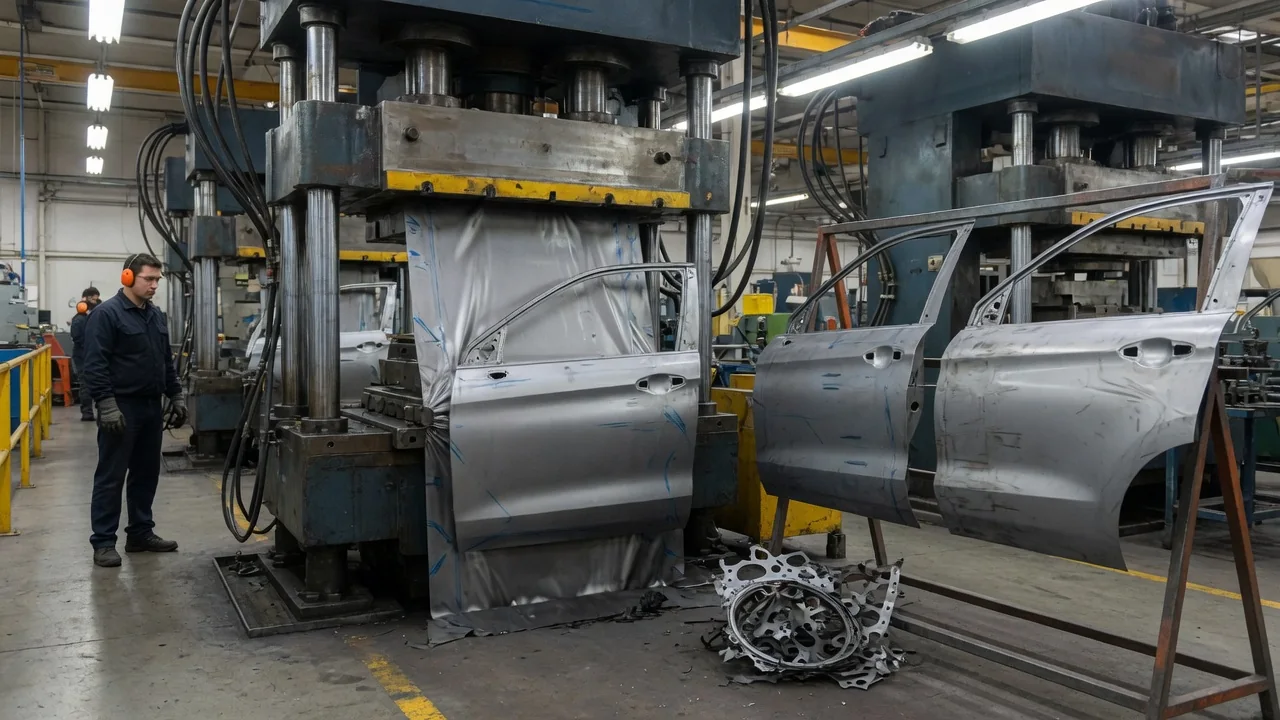
A hood, fender, or door skin begins as a flat sheet of steel or aluminum. It leaves the press shop with smooth curves, sharp feature lines, clean edges, and accurately placed holes, and a single press stroke cannot reliably produce all of that. Car body panels are drawn in multiple press steps because of three linked problems: how far the metal can be stretched, how wrinkles are kept out of the surface, and how the part is cut to its final outline.
Shape depth: how far sheet metal can stretch
The first major operation on most body panels is the draw. A punch pushes the blank into a shaped die. Meanwhile, the outer edges of the sheet are clamped between the die face and a binder, often called a blankholder. As the punch advances, metal is pulled inward from the clamped area and stretched over the punch surface. Sheet metal can only stretch so far before it thins locally, necks, and splits. Greater depth, tighter radii, and compound curvature all raise the strain in specific areas. Manufacturing engineers use forming limit data for each material to judge whether a shape is achievable. Higher-strength steels and many aluminum alloys generally stretch less than mild drawing-quality steel, which leaves less margin for forming an aggressive shape in one hit.
Splitting the work across stations keeps each step inside those limits. The draw die typically establishes the overall depth and main surface. Later stations add sharper character lines, small embossments, or tighter radii that would overload the metal if they were formed at the same moment. Particularly deep or complex parts may need a redraw, where a second forming die takes the shape further. Springback is another reason for extra steps. When the punch retracts, the elastically stressed metal relaxes and pulls slightly away from the tool shape. Once most of the forming is done, a restrike operation can sharpen lines and set radii more precisely.
Wrinkle control: keeping the sheet in tension
Wrinkles are the opposite failure. Metal is sometimes compressed instead of stretched, for example when a wide flange area is drawn into a smaller perimeter, and the thin sheet then buckles. Large exterior panels add a subtler problem. A roof or door skin is broad and fairly shallow, so parts of it may receive very little stretch. Under-stretched areas can end up wavy or soft, or they can be prone to oil canning, where the panel flexes in and out under light pressure. The goal of the draw stage is to keep the entire sheet in controlled tension so the surface comes out taut and stable.
Several tools manage that tension. Binder pressure controls how easily the sheet slides into the die. Draw beads are ridges and grooves on the binder surfaces that force the metal to bend and unbend as it flows, which adds restraint exactly where it is needed. The addendum is extra surface designed around the actual part, and its shape guides how material feeds in. Lubrication changes friction. Too little restraint lets wrinkles form, and too much makes the panel split. Because the working range between those two failures can be narrow, the draw stage is dedicated to this balance and does not also try to cut edges or punch holes.
Later stations benefit from the tension set during the draw. Stretched metal work-hardens, so the panel becomes stiffer and holds its shape better through the remaining operations. Flanging bends edges to create mounting or joining surfaces, and it brings its own risks. An edge bent along a convex curve tends to compress and wrinkle, while one bent along a concave curve tends to stretch and crack. Handling flanges in dedicated dies, with pads clamping the panel, lets each risk be controlled separately.
Final trim: cutting and piercing after the draw
After the draw, the panel is still surrounded by the clamped binder area, the addendum, and the marks left by draw beads. That material was essential for controlling flow, but it is not part of the finished panel, so a trim die cuts the part to its net outline. The flat blank cannot simply be trimmed beforehand. The edges move as metal flows into the die, and their final position is not predictable enough for tight body fits. Piercing follows similar logic. Holes for fasteners, clips, drainage, and mounting points are usually punched after forming, because holes made earlier would stretch and shift.
Not every cut or bend lines up with the press stroke. Some edges and holes sit on steep walls, so dies use cam mechanisms that convert the vertical press motion into angled cutting or forming. Putting all these operations in one die would make it very complex and hard to maintain. For that reason, car panel press stages are usually spread across a tandem line of separate presses or a large transfer press that moves the part from die to die. Some edges are also prepared for hemming, which folds an outer skin around an inner panel. Hemming is typically completed later, during body assembly, not on the press line.
Practical implications and limits
For owners and repairers, these mechanisms explain why a stamped panel is harder to reproduce than it looks. Its thickness is not uniform. Areas that were stretched hardest, such as deep corners, are thinner than flat zones, and the metal has been work-hardened unevenly. Hammering and filling can restore appearance after damage, but they do not recreate the controlled stretch of the original draw. That is one reason badly stretched or creased panels are often replaced rather than repaired. Replacement parts may come from different tooling and processes, so fit, surface quality, and edge alignment can vary between suppliers.
Body design is shaped by the same limits. Feature lines, depths, and radii reflect what the chosen material can form without splitting or wrinkling. Some shapes require a styling compromise or an extra station. Tooling is expensive, so the number of stages balances part quality against cost and production volume.
This explanation covers general mechanisms, not any particular vehicle. The number and order of operations, the materials, and the press equipment differ by manufacturer, part, and production scale. Some low-volume or specialized vehicles use other processes or non-metal panels. The number of press steps alone says little about a car's overall build quality.