What Is Cylinder Wall Crosshatch? Oil Retention, Ring Seating and Wear
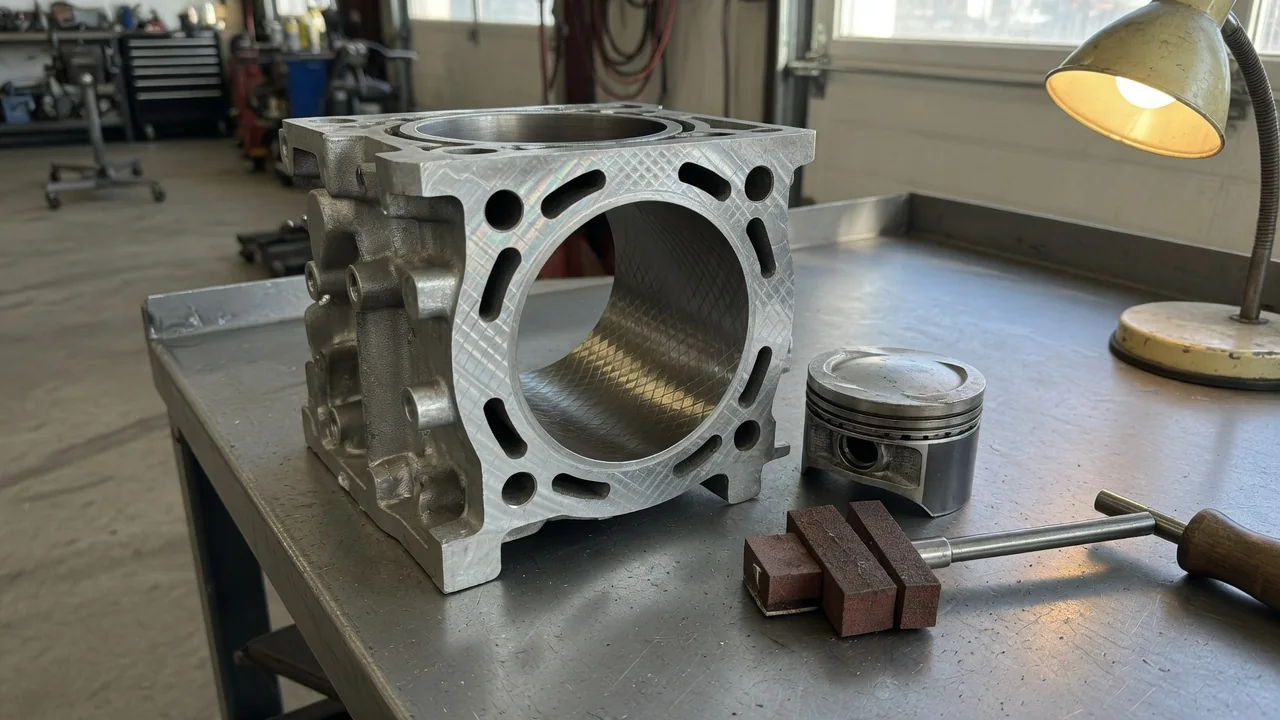
Cylinder wall crosshatch is the pattern of fine, intersecting scratches that honing leaves on the inside of an engine cylinder. Up close, the lines run diagonally in two directions and form a shallow diamond-shaped texture. That texture is not a defect or decoration. It helps the bore hold oil, lets new piston rings bed in against the wall, and affects how the cylinder wears over the life of the engine.
Oil Retention: How Crosshatch Holds Oil on the Cylinder Wall
A perfectly smooth, mirror-like bore might seem ideal, but it would give oil very little to cling to. The piston rings scrape the wall on every stroke, and the oil control ring is designed to leave only a very thin film behind. On a polished surface that film can be wiped away or thinned until metal-to-metal contact becomes more likely. The risk is highest at the top and bottom of the stroke, where the piston briefly stops and the oil wedge that normally separates the surfaces is weakest.
The valleys of the crosshatch act as tiny reservoirs. They trap a small volume of oil below the peaks of the surface, so some lubricant is still available to rebuild the film after a ring passes over. Because the grooves cross at an angle rather than running straight up and down or around the bore, the sliding ring spreads oil across the surface instead of channeling it in one direction. Grooves that ran nearly vertical could act as passages for oil and combustion gases. Grooves that ran nearly horizontal would tend to hold oil in bands. A diagonal pattern balances retention and distribution.
The depth of those valleys matters as much as their presence. Valleys that are too shallow hold too little oil. Scratches that are too deep or ragged can store more oil than the rings can control, which may raise oil consumption and deposit formation. This is why machinists talk about surface finish and not just the visible pattern.
Ring Seating: Why Crosshatch Helps New Rings Seal
New piston rings do not match the bore perfectly when an engine is first assembled. Microscopic irregularities on the ring face and on the cylinder wall prevent a complete seal. During the first period of operation, usually called break-in, the rings and the wall wear against each other slightly until their contact surfaces conform. This process is known as ring seating or bedding in.
Crosshatch supplies the controlled roughness that makes this possible. The peaks of the honed surface act as a very mild abrasive and wear down high spots on the ring face until it settles into full contact with the wall. The valleys keep enough oil present to prevent scuffing while that initial wear takes place. If the wall is too smooth, the rings can glaze instead of seating, leaving gaps that allow blow-by, reduce compression, and let oil pass into the combustion chamber. If the wall is too rough, the rings can wear excessively during break-in and never achieve a clean seal.
Ring material and design also play a role. Different ring face materials and coatings respond differently to a given surface texture, so the honing process is normally chosen to suit the rings being installed. This is one reason ring and engine manufacturers specify the honing stones, finish, and procedure in their rebuild instructions instead of leaving them to guesswork.
Wear: How the Crosshatch Pattern Changes Over Time
Engine cylinder crosshatch is not permanent. As an engine accumulates running time, ring contact gradually wears away the peaks of the honed texture. What remains is a smoother surface whose deeper valleys still hold some oil. Much of this change happens during break-in, and that is intentional. Some honing methods, often described as plateau honing, deliberately remove the sharpest peaks during machining so the bore starts closer to its worn-in condition. The goal is to keep the oil-holding valleys while reducing the amount of initial wear the rings must do.
Over a long service life, the crosshatch in the ring travel area may fade until it is hard to see. Marks often remain visible near the very top or bottom of the bore, where the rings do not reach. Fading by itself does not necessarily mean the cylinder is worn out. Problems arise when the wall becomes glazed, meaning a hard, shiny surface that holds little oil, or when wear produces taper, an out-of-round shape, or a ridge at the top of ring travel. Scoring is a different kind of damage. These vertical scratches from debris or poor lubrication interrupt the pattern and can create paths for gas and oil.
Lubrication conditions affect how quickly this wear progresses. Dirty oil, abrasive particles that get past the air filter, fuel washing oil off the walls, and repeated operation without adequate lubrication can all strip surface texture faster than normal ring contact would.
Practical Implications and Limits
For most owners, crosshatch matters when an engine is rebuilt or a cylinder is inspected. It is not something to check during routine maintenance. When cylinders are rebored or new rings are installed, the bores are normally honed to restore a fresh pattern. Fitting new rings into old, glazed bores without honing can make seating unreliable, which is why rebuild guides commonly call for at least a light hone. Some cylinder surfaces, such as certain coated or treated bores, are not meant to be honed with conventional methods at all. The manufacturer's service information should guide that decision.
Looking at crosshatch through a borescope, or with the cylinder head removed, gives a general clue about a cylinder's condition, but it is not a measurement. Bore diameter, taper, and roundness have to be checked with proper measuring tools against the engine's specifications. Compression or leak-down testing tells you more about sealing than appearance does. A bore can show faint crosshatch and still be out of specification, or show little pattern and still be serviceable.
The correct crosshatch angle, depth, and finish are not universal. They depend on the cylinder material, the ring package, and the engine's design, so specific figures should come from the engine or ring manufacturer's documentation. Break-in procedures also vary, and following the recommended oil and operating guidance after a rebuild helps the surfaces seat as intended. Crosshatch is one part of a system that includes the rings, oil, filtration, and machining quality, and it works only as well as that whole system allows.