What Is an HVAC Mode Door? Vent Routing, Actuators and Faults
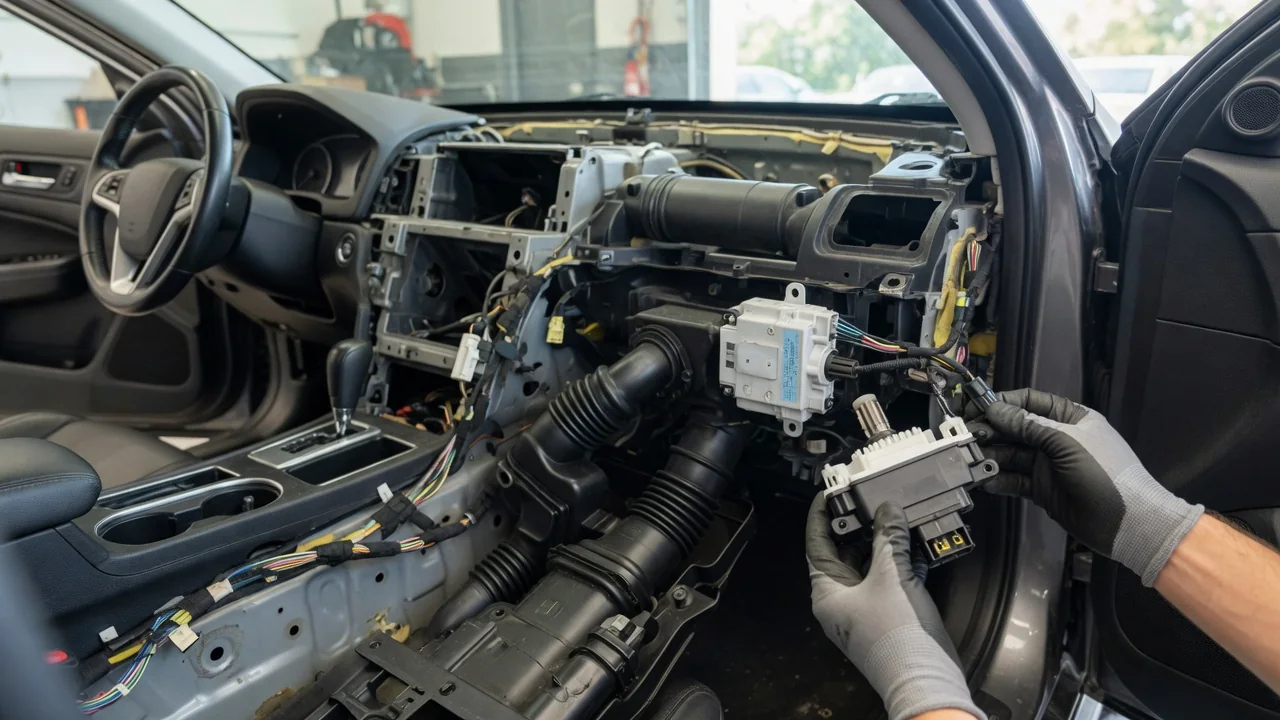
An HVAC mode door is a movable flap inside a vehicle's heating and air conditioning housing that decides which outlets receive conditioned air: the dashboard vents, the floor ducts, the windshield defroster, or a mix of them. When you turn the mode knob or press a vent-selection button, you are commanding this door, or a set of linked doors, to change position. Understanding how a car HVAC mode door routes air, how it is moved, and how it fails makes airflow complaints much easier to interpret.
Vent Routing: How the Mode Door Directs Air
Inside the dash, most systems pass incoming air through the blower and across the evaporator core. The air then goes through or around the heater core, where a separate blend door sets the temperature. Only after the air has been conditioned does it reach the distribution section of the housing. That section contains one or more mode doors, sometimes called distribution doors. They open and close passages leading to the panel outlets, the floor ducts, and the defroster ducts at the base of the windshield. Many designs also feed side window demisters from the defrost path. The mode door does not change air temperature or volume by itself. It only decides where the air already moving through the housing goes.
Common positions include panel, bi-level, floor, floor and defrost, and full defrost, although the names and number of steps vary between vehicles. Intermediate positions split the flow by holding a door partway open, so some air goes on purpose to a secondary outlet. In bi-level, for example, a share of air goes to the face vents while the rest flows to the floor. Some housings use a single door with several sealing edges. Others use two or three doors connected by a cam, linkage, or gear, so that one input moves them in a coordinated sequence. Dual-zone and rear-zone systems may add separate mode doors for each zone. The door edges seal against the housing with foam or rubber, so the condition of that seal affects how cleanly air is separated between outlets.
The Mode Door Actuator
Something has to move the door, and vehicles have used three broad approaches. Older or simpler systems often use a cable running from the control knob to a lever on the HVAC housing, so the driver positions the door directly. Many older designs used vacuum instead. Engine vacuum is stored in a reservoir and routed through a selector valve to small diaphragm actuators, and each actuator pulls a door to one of a limited number of positions. On many vacuum systems the doors are spring-loaded toward defrost, so a vacuum leak tends to send air to the windshield. This default is not universal.
Most modern vehicles use electric actuators. These are small housings mounted on the HVAC case, each containing a DC motor and a plastic reduction gear train that turns the door shaft. The climate control module needs to know where the door is. The actuator commonly reports its position through a feedback circuit such as a potentiometer, or the system tracks motor movement electronically. Some vehicles wire each actuator directly to the module, while others connect several actuators on a shared communication line. These details are vehicle-specific. The service information for a given model is the reliable reference for pinouts, signal types, and test values.
Electric actuators usually work between defined end stops. After a battery disconnection, module replacement, or actuator replacement, many systems run a calibration or relearn routine to find those stops again. On some vehicles this happens automatically at key-on. On others it requires a specific procedure or a scan tool command. If a required calibration is skipped, the module can hold a wrong idea of the door position. The result is incorrect airflow even though the hardware is sound.
Common Mode Door Faults
The best-known symptom of a failing electric mode door actuator is a repeated clicking or knocking from behind the dashboard. It is often heard briefly after the vehicle is started or when the mode is changed. That noise usually means stripped or cracked gear teeth are slipping as the motor tries to reach a commanded position. Other signs include air coming only from one set of outlets regardless of the selection, airflow that settles in the wrong outlet, or a mode change that takes effect only partially. Many vehicles with automatic climate control store diagnostic trouble codes for actuator circuit or range faults, which can narrow the search.
Not every mode problem is the actuator. The door itself can break at its shaft or pivot, so the actuator turns but the door does not follow. Linkages and cams can pop off or wear out. Deteriorated door seal foam can let air bleed to outlets that should be closed. Debris that enters through the fresh air intake, such as leaves or small objects, can jam a door. In vacuum systems, a cracked hose, a failed check valve, or a leaking reservoir often shows up as airflow that drifts toward defrost under hard acceleration, when engine vacuum drops. Electrical faults can mimic a mechanical failure. Examples include a blown fuse, damaged wiring, poor connector contact, or a control module problem.
Mode door faults should be separated from problems in nearby parts of the system. Weak airflow from every outlet points more toward the blower, its speed control, or a clogged cabin air filter. Correct airflow at the wrong temperature points toward the blend door or the refrigerant and coolant sides of the system. Air that smells musty or carries outside fumes may involve the recirculation door instead.
Practical Implications and Limits
For drivers, the mode door matters most because of visibility. If a vehicle cannot reliably deliver air to the windshield, fog and frost become hard to clear, which makes it a safety concern rather than a comfort issue. Until the fault is fixed, a vehicle with a stuck mode door should not be relied on in conditions that call for strong defrosting. Many systems also engage the air conditioning compressor in defrost to dry the air, so defrost performance can depend on more than the mode door alone.
How hard the repair is varies widely. On some vehicles the mode actuator can be reached under the dash with basic tools. On others, reaching it or replacing a broken door means removing trim, the glove box, or large parts of the instrument panel, and some door repairs require splitting the HVAC housing. Before buying parts, confirm the diagnosis using the vehicle's service manual, any trouble codes, and the module's ability to command the actuator. A new actuator will not fix a broken door, a missing link, or a wiring fault. Forcing a door by hand can damage the housing or the gears. After any repair, run the specified calibration and check every mode position to confirm the system works as designed. A general explanation like this one covers the mechanism, but exact layouts, default positions, and procedures are specific to each vehicle.