What Is an HVAC Blend Door?
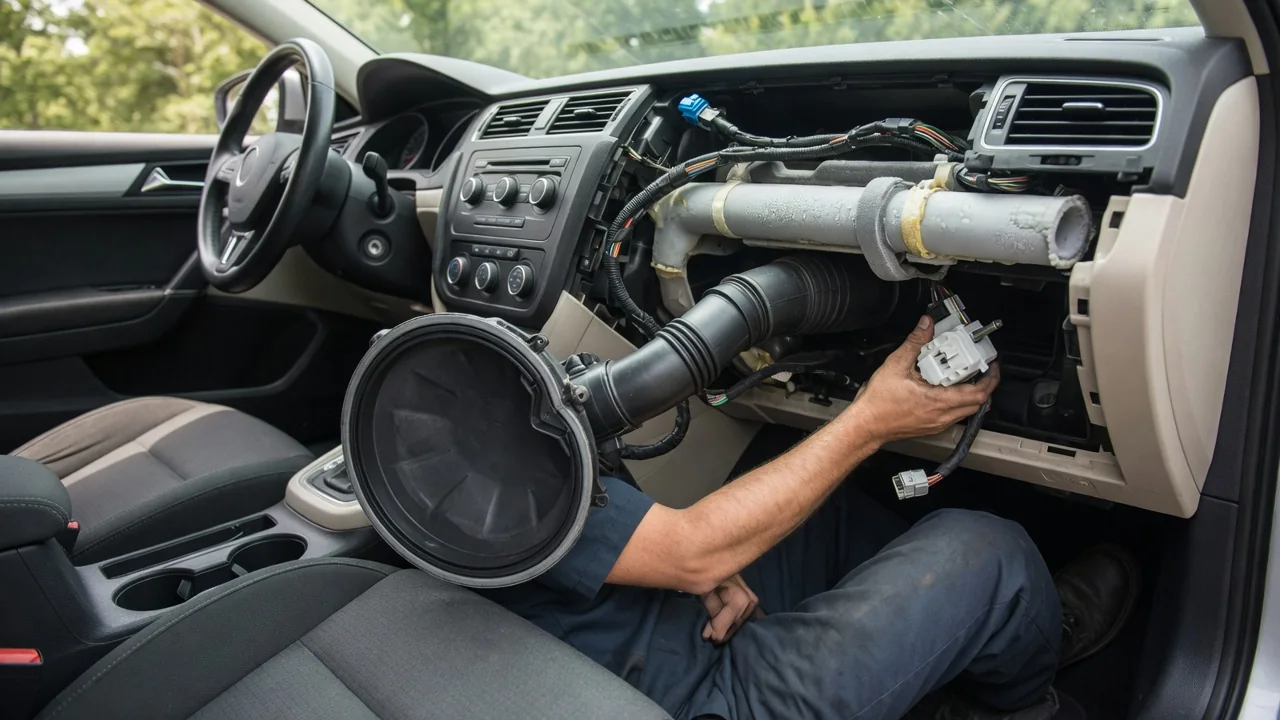
Anyone asking what is an HVAC blend door is really asking how a car turns one stream of incoming air into the exact temperature selected on the dash. The blend door is a movable flap inside the climate control housing that decides how much air passes through the heater core. Its position, not the heat source itself, sets the temperature felt at the vents.
Door movement
Inside the plastic HVAC case behind the dashboard, air from the blower motor first crosses the evaporator, where it can be cooled and dried when the air conditioning compressor is running. From there the blend door splits the flow. Swung fully one way, it sends all the air around the heater core for the coldest output. Swung the other way, it forces the air through the hot core. Anywhere in between, the two streams recombine downstream and arrive at the vents as a mixed temperature.
How the door is moved depends on the vehicle. Older and simpler systems often use a cable running from the temperature knob, so the driver's hand supplies the motion directly. Many later designs use a small electric actuator with a gear train, commanded by the climate control module and often reporting its position back through a built-in sensor. Some vehicles have used vacuum motors instead. The door itself may be a hinged flap, a rotating drum, or a sliding panel, so the layout behind one dashboard can look quite different from another.
Dual-zone operation
A dual-zone system lets the driver and front passenger choose different temperatures, and it usually does this with separate blend doors rather than separate heat sources. A single evaporator and a single heater core serve both sides, while the case is partitioned so each side has its own mixing path. One door might sit mostly closed to the heater core for a driver who wants cool air, while the other opens wider to warm the passenger side from the same incoming airflow.
Each door in such a system normally has its own actuator, and the control module positions them independently using the setpoints and cabin temperature readings available to it. Vehicles with rear climate controls may add further doors in a separate rear unit. Because of this, one side can misbehave while the other works normally, which is a useful observation in itself. The number of doors, their locations, and whether a sync function ties the zones together all vary by manufacturer and trim level.
Fault clues
The most recognizable sign of a blend door problem is vent temperature that does not follow the control. Air may stay hot with the dial at full cold, stay cold at full heat, or change only at the extremes of the setting. On dual-zone vehicles, a marked difference between the left and right vents with both sides set alike points toward one side's mixing path. A repetitive clicking or tapping behind the dash, especially just after startup or a temperature change, often accompanies a struggling actuator.
These clues narrow the possibilities without confirming a cause. Low coolant, a restricted heater core, a thermostat stuck open, or a low refrigerant charge can all produce similar temperature complaints with a perfectly healthy door. Some climate modules store fault codes for actuator circuits or position feedback, but a code is evidence to interpret, since wiring faults, a binding door, or a failed calibration can set the same entry. Code meanings also differ between manufacturers, so they need to be checked against information for the specific vehicle.
Everyday Use and Observations
In normal driving the blend door is constantly at work, even though it is never seen. With manual controls, turning the temperature knob from blue to red should produce a smooth, progressive change at the vents within a few seconds once the engine is warm. With automatic climate control, the door moves on its own as the cabin approaches the set temperature, which is why vent air may start very hot or very cold and then moderate without anyone touching the controls.
A few simple observations reveal a lot about how the system is behaving. Holding a hand at the center vents while sweeping the temperature setting from one end to the other shows whether the change is gradual or abrupt. Listening with the fan on low can pick up a faint whir as an electric actuator travels, which is normal. It also helps to remember that the blend door is separate from the mode doors that direct air to the floor, dash, or windshield, and from the recirculation door.
Limits and Next Steps
What an owner can judge from the driver's seat has limits. The door and its actuator are usually buried in the HVAC case, and access ranges from a panel under the glovebox on some vehicles to substantial dashboard disassembly on others. A door with a broken pivot can feel the same from the cabin as an actuator that has lost its position reference. Some systems also need a calibration routine after battery disconnection or parts replacement, and the method is specific to the vehicle.
A sensible next step is to record the pattern before any work is planned: which vents are affected, at which settings, whether the engine was warm, and whether noises occur. Checking coolant level on a cold engine and confirming that the air conditioning cools at all helps separate mixing faults from heating or cooling faults. From there, a technician with a capable scan tool can command the actuator, watch its reported position, and compare it with actual vent temperature, using service information for that model to confirm the diagnosis.