Why Does a Car Display Outside Air Quality?
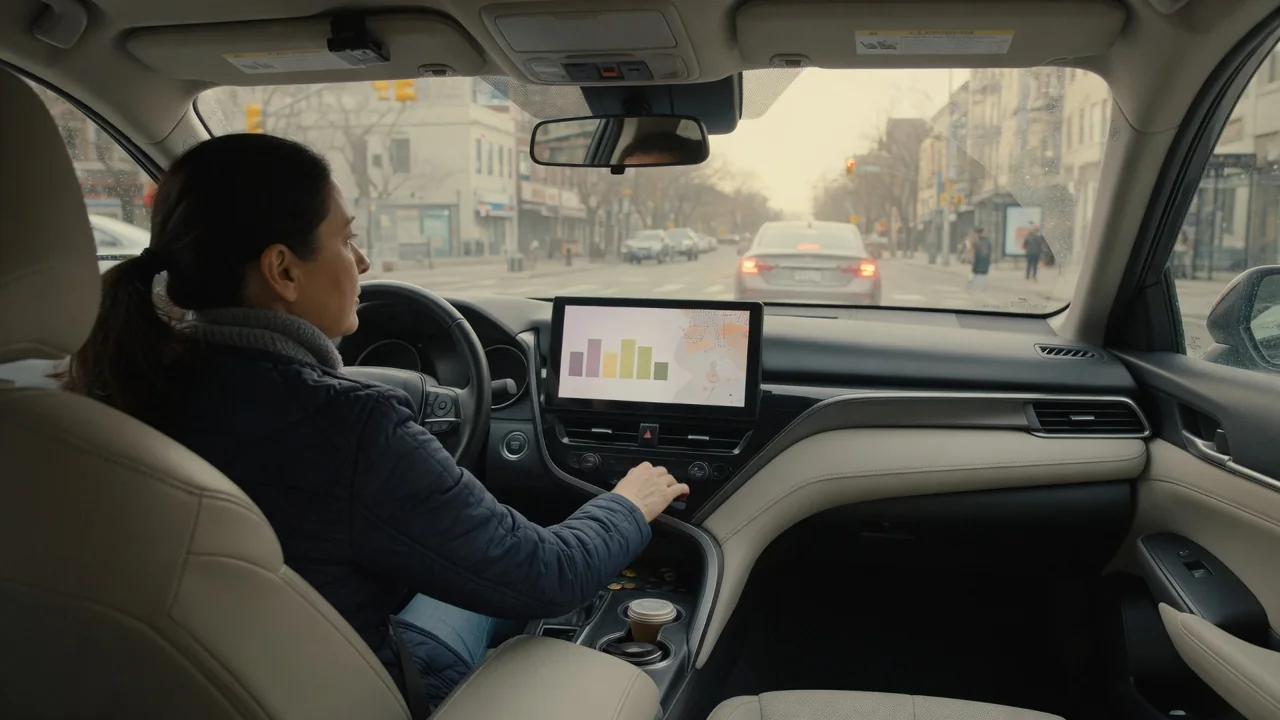
Drivers who notice a pollution reading on the dashboard or center screen often ask why does a car display outside air quality at all. The reading serves two roles: it informs the people inside about conditions around the vehicle, and in some vehicles it also feeds the climate system's decisions about fresh air and recirculation. Knowing which role applies helps you interpret it.
Sensor or external data
An outside air quality reading can come from two very different places. Some vehicles carry an onboard sensor, commonly mounted in the fresh air intake path near the base of the windshield, that reacts to exhaust gases or fine particles in the air the car is about to draw in. Other vehicles have no such hardware and instead show a regional figure delivered through the connected navigation or weather service, which reflects a monitoring station that may sit miles from your actual position.
The difference shows up in how the reading behaves. A sensor-based value tends to change quickly, jumping as you pull behind a diesel truck or enter a tunnel and settling again once traffic clears. A data-fed value usually stays steady for long stretches and updates only when the service refreshes or you travel into another reporting area. The owner's manual or the climate menu typically indicates which source your vehicle uses, and some models combine both, so vehicle-specific confirmation is worthwhile.
Display limits
A displayed figure is a simplification. Onboard gas sensors generally respond to a limited group of pollutants, so a clean reading does not rule out pollen, dust, wildfire smoke, or odors the sensor was never designed to detect. Particle sensors, where fitted, measure a specific size range and may be affected by humidity or fog. Many screens reduce everything to a color band or a single word such as good or poor, which hides what was actually measured and how recently.
The outside reading also says little about the air you are actually breathing. Cabin air passes through a filter, and its condition, the fan speed, and whether windows are open all shape what reaches the occupants. Some vehicles show a separate interior value beside the exterior one, while others show only one number without clearly labeling it. A reading that never changes, or goes blank, may point to lost connectivity or a sensor concern, but that is a clue to investigate rather than a diagnosis.
Driver decisions
This is where information and HVAC control separate. On some vehicles the display is purely informational: it tells you the outside air is poor, and it is up to you to press the recirculation button, close the windows, or change the air intake setting. On others, an automatic recirculation feature uses the sensor signal to close the fresh air flap by itself when pollution rises, then reopens it later. The same number on the screen can therefore mean a suggestion in one car and a trigger in another.
Recirculation is useful, but it involves trade-offs that the display does not weigh for you. Keeping the cabin sealed for a long time can let humidity build, fogging the glass in cool or wet weather, and the air may begin to feel stale with several passengers aboard. Many climate systems limit how long recirculation stays active or override it when defrost is selected for exactly this reason. Treat a poor reading as a prompt to recirculate briefly, then return to fresh air once conditions improve.
Everyday Use and Observations
In daily driving, the reading is most useful when you connect it with what you can see and smell. Watch whether the value climbs in stop-and-go traffic, in tunnels, near construction, or on days when smoke or haze is visible, and whether the recirculation indicator lights up by itself at those moments. If the lamp switches on without your input, your vehicle is likely using the sensor for control. If nothing changes until you press the button, the display is advisory only.
Patterns over several weeks tell you more than any single glance. A value that matches the regional forecast on your phone almost exactly probably comes from the same kind of external data rather than a sensor on the car. Readings that differ between the morning commute and a quiet evening road suggest live measurement. Trim level, model year, market, and optional packages can all change what is fitted, so two outwardly identical vehicles may behave differently, and a lapsed subscription can remove a data-based display entirely.
Limits and Next Steps
No in-car display should be treated as a health instrument. It is not calibrated like an official monitoring station, and it cannot account for individual sensitivity to pollution, allergies, or respiratory conditions. People who need to manage exposure carefully should rely on official local air quality reports and medical guidance, using the dashboard reading only as a convenient secondary signal. Likewise, a good reading outside does not confirm that the cabin filter is doing its job or that the ventilation system is free of odors.
Sensible next steps are simple. Read the climate section of the owner's manual to learn the source of the reading and whether automatic recirculation can be switched on, off, or adjusted for sensitivity. Have the cabin air filter checked according to the manufacturer's schedule, since filtration matters more to interior air than the number on the screen. If the display stays blank, frozen, or clearly contradicts conditions, a qualified technician can check the sensor, wiring, software, and connectivity before any part is assumed to be faulty.