What Is an Outside Air Temperature Sensor?
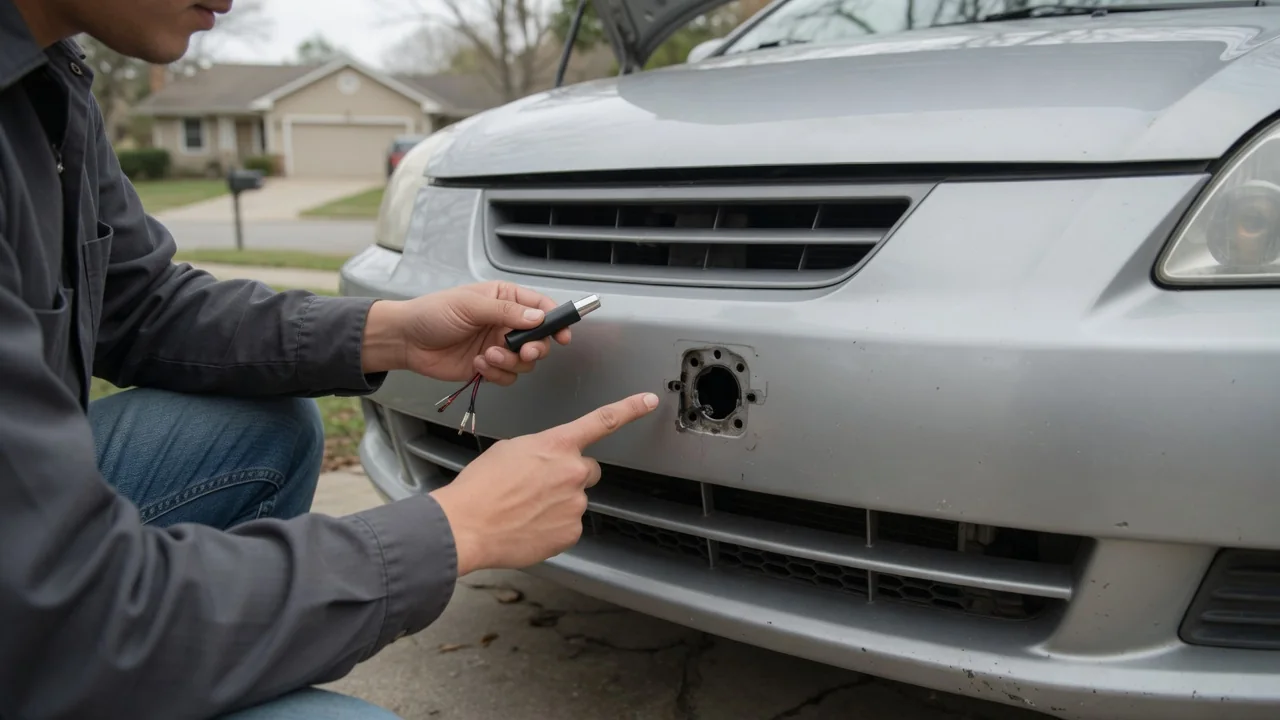
If you have ever wondered what is an outside air temperature sensor, the short answer is that it is a small electronic probe that reports ambient temperature to the vehicle. Its reading appears on the dashboard and often informs climate control decisions. Understanding where that number comes from, and why it sometimes trails reality, makes the display far more useful.
Sensor placement
Most ambient temperature sensors are thermistors, components whose electrical resistance changes as they warm or cool. A control module interprets that resistance as a temperature and shares it with the instrument cluster and climate system. Because the goal is to sample air unaffected by the vehicle itself, engineers typically mount the probe toward the front, commonly behind the grille, near the lower bumper opening, or ahead of the radiator support. Some designs instead tuck it into the underside of a door mirror housing.
Each location is a compromise. A front-mounted probe receives steady airflow at speed but sits close to the radiator, condenser, and hot pavement when the car is stopped. A mirror-mounted probe sits higher and farther from engine heat, yet it can be warmed by direct sun on the housing. Placement varies by manufacturer, model, and even model year, so the owner's manual or vehicle-specific service information is the reliable way to confirm where yours lives before assuming anything about its behavior.
Road heat
Asphalt absorbs sunlight and can become much hotter than the air above it, radiating that warmth upward into a sensor mounted low at the front of the car. In stop-and-go traffic or while idling in a parking lot, heat from the engine bay, the radiator, and the exhaust of vehicles ahead adds to the effect. The displayed figure may then read noticeably higher than a weather report, not because the sensor is wrong, but because it is faithfully measuring a pocket of heated air.
Once the car moves, fresh airflow washes that trapped heat away and the reading gradually settles toward true ambient temperature. The same pattern appears after a hot engine is shut off and restarted shortly afterward, when residual heat has soaked the front end. A car parked in direct sun on dark pavement will usually show a higher starting value than one parked in shade or a garage. These swings are normal behavior and tend to be most pronounced in summer at low speeds.
Fault clues
A genuine problem usually looks different from ordinary heat soak. Warning signs include a display that shows dashes or goes blank, a reading that stays fixed regardless of weather, or a value that is wildly implausible, such as deep cold on a warm afternoon. Because many automatic climate control systems use ambient temperature as an input, a faulty signal can also show up as air conditioning that behaves oddly, for example a compressor that refuses to engage because the system believes it is freezing outside.
Some vehicles store a diagnostic trouble code when the sensor circuit reads out of range, though whether a warning light appears depends on the manufacturer. A stored code is evidence pointing at a circuit, not proof that the sensor itself has failed. Damaged wiring, a corroded connector, or a probe knocked loose in a minor front-end bump can produce the same symptoms. Code meanings also differ between makes, so the definition should be confirmed against information specific to the vehicle before any part is replaced.
Everyday Use and Observations
Drivers often notice that the displayed temperature does not change the instant conditions do. That lag is frequently deliberate. Many vehicles filter the signal in software, slowing or holding upward changes when the car is stationary or moving slowly so that engine and road heat do not send the number climbing. The reading may update freely only above a certain speed or after a period of steady driving. The exact logic varies by manufacturer, which is why two cars parked side by side can disagree.
This explains several familiar observations. Pulling out of a warm garage on a winter morning, the display may take several minutes of driving to fall to the real outdoor value. Driving into a cool mountain valley or through a rain shower, the number drifts down gradually rather than dropping at once. Many vehicles also use the reading to trigger a low-temperature or ice alert near freezing, which is helpful as a prompt for caution but should not be treated as a guarantee of road conditions.
Limits and Next Steps
The sensor measures air at one point on the car, not the temperature of the road surface, and not the conditions at an official weather station. Bridges, shaded stretches, and low-lying areas can be icy while the display still reads above freezing, and the built-in lag means the figure may trail a rapid change. It is best treated as a useful estimate. The most trustworthy readings come after several minutes of steady driving, when airflow has cleared residual heat from around the probe.
If the display seems suspect, a sensible first step is comparing it with a local forecast after a sustained drive, ideally on a mild, overcast day when road heat is minimal. A small difference is normal; a large, persistent gap or a blank display deserves attention. A visual check that the probe and its wiring were not disturbed by front-end damage or recent bodywork can be informative. Beyond that, a qualified technician with vehicle-specific data can test the circuit properly rather than guessing at parts.