What Is a Wireless Charging Pad in a Car?
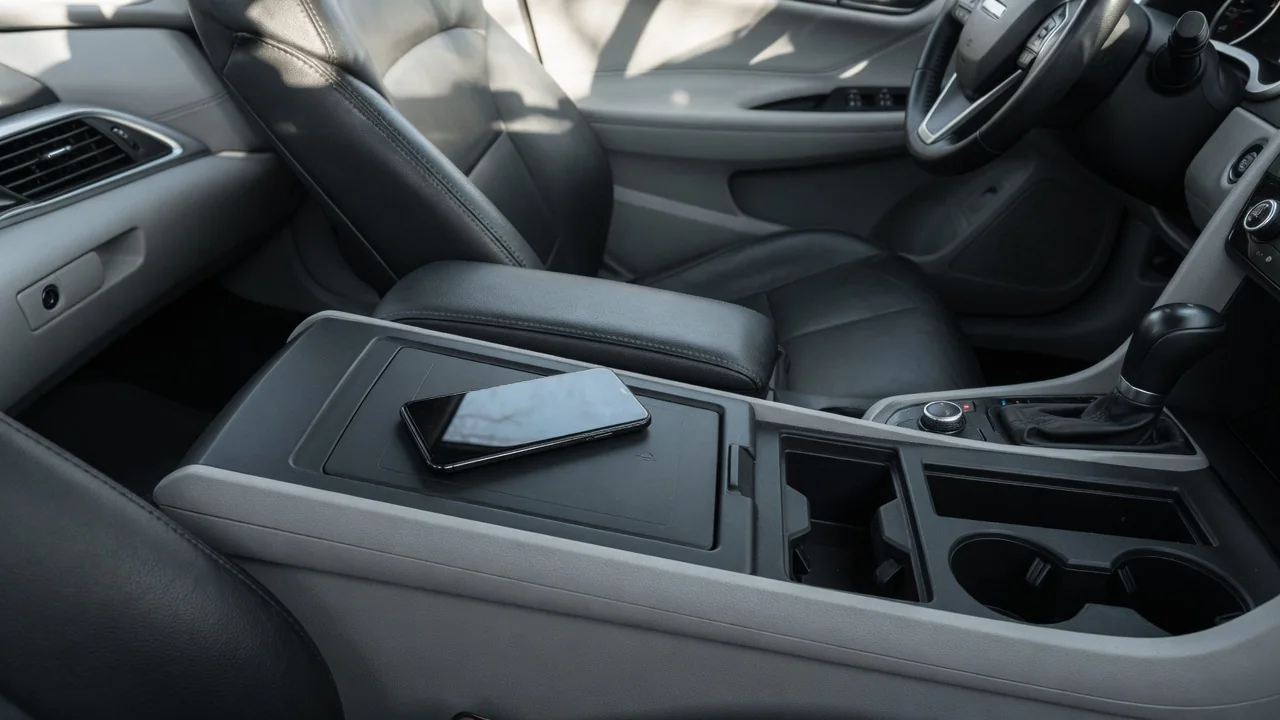
Drivers often ask what is a wireless charging pad in a car, and the short answer is a tray or shelf, usually in the center console, that charges a compatible phone without a cable. It uses inductive charging, where a coil in the pad transfers energy to a coil in the phone across a small gap. It is convenient, but it has real limits.
Phone alignment
Inductive charging depends on two coils sitting close together and roughly centered on each other. The transmitter coil under the pad's surface creates an alternating magnetic field, and the receiver coil in the back of the phone turns that field back into electrical current. When the coils overlap well, most of the energy reaches the battery. When the phone sits off-center, the coupling weakens, less power gets through, and more of the energy is lost as warmth in the pad and the phone.
In a moving vehicle, alignment is harder to keep than on a desk. A phone can slide during cornering, braking or on rough pavement, and charging may pause and resume without the driver noticing. Automakers address this in different ways, including rubberized surfaces, raised edges, sloped pockets, multiple coils or magnetic positioning on some newer designs. Phone size matters too, since a large handset may not sit flat in a small tray, and the receiver coil is not in the same place on every phone.
Heat
Warmth is a normal by-product of wireless charging, because transferring energy through a magnetic field is less efficient than sending it down a cable. Some of the lost energy becomes heat in both coils, so a phone that feels warm when lifted from the pad is not unusual. A car cabin adds to the load. A console in direct sunlight, a parked vehicle on a hot day, or a phone running navigation and streaming audio at the same time all raise the temperature further.
Phones and pads both protect themselves when temperatures climb. The phone may slow its charging rate or stop it entirely until it cools, and the pad may shut off and show a warning on the infotainment screen or with an indicator light. Some vehicles route cooled air to the charging pocket or use a small fan, while others rely on passive cooling alone. A thick case traps heat and widens the gap between coils, so removing it often helps on long, warm drives.
Charging speed
A car's wireless pad is generally slower than a good wired connection. The power the pad can deliver varies by vehicle, model year and trim, and the phone also decides how much it will accept, so the lower of the two limits sets the rate. Efficiency losses from the air gap, the case and any misalignment reduce what actually reaches the battery. The owner's manual or the vehicle's specifications are the right place to confirm the pad's rated output.
Real-world results depend heavily on what the phone is doing. With the screen on, wireless phone projection active and a navigation app running, a phone may consume power nearly as fast as the pad supplies it, so the battery percentage holds steady or rises slowly. On a short commute, that can mean only a modest gain. On a long highway drive with the screen off, the same pad can add a useful amount of charge. Drivers who need a fast top-up are usually better served by a wired port.
Everyday Use and Observations
Day to day, the pad works best as a place to keep a phone topped up rather than a way to recover from a nearly empty battery. Most systems confirm charging with an indicator light near the pad, an icon on the center display, or the charging symbol on the phone itself. A light that changes color or blinks usually signals a fault, a misaligned phone or an object the pad cannot charge, though the exact meaning of each signal differs between manufacturers.
A few habits improve reliability. Keeping the pad clear of coins, keys and other metal objects matters, because metal in the magnetic field can heat up, and many pads will stop charging when they detect a foreign object. Cards with magnetic stripes or chips should not sit between the phone and the pad. Metal plates for magnetic mounts and wallet-style cases often block charging altogether. Some vehicles also pause the pad briefly when the keyless entry system searches for the key fob, which can look like an intermittent fault.
Limits and Next Steps
The technology has clear boundaries. The phone must support wireless charging under a standard the pad also supports, and older or budget handsets may not charge at all. In many vehicles the pad only works with the ignition on or in accessory mode, and some let the driver switch it off through a settings menu. Because energy is lost in transfer, wireless charging will always produce more heat and less speed than a cable carrying the same power.
When a pad stops working, the simple checks come first: reposition the phone, remove the case, clear the tray, confirm the feature is enabled in the vehicle settings, and try a second compatible phone. If one phone charges and another does not, the pad is probably fine. If nothing charges and no indicator lights, the cause could be a fuse, wiring, software or the pad module itself, and a dealer or qualified technician can test it properly. The owner's manual lists compatible devices and what each warning means.