EV Wireless Charging Efficiency
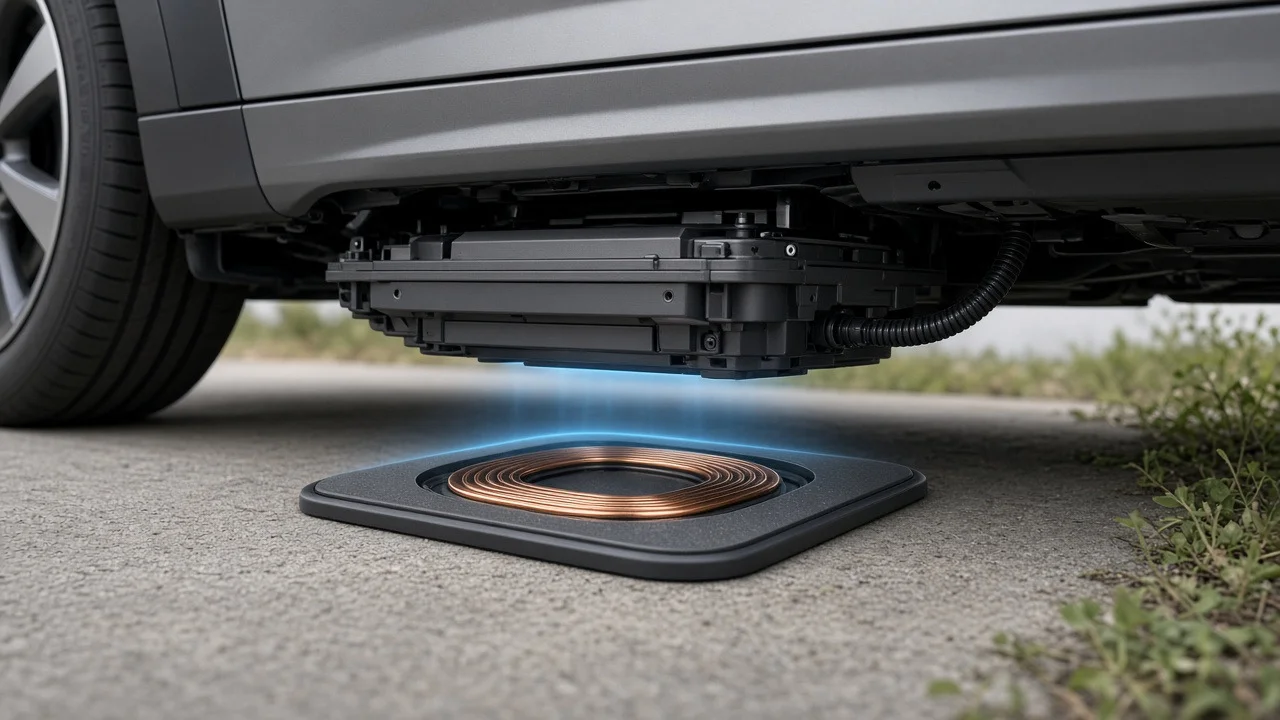
Wireless charging for electric vehicles replaces the familiar cable with inductive coupling, raising immediate questions about how much energy is lost along the way. EV wireless charging efficiency describes how much of the electrical supply actually reaches the battery after conversion, alignment, and control losses. Because no physical connector standard defines the magnetic interface as it does a plug, understanding charging power, vehicle compatibility, and supply capacity becomes central. The practical result depends on the gap between the ground pad and vehicle receiver, the charging protocol that coordinates power flow, and the thermal behavior of both modules.
Essential answer
Wireless EV charging is generally less efficient than a properly connected cable system, although well-aligned inductive hardware can still deliver most of the source energy to the battery. The difference comes from multiple small losses that a direct connector avoids: the inverter that creates a high-frequency magnetic field, the receiver coil that captures it, and the rectifier that converts it back to direct current all dissipate heat. Alignment between the transmitter and receiver pads has an especially strong influence, because lateral offset or an excessive air gap reduces the magnetic coupling and lowers the amount of energy transferred per charging session.
Efficiency is not a single fixed value for every installation. It varies with the shape and size of the coils, the operating frequency, the charging power negotiated between the vehicle and the pad, and the condition of surrounding metal. A system that works efficiently in a laboratory fixture may behave differently under a vehicle with shielding, ground clearance, and real-world parking variation. For that reason, wireless EV charging efficiency should be understood as a system characteristic involving the ground assembly, the onboard receiver, vehicle compatibility, and the control electronics that adjust output safely as coil positioning changes.